The sample copy of this report is available for access.
The North America Gaming Peripheral Market is expected to reach USD 3.8 billion by 2032, growing at a CAGR of 10.6% during (2026 – 2033).
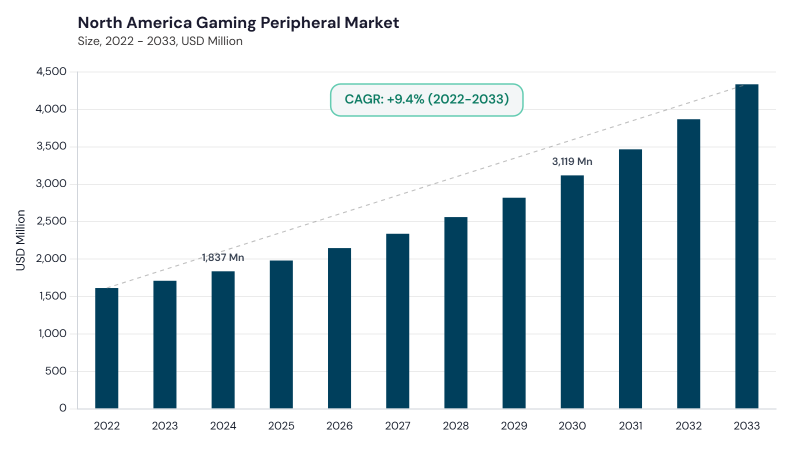
Gaming peripherals across North America evolved alongside the expansion of personal computing and home consoles, moving from basic keyboards, mice, joysticks, and controllers toward specialized hardware designed for precision, comfort, and immersive gameplay. Advances in mechanical switches, optical and laser sensors, haptic feedback, programmable controls, and ergonomic design progressively enhanced peripheral performance. The growth of esports, online multiplayer gaming, and streaming further increased demand for professional-grade equipment with faster response times and greater customization.
Wireless connectivity, customization, accessibility, and integrated software ecosystems are increasingly influencing regional market development. Improvements in low-latency wireless technologies, battery efficiency, and signal stability are reducing traditional performance differences between wired and wireless products, while modular designs and programmable features allow users to personalize devices according to gaming styles and ergonomic preferences. Manufacturers are also expanding adaptive and inclusive peripheral designs to support users with diverse physical requirements.
Based on Device, the market is segmented into PC and Gaming Consoles. The PC market dominated the North America Gaming Peripheral Market by Device in 2025, and would continue to be a dominant market till 2033; thereby, achieving a market value of USD 2.1 billion by 2032, growing at a CAGR of 10.3 % during the forecast period. The Gaming Consoles market is expected to witness a CAGR of 10.9% during (2026 - 2033).
PC peripherals include gaming mice, keyboards, headsets, controllers, joysticks, steering wheels, microphones, and other specialized accessories used to enhance accuracy, communication, responsiveness, and gameplay customization. Demand is supported by low-latency wireless technologies, high-resolution optical sensors, mechanical and optical switches, programmable controls, RGB lighting, and ergonomic designs. Gaming Consoles remain important through demand for wireless controllers, headsets, charging docks, racing wheels, arcade sticks, and other platform-compatible accessories. Adaptive triggers, haptic feedback, motion sensors, immersive audio, and cross-platform compatibility are strengthening console peripheral functionality, although proprietary standards and compatibility limitations can influence adoption.
Based on Type, the market is segmented into Wired and Wireless. The Wired market dominated the North America Gaming Peripheral Market by Type in 2025, and would continue to be a dominant market till 2033; thereby, achieving a market value of USD 1.9 billion by 2032, growing at a CAGR of 10.2 % during the forecast period. The Wireless market is expected to witness a CAGR of 11% during (2026 - 2033).
Wired peripherals remain relevant across gaming mice, keyboards, headsets, controllers, steering wheels, and other accessories where continuous operation and reliable responsiveness are essential. High polling rates, mechanical switches, advanced sensors, braided cables, detachable connectors, and improved cable management continue to support the segment. Wireless peripherals are expanding rapidly as improvements in battery life, fast charging, lightweight designs, signal stability, and low-latency connectivity reduce historical performance limitations. Wireless products also benefit from multi-device and cross-platform compatibility, although higher pricing, charging requirements, battery degradation, and potential signal interference can affect adoption among highly performance-sensitive users.
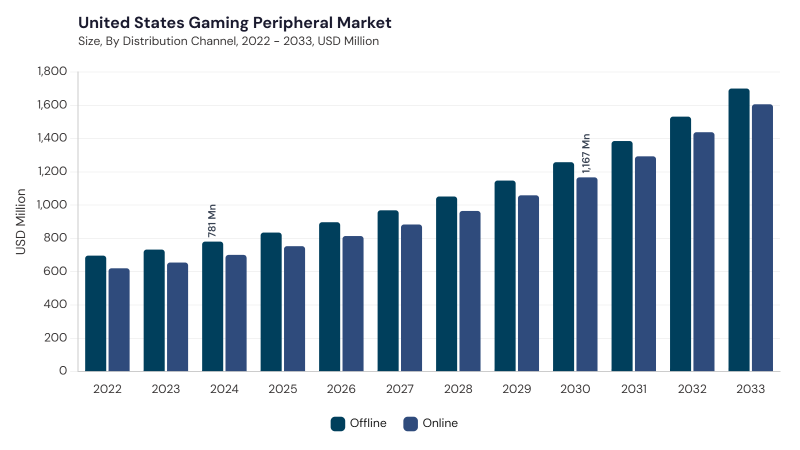
Based on Distribution Channel, the market is segmented into Offline and Online. Offline channels allow gamers to physically assess ergonomics, responsiveness, build quality, switch feel, audio performance, and other features before making purchase decisions, particularly for premium peripherals. Specialty stores and electronics retailers also support demonstrations, in-store events, and consultation that strengthen product engagement.
Online distribution continues to expand through dedicated gaming websites, global e-commerce platforms, and manufacturer direct-to-consumer channels offering broad assortments, competitive pricing, exclusive launches, and home delivery. Product reviews, esports exposure, influencer recommendations, faster logistics, and convenient model comparisons are further supporting online purchasing among technology-oriented consumers.
Based on Product, the market is segmented into Headsets, Mice, Keyboard, Controller, and Other Product. Headsets support spatial audio, multiplayer communication, noise management, and immersive sound through wired and wireless formats, while Mice remain important for precision gaming through high-DPI sensors, programmable buttons, low-latency performance, and ergonomic configurations.
Keyboard demand is supported by mechanical and hybrid switches, anti-ghosting, macros, programmable keys, and RGB customization, whereas Controller adoption benefits from console gaming, cross-platform play, haptic feedback, adaptive triggers, motion sensing, and customizable controls. Other Product includes gaming mousepads, webcams, steering wheels, joysticks, gaming chairs, macro pads, VR peripherals, and other specialized accessories that improve comfort, immersion, and gameplay functionality across different genres.
Free Valuable Insights: The Global Gaming Peripheral Market will hit USD 14.7 Billion billion by 2033, at a CAGR of 11.2%
Based on Country, the market is segmented into US, Canada, Mexico, and Rest of North America. The US market dominated the North America Gaming Peripheral Market by Country in 2025, and would continue to be a dominant market till 2033; thereby, achieving a market value of USD 2.9 billion by 2032, growing at a CAGR of 9.9 % during the forecast period. The Canada market is expected to witness a CAGR of 13.3% during (2026 - 2033). Additionally, The Mexico market is expected to witness a CAGR of 12.2% during (2026 - 2033).
Across North America, gaming peripheral adoption is increasingly shaped by esports, wireless technologies, customization, ergonomics, sustainability, and broader cross-platform gaming. The US is advancing high-polling-rate devices, low-latency wireless systems, cross-platform compatibility, ergonomic designs, and AI-supported customization, while Canada is emphasizing advanced wireless products, modular peripherals, sustainability, haptic technologies, and localized consumer support. Mexico is progressing through esports-oriented equipment, smart wireless devices, environmentally conscious product design, and locally adapted distribution strategies, whereas Rest of North America is expanding modular hardware, sustainable materials, AI-enabled customization, adaptive feedback, and low-latency connectivity.

By Device
By Type
By Distribution Channel
By Product
By Country
Set to reach $3.8 Billion by 2032, growing at 10.6% CAGR during 2026-2033.
The US leads with $2.9 billion by 2032, growing at a CAGR of 9.9% during the forecast period.
The PC segment will reach $2.1 billion by 2032, growing at a CAGR of 10.3% during the forecast period.
The Canada market is expected to witness a CAGR of 13.3% during 2026-2033.
The Wireless segment is expected to witness a CAGR of 11% during 2026-2033.
Our team of dedicated experts can provide you with attractive expansion opportunities for your business.




 Unique Offerings