The sample copy of this report is available for access.
“Global Gaming Peripheral Market to reach a market value of USD 14,717.44 Million by 2033 growing at a CAGR of 11.2%”
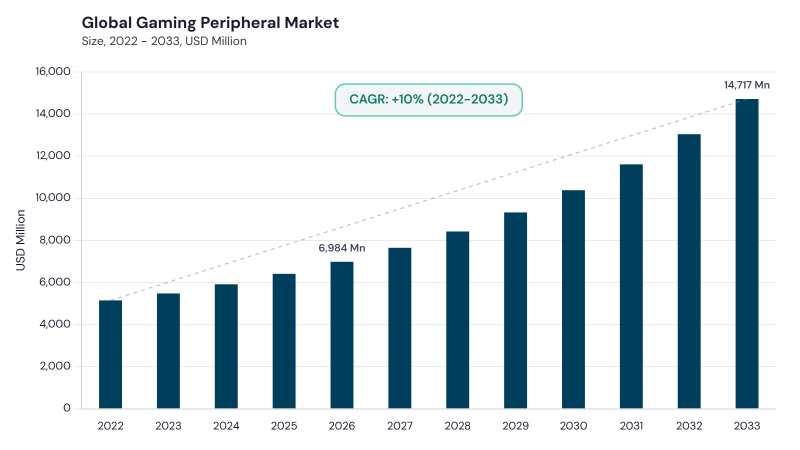
The Global Gaming Peripheral Market is expected to reach USD 14.7 billion by 2033, growing at a CAGR of 11.2% during (2026 – 2033).
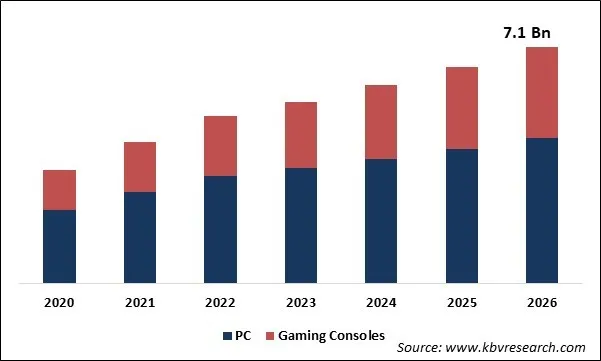
Rising demand for immersive gaming experiences, expanding esports participation, and increasing PC and console gaming are strengthening the adoption of specialized gaming accessories. Consumers increasingly prioritize precision, responsiveness, ergonomic comfort, customizable controls, and high-performance equipment. Advances in low-latency wireless connectivity, haptic feedback, RGB customization, AI-enabled functionality, premium sensors, and cross-platform compatibility are further reshaping product development.
The gaming peripheral industry has evolved from basic joysticks, keyboards, and conventional input devices toward highly specialized gaming ecosystems built around precision sensors, mechanical switches, wireless connectivity, haptic feedback, programmable controls, and sophisticated software. Increased competitive gaming and prolonged gaming sessions have encouraged manufacturers to prioritize low latency, ergonomics, durability, and personalized user interfaces. The market is now moving toward smarter wireless peripherals, modular designs, immersive feedback, AI-supported features, and deeper integration across gaming platforms.
Competitive development increasingly centers on technological differentiation, ecosystem integration, ergonomic performance, software customization, and pricing strategy. Manufacturers are investing in advanced sensors, adaptive software, wireless technologies, AI-powered customization, and cross-platform functionality while partnering with game developers, esports organizations, creators, and technology providers. Localization and diversified product portfolios are also being used to address regional gamer preferences and expand participation across premium, mainstream, and emerging gaming segments.
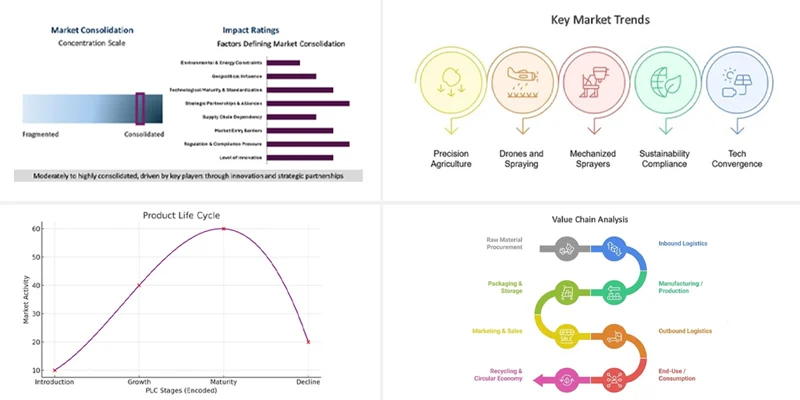

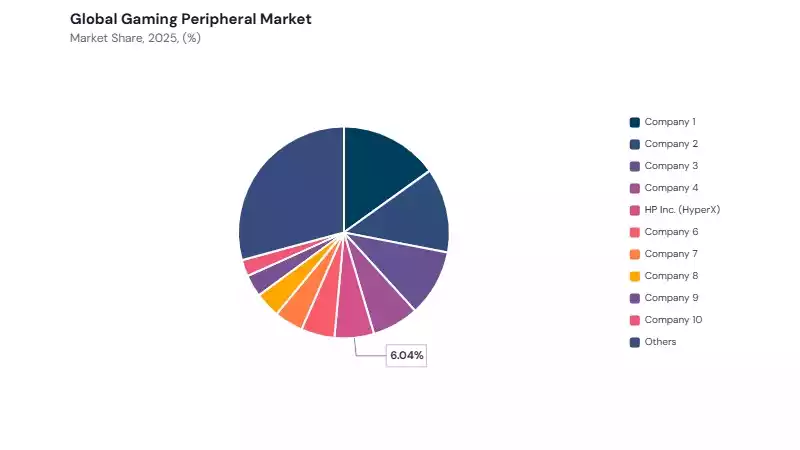
The Gaming Peripheral Market exhibits a moderately consolidated and innovation-driven competitive landscape. Logitech maintains a leading position through Logitech G and ASTRO, while Razer competes through its gaming-focused hardware and software ecosystem. Corsair forms another major competitive tier through Corsair, Elgato, and SCUF, while GN Store Nord participates through SteelSeries and KontrolFreek. HP strengthens competition through HyperX, alongside Turtle Beach, ASUS, Sony, Microsoft, and Guillemot. Future competition is expected to focus on integrated software ecosystems, low-latency wireless technologies, sensor precision, ergonomic design, esports partnerships, AI-enhanced functionality, and cross-platform compatibility.
On the basis of Device, the Gaming Peripheral Market is classified into PC and Gaming Consoles. The PC market dominated the Global Gaming Peripheral Market by Device in 2025, and would continue to be a dominant market till 2033; thereby, achieving a market value of USD 8.2 billion by 2033, growing at a CAGR of 11 % during the forecast period. The Gaming Consoles market is expected to witness a CAGR of 11.6% during (2026 - 2033).
PC gaming supports a broad peripheral ecosystem encompassing mice, keyboards, headsets, controllers, simulation devices, and other specialized accessories. Demand is reinforced by customization, hardware upgrades, competitive gaming, streaming, and performance-oriented accessories. Gaming Consoles rely strongly on controllers, gaming headsets, racing equipment, charging accessories, and other platform-compatible peripherals, with demand influenced by console generations, exclusive titles, advanced haptics, wireless connectivity, and increasing cross-platform compatibility.
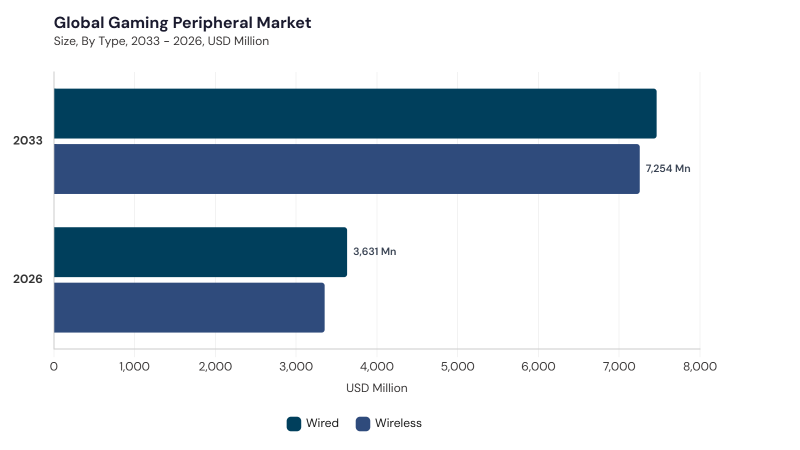
On the basis of Type, the Gaming Peripheral Market is classified into Wired and Wireless. The Wired market dominated the Global Gaming Peripheral Market by Type in 2025, and would continue to be a dominant market till 2033; thereby, achieving a market value of USD 7.4 billion by 2033, growing at a CAGR of 10.8 % during the forecast period. The Wireless market is expected to witness a CAGR of 11.7% during (2026 - 2033).
Wired peripherals remain important for competitive environments where stable connectivity, low input lag, and uninterrupted performance are essential. Wireless peripherals are gaining traction as Bluetooth, proprietary low-latency protocols, improved battery life, and high polling rates enhance responsiveness while supporting greater mobility and cleaner gaming setups. Growing cloud gaming, multi-device usage, portability, and untethered gaming experiences continue to strengthen wireless product development.
On the basis of Distribution Channel, the Gaming Peripheral Market is classified into Offline and Online. The Offline market dominated the Global Gaming Peripheral Market by Distribution Channel in 2025, and would continue to be a dominant market till 2033; thereby, achieving a market value of USD 7.6 billion by 2033, growing at a CAGR of 10.9 % during the forecast period. The Online market is expected to witness a CAGR of 11.6% during (2026 - 2033).
Offline channels include gaming specialty stores, electronics retailers, and large-format outlets where consumers can physically evaluate performance, ergonomics, and build quality before purchase. Online distribution includes e-commerce platforms, digital marketplaces, and brand websites offering broad product selection, competitive pricing, reviews, convenient delivery, and rapid access to newly launched or specialized peripherals. E-commerce growth and digital purchasing behavior are increasingly strengthening the role of online distribution.
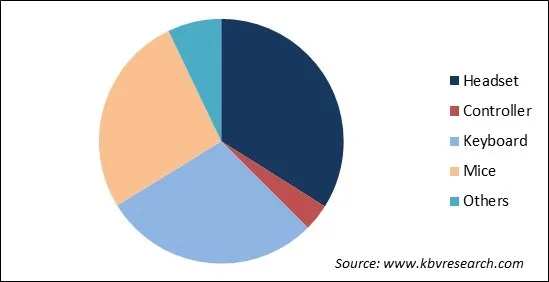
On the basis of Product, the Gaming Peripheral Market is classified into Headsets, Mice, Keyboard, Controller, and Other Product. The Headsets market dominated the Global Gaming Peripheral Market by Product in 2025, and would continue to be a dominant market till 2033; thereby, achieving a market value of USD 3.9 billion by 2033, growing at a CAGR of 10.3 % during the forecast period. The Mice market is expected to witness a CAGR of 11% during (2026 - 2033). Additionally, The Keyboard market is expected to witness highest CAGR of 11.5% during (2026 - 2033).
Headsets support immersive audio and multiplayer communication through spatial sound, noise cancellation, and integrated microphones. Mice emphasize precision sensors, polling rates, programmable controls, and ergonomic performance, while gaming keyboards focus on mechanical switches, macro functions, anti-ghosting, and customization. Controllers remain central to console and hybrid gaming through haptic feedback, adaptive triggers, and wireless connectivity. Other Product includes racing wheels, gaming chairs, VR controllers, capture devices, microphones, and other specialized gaming and streaming equipment.
Free Valuable Insights: Gaming Peripheral Market Size to reach $14.7 Billion by 2033
Region-wise, the Gaming Peripheral Market is analyzed across North America, Europe, Asia Pacific, and LAMEA. The Asia Pacific market dominated the Global Gaming Peripheral Market by Region in 2025, and would continue to be a dominant market till 2033; thereby, achieving a market value of USD 5.8 billion by 2033, growing at a CAGR of 11.6 % during the forecast period. The North America market is expected to witness a CAGR of 10.6% during (2026 - 2033). Additionally, The Europe market is expected to witness a CAGR of 11% during (2026 - 2033).
Asia Pacific maintains the leading market position, supported by a large gaming population, expanding esports participation, increasing disposable incomes, and growing adoption of advanced gaming hardware. North America benefits from strong premium peripheral spending and established gaming ecosystems, while Europe is supported by competitive gaming communities and esports infrastructure. LAMEA continues developing through increasing internet penetration, wider access to gaming platforms, and growing demand for affordable and performance-oriented gaming accessories.
| Report Attribute | Details |
|---|---|
| Market size value in 2026 | USD 6.9 billion |
| Market size forecast in 2033 | USD 14.7 billion |
| Base Year | 2025 |
| Historical Period | 2022 to 2024 |
| Forecast Period | 2026 to 2033 |
| Revenue Growth Rate | CAGR of 11.2% from 2026 to 2033 |
| Number of Pages | 570 |
| Tables | 690 |
| Report Coverage | Market Trends, Revenue Estimation and Forecast, Segmentation Analysis, Regional and Country Breakdown, Competitive Landscape, Market Share Analysis, Company Profiling, Companies Strategic Developments, SWOT Analysis, Product Life Cycle Analysis, Value Chain Analysis, Market Consolidation Analysis, Key Customer Criteria, Pandemic Impact Analysis, and Winning Imperatives |
| Segments Covered | Device, Type, Distribution Channel, Product, and Geography |
| Country Scope |
|
| Companies Included | Logitech International S.A.; Razer Inc.; Corsair Gaming, Inc.; GN Store Nord A/S; HP Inc.; Turtle Beach Corporation; ASUSTeK Computer Inc.; Sony Group Corporation; Microsoft Corporation; Guillemot Corporation S.A. |
By Device
By Type
By Distribution Channel
By Product
By Geography
Valued at USD 6.9 billion in 2026, it's expected to reach USD 14.7 billion by 2033, growing at 11.2% CAGR during 2026-2033.
The PC segment leads, projected to achieve a market value of USD 8.2 billion by 2033.
Logitech, Razer, Corsair, GN Store Nord, HP, Turtle Beach, ASUSTeK, Sony, Microsoft, and Guillemot are key players.
Asia Pacific leads with a market value of USD 5.8 billion by 2033, supported by a large gaming population.
Rising consumer demand for enhanced gaming experience and expanding esports industry are key growth drivers.
The Headsets segment leads, achieving a market value of USD 3.9 billion by 2033.
Our team of dedicated experts can provide you with attractive expansion opportunities for your business.








 Unique Offerings