The sample copy of this report is available for access.
The LAMEA Gaming Peripheral Market is expected to reach USD 600.0 million by 2029, growing at a CAGR of 12.8% during (2026 – 2033).
Gaming peripherals across LAMEA evolved from basic wired keyboards, mice, headsets, and controllers into increasingly specialized devices designed for higher precision, durability, comfort, and immersive gameplay. Early reliance on imported accessories gradually shifted as gaming communities expanded, internet access improved, and regional demand encouraged more localized product offerings. Advances in sensor technologies, programmable keys, RGB lighting, enhanced audio, ergonomic design, and wireless connectivity progressively raised consumer expectations.
Mobile and cloud gaming, sustainability, esports, and regional customization are increasingly shaping market development. Compact controllers, Bluetooth-enabled keyboards, and multi-platform peripherals are expanding as users seek enhanced gaming experiences across smartphones, tablets, PCs, and consoles. Environmental considerations are also influencing materials, production processes, and product positioning, while competitive gaming is increasing demand for peripherals with higher precision, durability, and customization.
Based on Device, the market is segmented into PC and Gaming Consoles. The PC market dominated the LAMEA Gaming Peripheral Market by Device in 2025, and would continue to be a dominant market till 2033; thereby, achieving a market value of USD 345.5 million by 2029, growing at a CAGR of 12.5 % during the forecast period. The Gaming Consoles market is expected to witness a CAGR of 13.2% during (2026 - 2033).
PC peripherals include gaming keyboards, mice, headsets, controllers, joysticks, microphones, steering wheels, and other specialized accessories used to improve responsiveness, accuracy, communication, and gameplay control. Demand is supported by mechanical switches, programmable controls, low-latency wireless options, surround-sound headsets, ergonomic designs, and customizable lighting. Gaming Consoles continue to support demand for controllers, headsets, charging docks, racing wheels, arcade sticks, and other accessories designed for accessible home entertainment and multiplayer gaming. Wireless connectivity, haptic feedback, rechargeable systems, and cross-platform compatibility are strengthening the console segment, although pricing, import duties, and platform-specific restrictions can influence adoption.
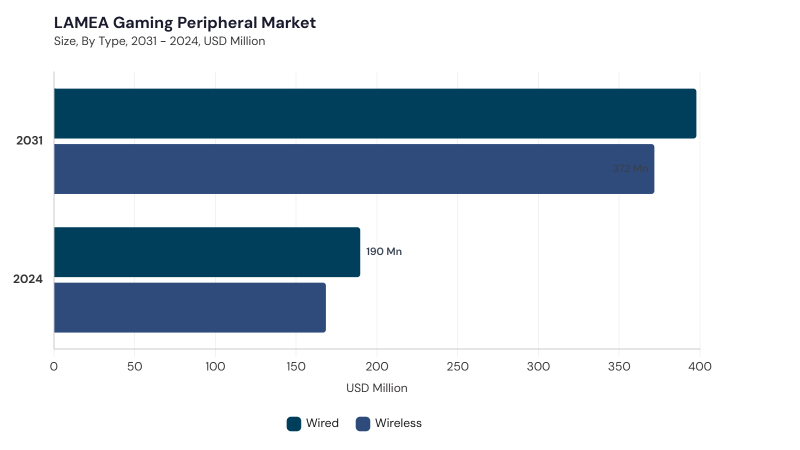
Based on Type, the market is segmented into Wired and Wireless. The Wired market dominated the LAMEA Gaming Peripheral Market by Type in 2025, and would continue to be a dominant market till 2033; thereby, achieving a market value of USD 312.5 million by 2029, growing at a CAGR of 12.4 % during the forecast period. The Wireless market is expected to witness a CAGR of 13.3% during (2026 - 2033).
Wired peripherals remain important among price-sensitive users, gaming cafés, esports venues, and consumers seeking uninterrupted operation without battery or charging requirements. Reinforced cables, USB-C interfaces, mechanical switches, advanced sensors, and ergonomic improvements are supporting product durability and performance. Wireless peripherals are gradually expanding as Bluetooth, radio-frequency technologies, battery efficiency, fast charging, and signal stability improve. Their flexibility, portability, and compatibility across PCs, consoles, smartphones, and tablets are strengthening appeal, although premium pricing, signal interference, product availability, and after-sales support can restrict broader adoption in some markets.
Based on Distribution Channel, the market is segmented into Offline and Online. Offline channels remain important because consumers can physically assess ergonomics, responsiveness, audio quality, build quality, and compatibility before selecting peripherals. Electronics stores, gaming shops, gaming lounges, and esports venues also support demonstrations, immediate purchases, localized promotions, and after-sales assistance.
Online distribution is expanding through e-commerce platforms, digital marketplaces, and brand websites that provide broader assortments, competitive pricing, user reviews, and cross-border product access. Rising smartphone penetration, improved payment systems, digital promotions, influencer campaigns, and expanding delivery networks are strengthening online adoption, particularly among younger and digitally active consumers.
Based on Product, the market is segmented into Headsets, Mice, Keyboard, Controller, and Other Product. Headsets support positional audio, multiplayer communication, streaming, and cross-device gaming through both wired and wireless formats, while Mice remain important for precision gaming through advanced sensors, programmable buttons, ergonomic shapes, and adjustable DPI settings.
Keyboard demand is supported by mechanical switches, macro functions, programmable keys, customizable lighting, and durable designs, whereas Controller adoption benefits from console gaming, cloud gaming, mobile gaming, cross-platform compatibility, motion sensing, and haptic feedback. Other Product includes gaming mousepads, racing wheels, joysticks, webcams, streaming equipment, gaming chairs, VR accessories, and other specialized devices that improve immersion, comfort, content creation, and overall gaming functionality.
Free Valuable Insights: Gaming Peripheral Market Size Worth USD 14.7 Billion billion by 2033
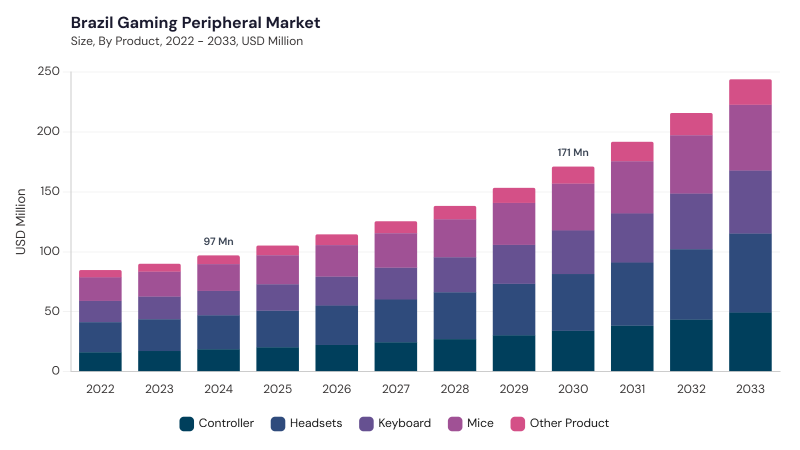
Based on Country, the market is segmented into Brazil, Argentina, UAE, Saudi Arabia, South Africa, Nigeria, and Rest of LAMEA. The Brazil market dominated the LAMEA Gaming Peripheral Market by Country in 2025, and would continue to be a dominant market till 2033; thereby, achieving a market value of USD 153.3 million by 2029, growing at a CAGR of 11.4 % during the forecast period. The Argentina market is expected to witness a CAGR of 14.1% during (2026 - 2033). Additionally, The UAE market is expected to witness a CAGR of 11.6% during (2026 - 2033).
Across LAMEA, gaming peripheral adoption is increasingly influenced by esports, wireless technologies, affordability, mobile gaming, sustainability, and localized consumer preferences. Brazil is advancing esports-focused hardware, software customization, wireless charging, and localized products, while Argentina is emphasizing performance-oriented peripherals, sustainable materials, haptic technologies, and advanced RGB customization. The UAE is strengthening premium gaming devices, AI-assisted personalization, ergonomic designs, and esports-oriented hardware, whereas Saudi Arabia is expanding low-latency wireless products, environmentally conscious peripherals, Arabic-language support, and professional gaming solutions. South Africa is progressing through wireless adoption, ergonomic customization, esports partnerships, and localized pricing strategies, while Nigeria is emphasizing mobile-compatible accessories, affordable designs, localized firmware, and durable gaming products. Rest of LAMEA is also advancing low-latency wireless systems, modular hardware, climate-adapted products, and regional software customization.

By Device
By Type
By Distribution Channel
By Product
By Country
Set to reach $600.0 Million by 2029, growing at 12.8% CAGR during 2026-2033.
Brazil leads with a market value of USD 153.3 million by 2029, growing at a CAGR of 11.4% during the forecast period.
The PC market will reach USD 345.5 million by 2029, growing at a CAGR of 12.5% during the forecast period.
The Wireless market is expected to witness a CAGR of 13.3% during 2026-2033.
The UAE market is expected to witness a CAGR of 11.6% during 2026-2033.
The Gaming Consoles market is expected to witness a CAGR of 13.2% during 2026-2033.
Our team of dedicated experts can provide you with attractive expansion opportunities for your business.




 Unique Offerings