The sample copy of this report is available for access.
The North America Fault-tolerant Servers Market is expected to reach USD 4.7 billion by 2032, growing at a CAGR of 4.7% during (2026 – 2033).
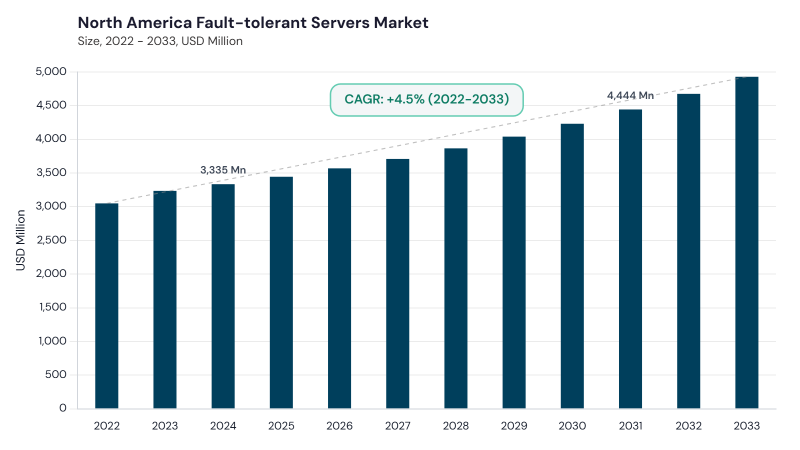
The North America Fault-tolerant Servers Market originated from the rising need for uninterrupted computing across finance, telecommunications, healthcare, government, and other mission-critical sectors. Early systems relied on specialized hardware redundancy, error detection, mirrored components, and automatic failover mechanisms to prevent downtime. These solutions were initially expensive and mainly used where service interruption carried severe operational or financial risk. Over time, microprocessor improvements, virtualization, cloud infrastructure, and distributed computing made fault-tolerant systems more scalable and practical.
The North America Fault-tolerant Servers Market is being shaped by real-time data processing needs, AI workloads, edge computing, distributed databases, cloud-native applications, and strong business continuity requirements. Organizations are using fault-tolerant servers to support uninterrupted transaction processing, secure data management, clinical systems, telecom networks, e-commerce platforms, and industrial control environments. Demand is supported by hybrid cloud adoption, DevSecOps practices, predictive analytics, secure boot, hardware root of trust, and automated recovery tools. Vendors are focusing on modular redundancy, software-defined resilience, energy-efficient server designs, compliance-ready systems, and proactive maintenance.
Based on Deployment, the market is segmented into On-Premise and Cloud-based. The On-Premise market dominated the North America Fault-tolerant Servers Market by Deployment in 2025, and would continue to be a dominant market till 2033; thereby, achieving a market value of USD 2.9 billion by 2032, growing at a CAGR of 4.4 % during the forecast period. The Cloud-based market is expected to witness a CAGR of 5.2% during (2026 - 2033).
On-Premise leads due to strong demand from highly regulated enterprises that require direct control over mission-critical workloads, sensitive data, latency-sensitive applications, and compliance-heavy infrastructure. It remains important in BFSI, healthcare, government, defense, and industrial environments where uninterrupted local processing is essential. Cloud-based deployments remain significant as organizations adopt hybrid cloud, disaster recovery, geographic redundancy, and scalable high-availability architectures. This segment benefits from cloud-native failover, multi-region replication, containerization, microservices, DevSecOps automation, and flexible infrastructure models that reduce upfront hardware dependency.
Based on Enterprise Size, the market is segmented into Large Enterprises and SMEs. The Large Enterprises market dominated the North America Fault-tolerant Servers Market by Enterprise Size in 2025, and would continue to be a dominant market till 2033; thereby, achieving a market value of USD 3.3 billion by 2032, growing at a CAGR of 4.4 % during the forecast period. The SMEs market is expected to witness a CAGR of 5.6% during (2026 - 2033).
Large Enterprises lead due to their higher investment capacity, complex IT environments, extensive data center operations, strict uptime requirements, and dependence on resilient infrastructure for critical business functions. These organizations use fault-tolerant servers for transaction systems, telecom platforms, healthcare databases, industrial automation, and large-scale digital services. SMEs remain important as affordable, modular, and cloud-integrated fault-tolerant solutions improve access to downtime prevention. This segment is supported by growing digital adoption, e-commerce activity, compliance needs, hybrid backup models, simplified management interfaces, and rising awareness of business continuity risks.
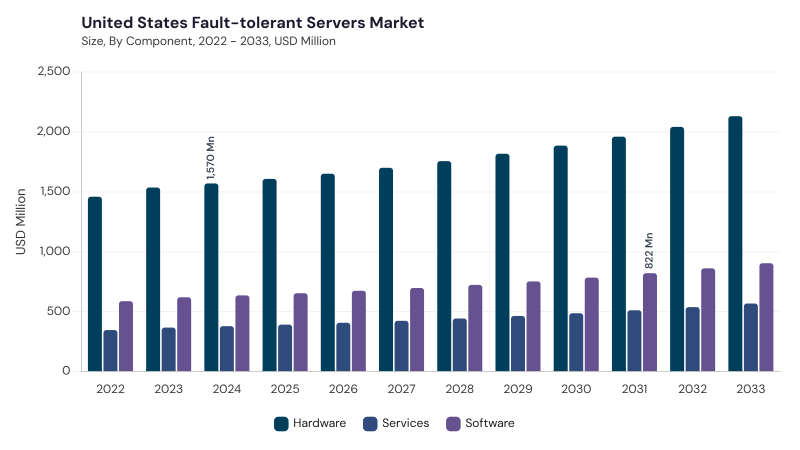
Based on Component, the market is segmented into Hardware, Software, and Services. The Hardware market dominated the North America Fault-tolerant Servers Market by Component in 2025, and would continue to be a dominant market till 2033; thereby, achieving a market value of USD 2.8 billion by 2032, growing at a CAGR of 4.4 % during the forecast period. The Software market is expected to witness a CAGR of 5% during (2026 - 2033). The Services market is expected to witness a CAGR of 5.6% during (2026 - 2033).
Hardware leads due to sustained demand for redundant processors, memory modules, storage systems, RAID controllers, power supplies, networking components, and server architectures designed for uninterrupted operation. These components provide the physical foundation for failover, error isolation, and continuous computing in mission-critical environments. Software remains significant through fault management tools, clustering solutions, virtualization, workload balancing, error correction, monitoring, and autonomous recovery capabilities. Services support adoption through consulting, installation, system integration, maintenance, managed support, remote monitoring, and optimization of fault-tolerant infrastructure across complex IT ecosystems.
Based on End Use, the market is segmented into BFSI, IT & Telecom, Healthcare, Manufacturing, Government & Defense, E-commerce & Retail, and Other End Use. BFSI leads due to continuous transaction processing, secure data management, real-time payments, trading systems, risk platforms, and strict operational resilience requirements. IT & Telecom uses fault-tolerant servers to support network uptime, cloud services, edge computing, data traffic, and uninterrupted connectivity.
Healthcare applies these systems for electronic health records, imaging systems, telemedicine, diagnostics, and patient data availability. Manufacturing, Government & Defense, E-commerce & Retail, and Other End Use areas add demand through industrial automation, mission-critical computing, public safety networks, online transaction reliability, energy systems, media platforms, and transportation control applications.
Free Valuable Insights: The Global Fault-tolerant Servers Market will hit USD 14.3 Billion billion by 2033, at a CAGR of 5.3%
Based on Country, the market is segmented into US, Canada, Mexico, and Rest of North America. The US market dominated the North America Fault-tolerant Servers Market by Country in 2025, and would continue to be a dominant market till 2033; thereby, achieving a market value of USD 3.4 billion by 2032, growing at a CAGR of 4 % during the forecast period. The Canada market is expected to witness a CAGR of 7% during (2026 - 2033). Additionally, The Mexico market is expected to witness a CAGR of 6.1% during (2026 - 2033).
The US leads due to advanced data center infrastructure, strong demand from BFSI, healthcare, telecom, government, and digital commerce, and rapid adoption of AI-enabled predictive maintenance and edge computing. Canada supports market growth through cloud reliability engineering, regulated financial and healthcare workloads, predictive analytics, and growing investments in hybrid IT resilience. Mexico is advancing through data center expansion, digital transformation, cloud adoption, edge computing, and demand for high-availability infrastructure across finance, telecom, government, manufacturing, and energy. Rest of North America benefits from modular server designs, software-defined infrastructure, sustainability-focused data centers, AI-based server health monitoring, and hybrid deployment models.

By Deployment
By Enterprise Size
By Component
By End Use
By Country
Set to reach $4.7 Billion by 2032, growing at 4.7% CAGR during 2026-2033.
The US leads with $3.4 billion by 2032, growing at a CAGR of 4% during the forecast period.
Rising enterprise cloud adoption and AI-driven workloads are the main catalysts.
Cloud-based segment grows at a 5.2% CAGR during 2026-2033.
The Canada market is expected to witness a CAGR of 7% during 2026-2033.
The hardware segment will achieve a market value of $2.8 billion by 2032, growing at a CAGR of 4.4%.
Our team of dedicated experts can provide you with attractive expansion opportunities for your business.




 Unique Offerings