The sample copy of this report is available for access.
The LAMEA Fault-tolerant Servers Market is expected to reach USD 1.1 billion by 2029, growing at a CAGR of 6.7% during (2026 – 2033).
The LAMEA Fault-tolerant Servers Market emerged from the need for uninterrupted computing across regions facing power instability, infrastructure gaps, and mission-critical digital workloads. Early systems relied on mirrored hardware, duplicated components, and basic failover mechanisms to reduce downtime in telecom, finance, and government applications. Over time, error detection, real-time recovery, virtualization, and self-diagnostic capabilities improved the reliability and adaptability of these servers. Adoption increased as enterprises across Latin America, the Middle East, and Africa modernized IT infrastructure and prioritized uptime, data integrity, and service continuity.
The LAMEA Fault-tolerant Servers Market is being shaped by financial sector digitization, cloud migration, hybrid IT models, critical infrastructure modernization, and rising demand for secure high-availability systems. Organizations are using fault-tolerant servers to support banking transactions, telecom networks, healthcare data, public-sector platforms, e-commerce systems, industrial automation, and digital service delivery. Demand is supported by real-time monitoring, automated failover, edge computing, predictive analytics, cybersecurity-focused resilience, and compliance-driven infrastructure upgrades. Vendors are focusing on modular redundancy, energy-efficient designs, adaptive cooling, localized support, managed services, and scalable fault-tolerant architectures.
Based on Deployment, the market is segmented into On-Premise and Cloud-based. The On-Premise market dominated the LAMEA Fault-tolerant Servers Market by Deployment in 2025, and would continue to be a dominant market till 2033; thereby, achieving a market value of USD 727.7 million by 2029, growing at a CAGR of 6.4 % during the forecast period. The Cloud-based market is expected to witness a CAGR of 7.3% during (2026 - 2033).
On-Premise leads due to strong preference for localized data control, secure infrastructure ownership, and direct management of mission-critical workloads across regulated industries. It remains important for BFSI, government, telecom, healthcare, and industrial organizations that require high availability despite power, connectivity, and compliance challenges. Cloud-based deployments remain significant as enterprises adopt hybrid cloud, cloud-based disaster recovery, multi-cloud continuity, and scalable high-availability models. This segment benefits from regional data centers, improved connectivity, cloud-native monitoring, software-defined failover, AI-enabled recovery, and flexible infrastructure consumption.
Based on Enterprise Size, the market is segmented into Large Enterprises and SMEs. The Large Enterprises market dominated the LAMEA Fault-tolerant Servers Market by Enterprise Size in 2025, and would continue to be a dominant market till 2033; thereby, achieving a market value of USD 820.5 million by 2029, growing at a CAGR of 6.4 % during the forecast period. The SMEs market is expected to witness a CAGR of 7.7% during (2026 - 2033).
Large Enterprises lead due to their higher investment capacity, broader digital operations, stricter uptime requirements, and stronger focus on enterprise-wide disaster recovery. These organizations deploy fault-tolerant servers for banking platforms, telecom systems, government applications, healthcare infrastructure, manufacturing control, and large-scale data center operations. SMEs remain important as scalable, modular, cloud-integrated, and cost-sensitive fault-tolerant solutions become easier to access. This segment is supported by digital commerce, managed IT services, remote monitoring, flexible payment models, cyber-risk awareness, and growing demand for business continuity without heavy infrastructure complexity.
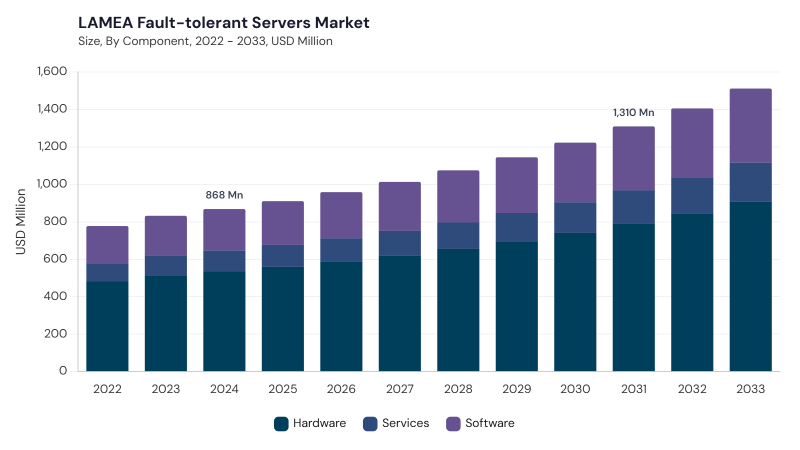
Based on Component, the market is segmented into Hardware, Software, and Services. The Hardware market dominated the LAMEA Fault-tolerant Servers Market by Component in 2025, and would continue to be a dominant market till 2033; thereby, achieving a market value of USD 695.3 million by 2029, growing at a CAGR of 6.4 % during the forecast period. The Software market is expected to witness a CAGR of 7% during (2026 - 2033). The Services market is expected to witness a CAGR of 7.7% during (2026 - 2033).
Hardware leads due to growing deployment of redundant processors, storage systems, memory modules, power supplies, server platforms, and resilient computing components across critical enterprise environments. These physical systems provide the base for continuous operation, failover, error correction, and uptime protection in challenging operating conditions. Software remains significant through virtualization tools, fault detection, workload orchestration, automated recovery, monitoring platforms, and AI-based predictive maintenance. Services support adoption through consulting, installation, system integration, technical support, managed monitoring, maintenance, and customized deployment assistance across diverse LAMEA markets.
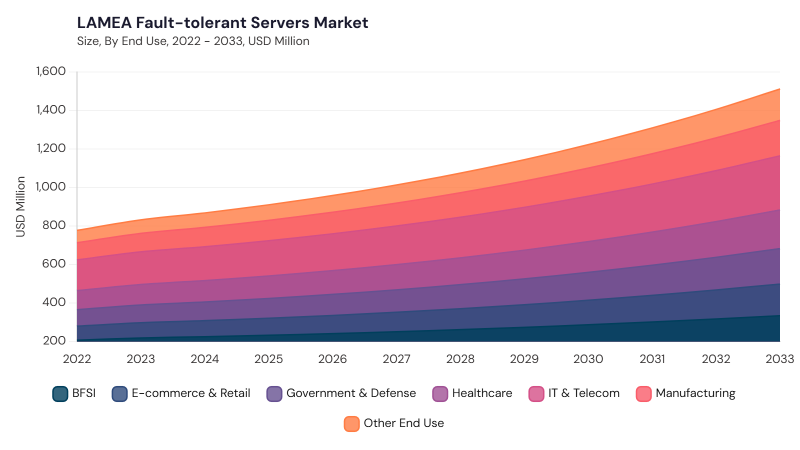
Based on End Use, the market is segmented into BFSI, IT & Telecom, Healthcare, Manufacturing, Government & Defense, E-commerce & Retail, and Other End Use. BFSI leads due to the need for secure digital banking, real-time transaction processing, payment reliability, audit readiness, and uninterrupted financial operations. IT & Telecom uses fault-tolerant servers to maintain data center uptime, telecom networks, cloud platforms, virtualization, 5G infrastructure, and continuous service availability.
Healthcare applies these systems for patient data management, clinical systems, diagnostic platforms, telemedicine, and hospital information infrastructure. Manufacturing, Government & Defense, E-commerce & Retail, and Other End Use areas add demand through industrial automation, public-sector systems, defense communication, online payments, smart grids, education platforms, transportation control, and media delivery.
Free Valuable Insights: Fault-tolerant Servers Market Size Worth USD 14.3 Billion billion by 2033
Based on Country, the market is segmented into Brazil, Argentina, UAE, Saudi Arabia, South Africa, Nigeria, and Rest of LAMEA. The Brazil market dominated the LAMEA Fault-tolerant Servers Market by Country in 2025, and would continue to be a dominant market till 2033; thereby, achieving a market value of USD 262.6 million by 2029, growing at a CAGR of 5.2 % during the forecast period. The Argentina market is expected to witness a CAGR of 8.1% during (2026 - 2033). Additionally, The UAE market is expected to witness a CAGR of 5.8% during (2026 - 2033).
Brazil leads due to expanding data center ecosystems, financial digitization, AI-ready infrastructure, hybrid cloud adoption, and demand for resilient server systems across telecom, government, and enterprise sectors. Argentina supports market growth through localization of fault-tolerant systems, mixed-criticality platforms, streaming data workloads, and regulatory-driven infrastructure modernization. The UAE contributes through sovereign data centers, AI-enabled monitoring, quantum-ready computing exploration, and strong digital government initiatives. Saudi Arabia, South Africa, and Nigeria add momentum through cloud adoption, cybersecurity resilience, edge computing, payment platforms, smart infrastructure, and localized IT modernization, while Rest of LAMEA benefits from modular servers, energy-efficient designs, software-defined resilience, and regional support networks.

By Deployment
By Enterprise Size
By Component
By End Use
By Country
Set to reach $1.1 Billion by 2029, growing at 6.7% CAGR during 2026-2033.
Brazil leads, achieving a market value of USD 262.6 million by 2029, growing at a CAGR of 5.2% during the forecast period.
Rising adoption of cloud-based solutions, with a projected CAGR of 7.3% during 2026-2033, drives growth.
The cloud-based segment is expected to witness a CAGR of 7.3% during 2026-2033.
The UAE market is expected to witness a CAGR of 5.8% during 2026-2033.
The SMEs segment is expected to witness a CAGR of 7.7% during 2026-2033.
Our team of dedicated experts can provide you with attractive expansion opportunities for your business.




 Unique Offerings