The sample copy of this report is available for access.
“Global Fault-tolerant Servers Market to reach a market value of USD 14,303.55 Million by 2033 growing at a CAGR of 5.3%”
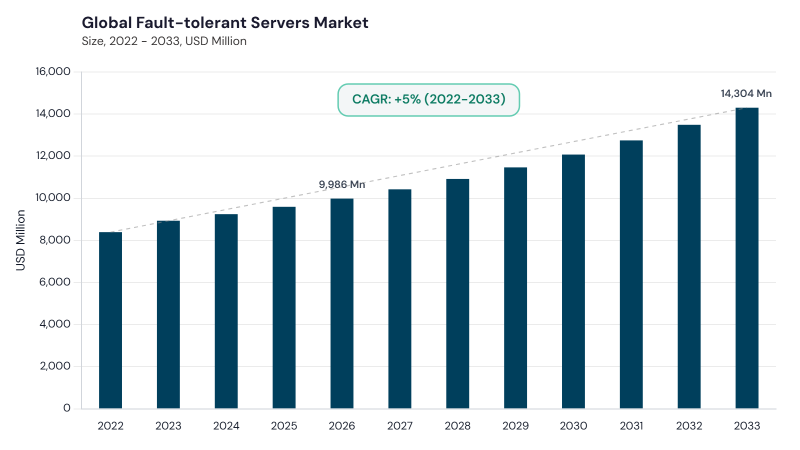
The Global Fault-tolerant Servers Market is expected to reach USD 14.3 billion by 2033, growing at a CAGR of 5.3% during (2026 - 2033).
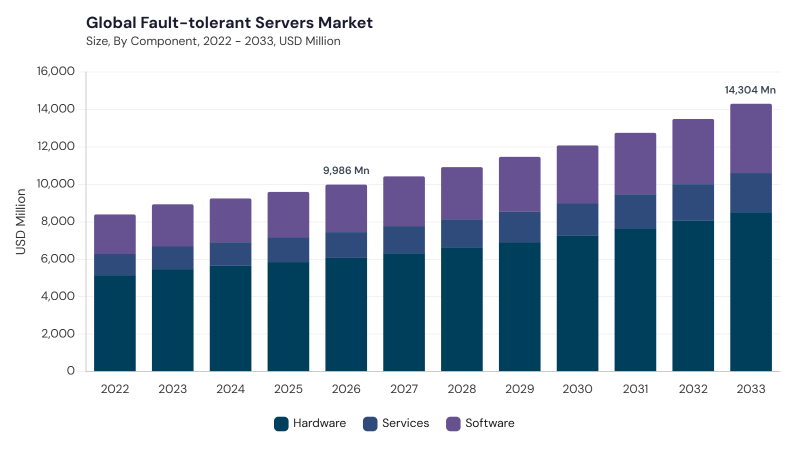
Fault-tolerant serves market is driven by rising demand for uninterrupted transaction processing, continuous computing availability, resilient IT infrastructure across healthcare, telecommunications, banking, government, manufacturing, and cloud environments. Market demand is also surging as enterprises focus on data integrity, business continuity, automated failover, system reliability, and reduced operational downtime. Fault-tolerant servers market evolved from the critical need to assure computing continuity during software or hardware failures. Early solutions largely rely on redundant hardware components like mirrored disks, dual power suppliers, and failover systems to reduce single points of failure.
Fault tolerant servers market is rising as organizations shift from basic redundancy toward automated, smart, and software-enabled resilience models. AI-driven predictive failure analysis, cloud-native fault tolerance, edge computing, modular architectures, real-time diagnostics, and energy-efficient designs are redefining server reliability. These developments are helping enterprises protect data integrity, reduce downtime, maintain continuity, and support distributed workloads across complex digital environments.
Competitive landscape of fault tolerant servers market is largely dynamic and mission-critical computing-driven, driven by enterprise infrastructure providers, dedicated fault-tolerant server vendors, and high-availability computing manufacturers. Providers compete through proven uptime, lockstep processing, redundant hardware architecture, edge computing compatibility, predictive fault detection, and lockstep processing. Competition in the market is accelerating to depend on autonomous recovery, AI-enabled infrastructure management, uninterrupted workload performance, and energy efficiency.
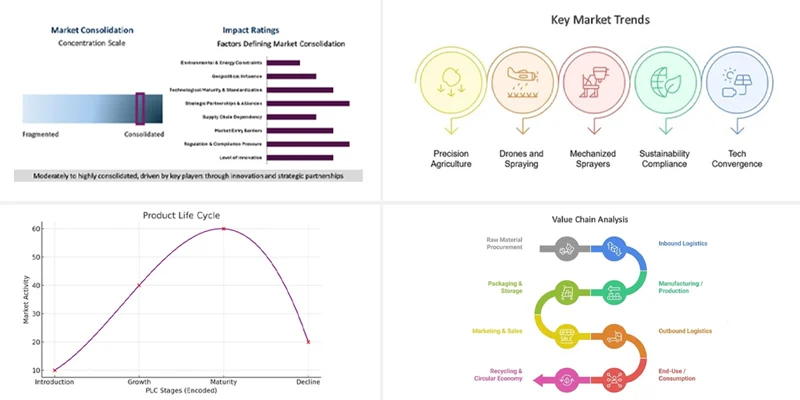

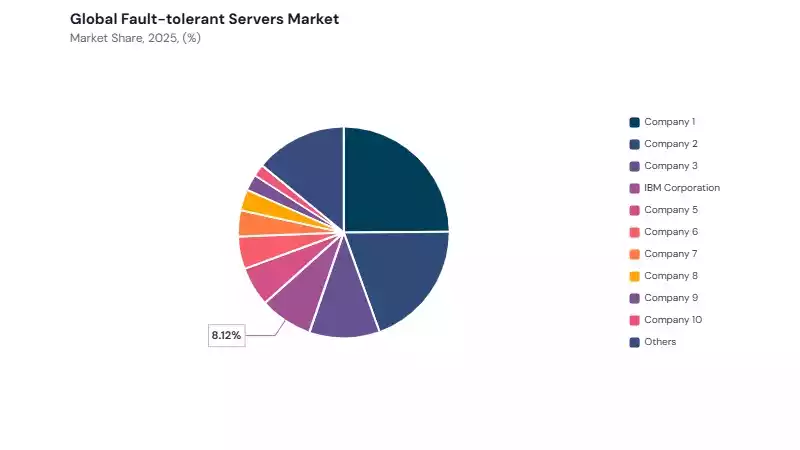
Fault tolerant servers market represents a mission-critical computing-driven and largely consolidated competitive landscape driven by enterprise infrastructure providers, dedicated fault-tolerant server providers, and high-availability computing manufacturers. IBM, NEC, Oracle, Fujitsu, Super Micro Computer, and Cisco further strengthen competition through redundant infrastructure, high-availability servers, resilient data center systems, virtualization, and mission-critical enterprise computing solutions.
Based on Deployment, the market is segmented into On-Premise and Cloud-based. The On-Premise market dominated the Global Fault-tolerant Servers Market by Deployment in 2025, and would continue to be a dominant market till 2033; thereby, achieving a market value of USD 8.9 billion by 2033, growing at a CAGR of 5 % during the forecast period. The Cloud-based market is expected to witness a CAGR of 5.8% during (2026 - 2033).
On-Premise leads the market as enterprises in regulated and mission-critical sectors require direct control over infrastructure, data security, compliance, and failover mechanisms. Cloud-based deployment is gaining traction through scalable disaster recovery, geographic redundancy, hybrid IT adoption, and reduced infrastructure management burden. Both models support high availability, with on-premise suited to strict control and cloud-based suited to flexible resilience.
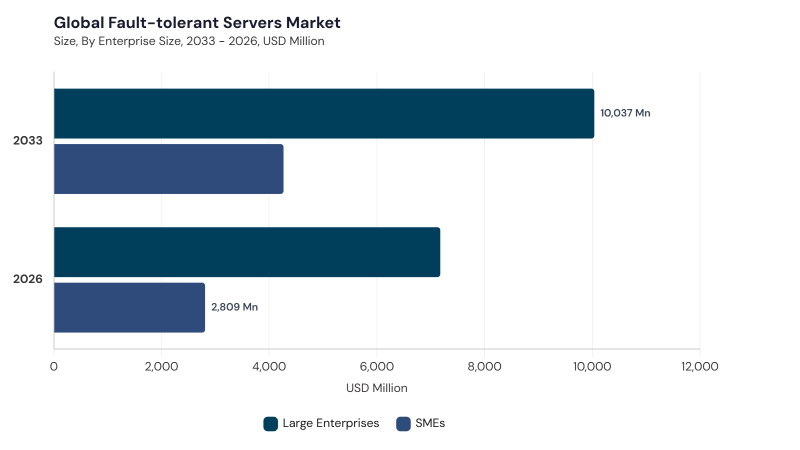
Based on Enterprise Size, the market is segmented into Large Enterprises and SMEs. The Large Enterprises market dominated the Global Fault-tolerant Servers Market by Enterprise Size in 2025, and would continue to be a dominant market till 2033; thereby, achieving a market value of USD 10.0 billion by 2033, growing at a CAGR of 4.9 % during the forecast period. The SMEs market is expected to witness a CAGR of 6.2% during (2026 - 2033).
Large Enterprises lead adoption due to extensive IT infrastructure, critical workloads, higher budgets, and strict uptime requirements across BFSI, healthcare, telecom, government, and manufacturing. SMEs are increasingly adopting resilient server models to protect business continuity, customer operations, and digital platforms. Cost-effective, modular, cloud-enabled, and managed fault-tolerant solutions are improving SME adoption.
Based on Component, the market is segmented into Hardware, Software, and Services. The Hardware market dominated the Global Fault-tolerant Servers Market by Component in 2025, and would continue to be a dominant market till 2033; thereby, achieving a market value of USD 8.5 billion by 2033, growing at a CAGR of 4.9 % during the forecast period. The Software market is expected to witness a CAGR of 5.5% during (2026 - 2033). The Services market is expected to witness a CAGR of 6.1% during (2026 - 2033).
Hardware leads the market because redundant processors, memory, storage, power supplies, and hot-swappable components form the foundation of fault-tolerant infrastructure. Software supports fault detection, workload monitoring, virtualization, error recovery, and system failover. Services support consulting, deployment, integration, maintenance, monitoring, and technical assistance for optimized server reliability.
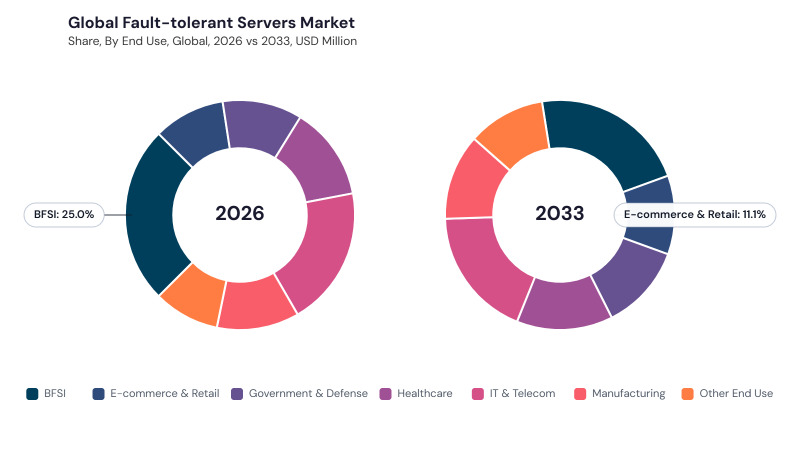
Based on End Use, the market is segmented into BFSI, IT & Telecom, Healthcare, Manufacturing, Government & Defense, E-commerce & Retail, and Other End Use. The BFSI market dominated the Global Fault-tolerant Servers Market by End Use in 2025, and would continue to be a dominant market till 2033; thereby, achieving a market value of USD 3.1 billion by 2033, growing at a CAGR of 3.4 % during the forecast period. The IT & Telecom market is expected to witness a CAGR of 4.2% during (2026 - 2033). Additionally, The Healthcare market is expected to witness highest CAGR of 5.7% during (2026 - 2033).
BFSI leads due to uninterrupted transaction processing, secure data handling, and continuous banking application availability. IT & Telecom depends on resilient servers for networks, cloud services, and data centers, while Healthcare uses them for EHR, diagnostics, and patient monitoring. Manufacturing, Government & Defense, E-commerce & Retail, and Other End Use adopt these systems for automation, secure operations, online transactions, and critical service continuity.
Free Valuable Insights: Fault-tolerant Servers Market Size to reach $14.3 Billion by 2033
Region-wise, the Fault-tolerant Servers Market is analyzed across North America, Europe, Asia Pacific, and LAMEA.
North America market captured highest share in the fault tolerant servers market in 2025, and is predicted to hold same position till 2033, by capturing a market share of USD 4.9 billion by 2033, expanding at a CAGR of 4.7% in the forecast period. Asia Pacific is predicted to expand at a CAGR of 5.8% during 2026-2033. Moreover, Europe is predicted to grow with a CAGR of 4.9% during the projection period.
North America dominates the market because of cloud infrastructure, strong enterprise data center adoption, mission-critical computing demand, healthcare IT and digital banking. Europe is driven by digital transformation, data protection regulations, and resilient IT infrastructure investments. Asia Pacific is also experiencing expansion through industrial modernization, cloud adoption, telecom expansion, and data center growth. Further, LAMEA is gaining momentum through increasing business continuity demand.
| Report Attribute | Details |
|---|---|
| Market size value in 2026 | USD 10.0 billion |
| Market size forecast in 2033 | USD 14.3 billion |
| Base Year | 2025 |
| Historical Period | 2022 to 2024 |
| Forecast Period | 2026 to 2033 |
| Revenue Growth Rate | CAGR of 5.3% from 2026 to 2033 |
| Number of Pages | 656 |
| Tables | 780 |
| Report Coverage | Market Trends, Revenue Estimation and Forecast, Segmentation Analysis, Regional and Country Breakdown, Competitive Landscape, Market Share Analysis, Company Profiling, Companies Strategic Developments, SWOT Analysis, Product Life Cycle Analysis, Value Chain Analysis, Market Consolidation Analysis, Key Customer Criteria, Pandemic Impact Analysis, and Winning Imperatives |
| Segments Covered | Deployment, Enterprise Size, Component, End Use, and Geography |
| Country Scope |
|
| Companies Included | Hewlett Packard Enterprise; Penguin Solutions (Stratus); NEC Corporation; IBM Corporation; Fujitsu Limited; Oracle Corporation; Dell Technologies; Lenovo Group; Super Micro Computer, Inc.; Cisco Systems, Inc. |
By Deployment
By Enterprise Size
By Component
By End Use
By Geography
Expected to reach USD 14.3 billion by 2033, growing at 5.3% CAGR during 2026-2033.
On-Premise segment leads, projected to achieve USD 8.9 billion by 2033.
Key players include Hewlett Packard Enterprise, Penguin Solutions, NEC Corporation, IBM, Fujitsu, Oracle, Dell, Lenovo, Super Micro, Cisco.
Large Enterprises segment leads with a market value of USD 10.0 billion by 2033.
North America leads, achieving USD 4.9 billion by 2033.
Increasing demand for high availability and reliability in critical applications drives growth.
Our team of dedicated experts can provide you with attractive expansion opportunities for your business.








 Unique Offerings