The sample copy of this report is available for access.
The North America eSIM Market is expected to reach USD 1703.2 million by 2032, growing at a CAGR of 16.1% during (2026 - 2033).
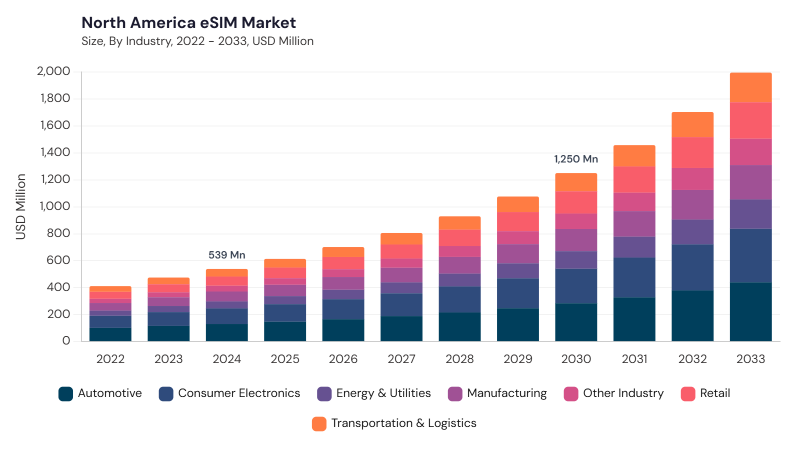
The North America eSIM Market evolved from early embedded-SIM deployments in IoT and machine-to-machine applications toward widespread consumer and enterprise connectivity. Improvements in remote SIM provisioning, standardized profiles, security protocols, smartphone integration, and operator interoperability progressively expanded adoption beyond niche industrial uses. The introduction of eSIM-enabled flagship devices accelerated consumer awareness and encouraged carriers to modernize digital activation and subscription-management systems. The market has subsequently progressed toward multi-profile connectivity, software-based carrier switching, cloud-supported provisioning, connected vehicles, wearables, and enterprise IoT, positioning eSIM as an important component of digitally managed mobile connectivity.
Accelerating consumer adoption, 5G deployment, IoT expansion, digital onboarding, and multi-network connectivity are shaping current market development. Operators and technology providers increasingly emphasize cloud-based remote provisioning, profile management, enhanced security, seamless carrier switching, and flexible subscription models across consumer and enterprise devices. Integration with smartphones, automotive systems, wearables, industrial IoT, smart infrastructure, and connected computing is broadening the technology’s addressable applications. However, high deployment costs, fragmented regulatory requirements, legacy-system integration, interoperability challenges, network infrastructure limitations, privacy concerns, and cybersecurity requirements continue to influence adoption and scalability across North America.
Based on Application, the market is segmented into Connected Cars, Smartphones, Wearable Devices, Laptops/Tablets, Smart Home Appliances, Vehicle Tracking, and Other Application. The Connected Cars market dominated the North America eSIM Market by Application in 2025, and would continue to be a dominant market till 2033; thereby, achieving a market value of USD 365.1 million by 2032, growing at a CAGR of 14.8 % during the forecast period. The Smartphones market is expected to witness a CAGR of 15% during (2026 - 2033). Additionally, The Wearable Devices market is expected to witness highest CAGR of 16.6% during (2026 - 2033).
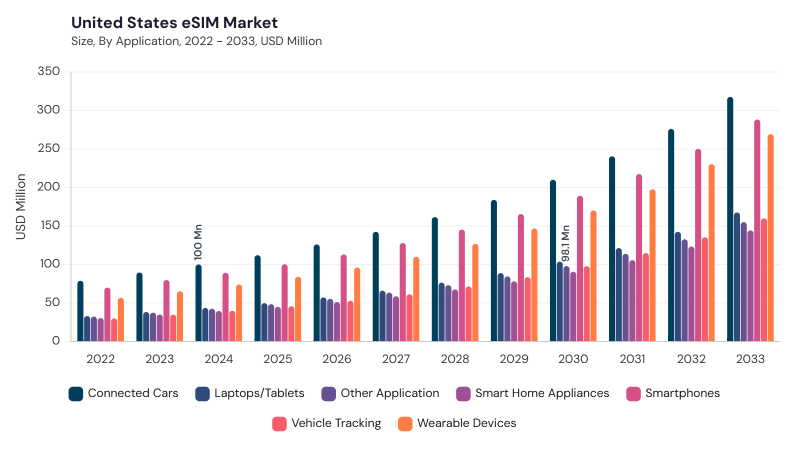
Connected Cars use eSIM technology to support persistent connectivity, over-the-air updates, navigation, telematics, diagnostics, and multi-network access throughout vehicle lifecycles. Smartphones benefit from digital activation, multi-profile management, carrier switching, and international connectivity, while Wearable Devices use embedded cellular connectivity for smartwatches, fitness products, health monitoring, emergency communication, and location services. Laptops/Tablets support always-connected computing for mobile professionals and remote users, whereas Smart Home Appliances use eSIM for secure, remotely managed IoT connectivity. Vehicle Tracking supports fleet visibility, asset monitoring, and logistics management, while Other Application includes industrial IoT, public safety, portable medical equipment, smart luggage, and specialized connected devices.
Based on Industry, the market is segmented into Automotive, Consumer Electronics, Manufacturing, Retail, Transportation & Logistics, Energy & Utilities, and Other Industry. Automotive applications rely on eSIM for telematics, infotainment, diagnostics, autonomous-driving support, connected services, and software-defined vehicle architectures. Consumer Electronics uses eSIM across smartphones, tablets, wearables, and smart devices to simplify activation and improve connectivity flexibility, while Manufacturing applies remotely provisioned connectivity to industrial IoT, robotics, predictive maintenance, and machine monitoring.
Retail uses eSIM-enabled POS terminals, inventory systems, and connected store infrastructure, whereas Transportation & Logistics applies the technology to fleet management, shipment monitoring, and asset tracking. Energy & Utilities uses eSIM for smart metering, grid monitoring, and remote infrastructure management, while Other Industry includes healthcare, agriculture, construction, public safety, and other specialized enterprise applications.
Free Valuable Insights: The Global eSIM Market will hit USD 5880.9 Million billion by 2033, at a CAGR of 16.7%
Based on Country, the market is segmented into US, Canada, Mexico, and Rest of North America. The US market dominated the North America eSIM Market by Country in 2025, and would continue to be a dominant market till 2033; thereby, achieving a market value of USD 1290.6 million by 2032, growing at a CAGR of 15.4 % during the forecast period. The Canada market is expected to witness a CAGR of 18.7% during (2026 - 2033). Additionally, The Mexico market is expected to witness a CAGR of 17.7% during (2026 - 2033).
Across North America, eSIM adoption is being shaped by digital connectivity, 5G, IoT expansion, interoperability, and consumer demand for flexible subscription management. The US emphasizes eSIM-only smartphones, remote provisioning, multi-profile services, MVNO participation, travel connectivity, IoT deployments, and next-generation connectivity platforms, while Canada focuses on 5G integration, cloud-based connectivity management, secure provisioning, enterprise IoT, and localized operator partnerships. Mexico is advancing multi-operator connectivity, IoT applications, remote lifecycle management, regulatory compliance, and cloud-based eSIM platforms, whereas Rest of North America increasingly emphasizes digital activation, travel connectivity, multi-profile management, IoT expansion, localized service models, and standardized interoperable connectivity.

By Application
By Industry
By Country
Set to reach $1703.2 Million by 2032, growing at 16.1% CAGR during 2026-2033.
The US leads with $1290.6 million by 2032, growing at 15.4% CAGR during 2026-2033.
Connected Cars dominate, reaching $365.1 million by 2032 at 14.8% CAGR during 2026-2033.
Canada is expected to witness a CAGR of 18.7% during 2026-2033.
Wearable Devices are expected to witness the highest CAGR of 16.6% during 2026-2033.
Our team of dedicated experts can provide you with attractive expansion opportunities for your business.




 Unique Offerings