The sample copy of this report is available for access.
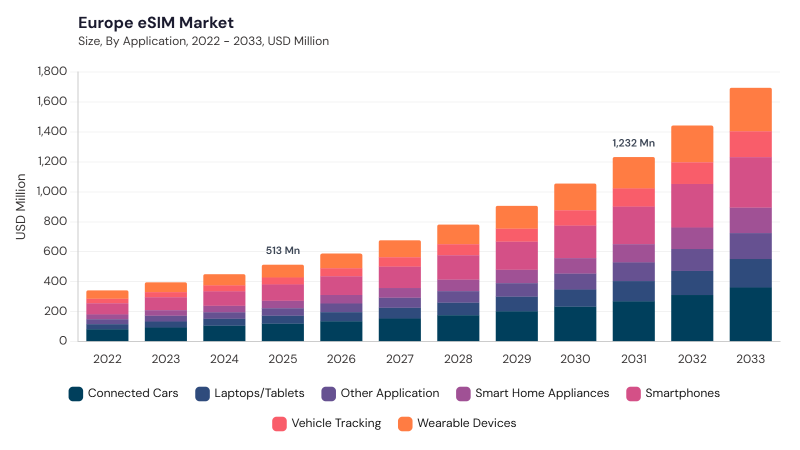
The Europe eSIM Market is expected to reach USD 1232.1 million by 2031, growing at a CAGR of 16.3% during (2026 - 2033).
The Europe eSIM Market evolved from early embedded subscriber identity solutions designed to replace physical SIM cards toward digitally managed connectivity based on remote provisioning and embedded universal integrated circuit card technology. Initial adoption centered on improving device form factors, security, and subscription flexibility, while broader standardization gradually enabled interoperability across mobile operators and devices. Expansion of 4G and 5G infrastructure, increasing IoT deployment, and growing support from handset and connected-device manufacturers accelerated adoption across consumer and enterprise environments. The market has since progressed toward multi-profile management, remote activation, cross-border connectivity, connected mobility, and scalable IoT applications supported by evolving European regulatory and telecommunications frameworks.
Regulatory harmonization, 5G expansion, IoT adoption, cross-border mobility, and growing demand for flexible digital connectivity are shaping current market development. Operators and technology providers increasingly focus on secure remote provisioning, multi-profile management, cloud-based subscription platforms, interoperability, and seamless carrier switching across devices and networks. eSIM integration is expanding beyond smartphones into connected vehicles, wearables, laptops, smart-home equipment, industrial IoT, utilities, and logistics. However, fragmented national regulations, high implementation costs, uneven infrastructure maturity, cybersecurity requirements, interoperability constraints, certification complexity, and user trust concerns continue to affect adoption and scalability across Europe.
Based on Application, the market is segmented into Connected Cars, Smartphones, Wearable Devices, Laptops/Tablets, Smart Home Appliances, Vehicle Tracking, and Other Application. The Connected Cars market dominated the Europe eSIM Market by Application in 2025, and would continue to be a dominant market till 2033; thereby, achieving a market value of USD 268.5 million by 2031, growing at a CAGR of 15.1 % during the forecast period. The Smartphones market is expected to witness a CAGR of 15.3% during (2026 - 2033). Additionally, The Wearable Devices market is expected to witness highest CAGR of 16.8% during (2026 - 2033).
Connected Cars use eSIM technology for infotainment, remote diagnostics, over-the-air updates, emergency services, navigation, telematics, and vehicle-to-everything connectivity. Smartphones benefit from digital activation, multi-profile management, carrier switching, and international roaming flexibility, while Wearable Devices use embedded connectivity for smartwatches, health monitors, fitness products, and other compact connected devices. Laptops/Tablets support always-connected computing for mobile and hybrid workforces, whereas Smart Home Appliances use eSIM for secure, remotely managed IoT connectivity. Vehicle Tracking supports fleet visibility, logistics coordination, asset monitoring, and cross-border operations, while Other Application includes industrial IoT, healthcare devices, public safety systems, smart metering, agriculture, and other specialized connected applications.
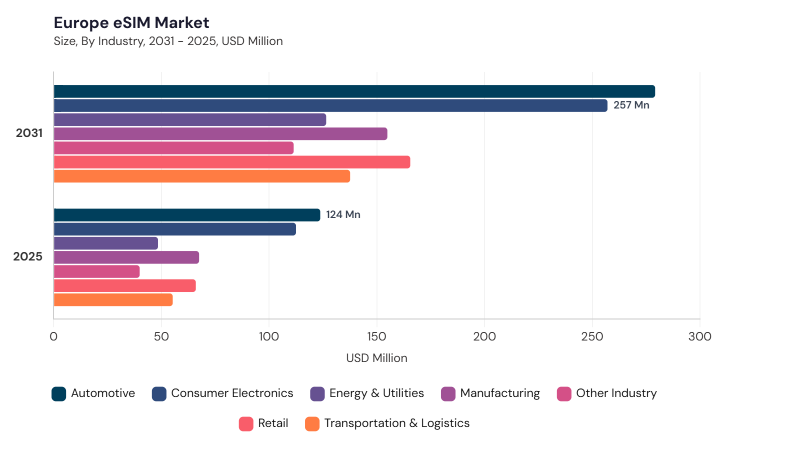
Based on Industry, the market is segmented into Automotive, Consumer Electronics, Manufacturing, Retail, Transportation & Logistics, Energy & Utilities, and Other Industry. Automotive applications rely on eSIM for telematics, infotainment, autonomous functions, diagnostics, over-the-air services, and connected mobility. Consumer Electronics uses eSIM across smartphones, tablets, wearables, laptops, and smart-home devices to improve activation flexibility and multi-network access, while Manufacturing applies remotely provisioned connectivity to industrial IoT, robotics, predictive maintenance, digital twins, and connected machinery.
Retail uses eSIM in POS terminals, digital signage, inventory systems, and customer-engagement devices, whereas Transportation & Logistics applies the technology to fleet management, cargo monitoring, and supply-chain visibility. Energy & Utilities uses eSIM for smart grids, remote metering, and distributed asset monitoring, while Other Industry includes healthcare, agriculture, public-sector applications, and other specialized enterprise connectivity environments.
Free Valuable Insights: The Worldwide eSIM Market is projected to reach USD 5880.9 Million billion by 2033, at a CAGR of 16.7%
Based on Country, the market is segmented into Germany, UK, France, Russia, Spain, Italy, and Rest of Europe. The Germany market dominated the Europe eSIM Market by Country in 2025, and would continue to be a dominant market till 2033; thereby, achieving a market value of USD 238.5 million by 2031, growing at a CAGR of 14.7 % during the forecast period. The UK market is expected to witness a CAGR of 15.3% during (2026 - 2033). Additionally, The France market is expected to witness a CAGR of 17.1% during (2026 - 2033).
Across Europe, eSIM adoption is being shaped by 5G deployment, IoT expansion, cross-border connectivity, regulatory compliance, digital identity, and remote provisioning. Germany emphasizes 5G integration, industrial IoT, digital identity, secure provisioning, and advanced connectivity management, while the UK focuses on IoT scalability, 5G-enabled connectivity, interoperability, AI-supported network management, and consumer flexibility. France is advancing cloud-based remote provisioning, IoT connectivity, 5G integration, AI-enabled network management, and secure multi-profile services, whereas Russia emphasizes localized identity verification, regulatory compliance, industrial IoT, multi-profile management, and secure remote provisioning. Spain focuses on travel connectivity, multi-profile services, automotive and fleet applications, privacy, and secure eSIM management, while Italy emphasizes digital roaming, IoT, 5G, remote provisioning, and secure subscription management. Rest of Europe continues to develop international mobility, scalable IoT connectivity, regulatory standardization, cloud-based orchestration, AI-supported subscription analytics, and localized multi-network solutions.

By Application
By Industry
By Country
Set to reach $1232.1 Million by 2031, growing at 16.3% CAGR during 2026-2033.
Germany leads with $238.5 million by 2031, growing at a 14.7% CAGR during 2026-2033.
Connected Cars segment will reach $268.5 million by 2031, growing at 15.1% CAGR during 2026-2033.
Wearable Devices segment is expected to witness the highest CAGR of 16.8% during 2026-2033.
The UK market is expected to witness a CAGR of 15.3% during 2026-2033.
France market is expected to witness a CAGR of 17.1% during 2026-2033.
Our team of dedicated experts can provide you with attractive expansion opportunities for your business.




 Unique Offerings