The sample copy of this report is available for access.
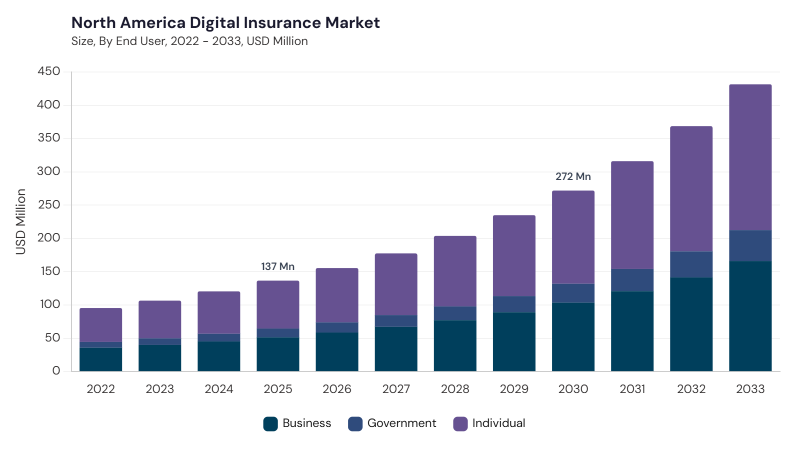
The North America Digital Insurance Market is expected to reach USD 368.6 billion by 2032, growing at a CAGR of 15.7% during (2026 - 2033).
The North America Digital Insurance Market has evolved from traditional paper-based insurance processes and basic online portals into an increasingly integrated digital ecosystem supporting underwriting, claims management, policy administration, distribution, and customer engagement. Growing adoption of cloud computing, artificial intelligence, data analytics, mobile applications, and automated workflows has improved operational efficiency and enabled more responsive insurance services. Legacy system modernization has further supported integration between customer-facing platforms and core insurance systems. The market now increasingly emphasizes personalized products, digital self-service, automated decision-making, embedded insurance, telematics, and connected insurance experiences.
Artificial intelligence, cloud modernization, usage-based insurance, embedded distribution, and stronger regulatory technology are shaping current market development. Insurers increasingly use AI and advanced analytics for underwriting, fraud detection, customer retention, claims automation, and personalized pricing, while telematics and IoT data support more behavior-based insurance models. Embedded insurance is expanding coverage distribution through e-commerce, mobility, travel, and other digital ecosystems, while cloud-native platforms improve scalability and product deployment. At the same time, cybersecurity, data privacy, AI governance, regulatory compliance, system interoperability, and digital talent requirements continue to influence technology investment and adoption across the regional insurance ecosystem.
Based on Component, the market is segmented into Solution and Services. The Solution market dominated the North America Digital Insurance Market by Component in 2025, and would continue to be a dominant market till 2033; thereby, achieving a market value of USD 320.8 billion by 2032, growing at a CAGR of 15.1 % during the forecast period. The Services market is expected to witness a CAGR of 19.9% during (2026 - 2033).
Solution includes digital insurance platforms supporting customer relationship management, policy administration, claims automation, AI-powered risk assessment, fraud detection, analytics, digital engagement, and other technology-enabled insurance operations. Services support consulting, implementation, systems integration, process transformation, cloud migration, maintenance, and managed operations required to deploy and optimize these platforms. Demand across both categories is being strengthened by legacy modernization, regulatory requirements, cybersecurity needs, cloud adoption, and insurers’ efforts to improve customer experience and operational agility.
Based on End User, the market is segmented into Individual, Business, and Government. The Individual market dominated the North America Digital Insurance Market by End User in 2025, and would continue to be a dominant market till 2033; thereby, achieving a market value of USD 187.9 billion by 2032, growing at a CAGR of 15.2 % during the forecast period. The Business market is expected to witness highest CAGR of 16% during (2026 - 2033).
Individual users increasingly rely on mobile applications, online portals, digital wallets, AI-enabled customer service, personalized pricing, and on-demand insurance products for personal coverage requirements. Business users require digital insurance platforms for commercial coverage, employee benefits, cyber protection, liability management, risk analytics, and scalable policy administration. Government users adopt digital platforms for public insurance programs, employee coverage, benefit administration, claims processing, fraud detection, auditability, and risk protection initiatives, with strong emphasis on regulatory compliance, transparency, and data security.
Based on Insurance Type, the market is segmented into Life & Health and Other Insurance Type. The Life & Health market dominated the North America Digital Insurance Market by Insurance Type in 2025, and would continue to be a dominant market till 2033; thereby, achieving a market value of USD 196.3 billion by 2032, growing at a CAGR of 15.3 % during the forecast period. The Other Insurance Type market is expected to witness a CAGR of 16.1% during (2026 - 2033).
Life & Health insurance increasingly uses digital platforms for policy enrollment, automated underwriting, customer servicing, claims management, health-data integration, telehealth connectivity, and personalized risk assessment. Advanced analytics, cloud platforms, mobile applications, and AI-supported processes are improving operational efficiency and enabling more tailored insurance experiences. Other Insurance Type includes digitization across property, casualty, automotive, travel, and specialized insurance products, where insurers are adopting telematics, automated claims, embedded distribution, digital risk assessment, and online servicing to expand accessibility and improve customer convenience.
Based on Enterprise Size, the market is segmented into Small & Medium Enterprises (SMEs) and Large Enterprises. Small & Medium Enterprises favor cost-efficient, modular, cloud-based, and SaaS-oriented insurance platforms that automate underwriting, claims, policy management, and customer engagement without requiring extensive internal technology infrastructure.
Large Enterprises require more sophisticated digital ecosystems integrating AI, advanced analytics, cybersecurity, blockchain, automation, and enterprise risk-management capabilities across complex commercial insurance portfolios. Adoption across both enterprise groups is influenced by regulatory compliance, digital transformation, cloud integration, cybersecurity requirements, product customization, and the need for scalable insurance operations.
Based on Distribution Channel, the market is segmented into Brokers, Tied Agents & Branches, and Other Distribution Channel. Brokers combine advisory expertise with digital platforms, AI-enabled analytics, CRM systems, and cloud-based tools to improve quotation, underwriting, servicing, and claims interactions. Tied Agents & Branches combine traditional insurer relationships with digital portals, mobile applications, virtual consultations, and omnichannel servicing to provide both human assistance and digital convenience.
Other Distribution Channel includes direct online sales, insurance aggregators, digital marketplaces, embedded insurance, and InsurTech platforms that provide self-service purchasing, policy management, automated claims, and digitally integrated insurance experiences across personal and commercial lines.
Free Valuable Insights: The Global Digital Insurance Market will hit USD 1468.6 Billion billion by 2033, at a CAGR of 16.1%
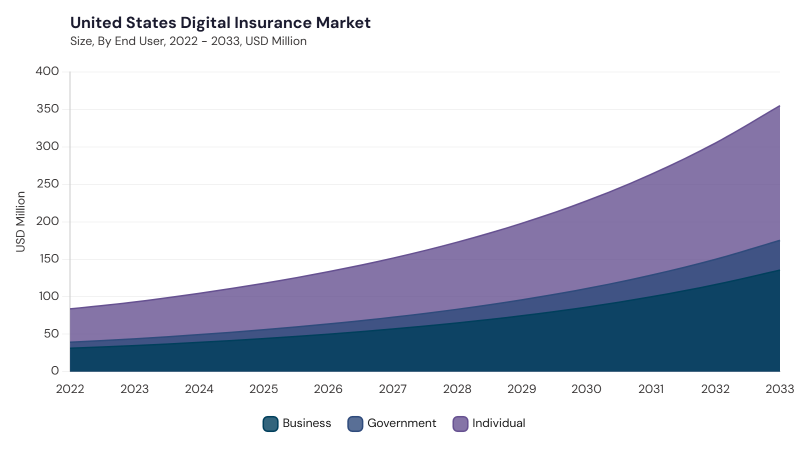
Based on Country, the market is segmented into US, Canada, Mexico, and Rest of North America. The US market dominated the North America Digital Insurance Market by Country in 2025, and would continue to be a dominant market till 2033; thereby, achieving a market value of USD 305.1 billion by 2032, growing at a CAGR of 15 % during the forecast period. The Canada market is expected to witness a CAGR of 19.4% during (2026 - 2033). Additionally, The Mexico market is expected to witness a CAGR of 18.2% during (2026 - 2033).
Across North America, digital insurance adoption is being shaped by AI-driven automation, cloud modernization, embedded insurance, personalized products, regulatory compliance, and data-driven customer engagement. The US emphasizes AI-enabled underwriting, automated claims, embedded insurance, API-based partnerships, responsible AI governance, and cloud-native infrastructure, while Canada focuses on AI-assisted underwriting, personalized insurance, cloud platforms, data security, provincial regulatory alignment, and InsurTech collaboration. Mexico is advancing AI-enabled risk assessment, embedded insurance, fintech partnerships, blockchain applications, localized digital products, and compliance technologies, whereas Rest of North America emphasizes predictive analytics, RegTech, cybersecurity, mobile engagement, API ecosystems, automated claims, and scalable digital insurance platforms.

By Component
By End User
By Insurance Type
By Enterprise Size
By Distribution Channel
By Country
Set to reach $368.6 Billion by 2032, growing at 15.7% CAGR during 2026-2033.
The US leads with $305.1 billion by 2032, growing at 15% CAGR during 2026-2033.
Rising enterprise cloud adoption and AI-driven workloads are the main catalysts.
Solution segment hits $320.8 billion by 2032, growing at 15.1% CAGR during 2026-2033.
Canada is expected to witness a CAGR of 19.4% during 2026-2033.
The services segment is expected to witness a CAGR of 19.9% during 2026-2033.
Our team of dedicated experts can provide you with attractive expansion opportunities for your business.




 Unique Offerings