The sample copy of this report is available for access.
The Asia Pacific Digital Insurance Market is expected to reach USD 238.3 billion by 2030, growing at a CAGR of 16.7% during (2026 - 2033).
The Asia Pacific Digital Insurance Market evolved from early digitization of policy issuance, claims handling, and customer servicing into a broader technology-enabled insurance ecosystem. Expansion of mobile connectivity, cloud computing, big data analytics, artificial intelligence, blockchain, and automated workflows progressively shifted insurers from manual processes toward data-driven platforms. InsurTech participation, digital payment adoption, and regulatory encouragement further accelerated transformation across markets with varying levels of insurance maturity. The industry now increasingly relies on mobile-first platforms, API-based ecosystems, embedded insurance, automated underwriting, digital claims, and real-time risk analytics.
Artificial intelligence, embedded insurance, customer-centric digitalization, cloud adoption, and emerging risk coverage are shaping current market development. Insurers increasingly use AI and machine learning for underwriting, fraud detection, claims automation, predictive risk assessment, and personalized products, while APIs connect insurance with e-commerce, mobility, fintech, healthcare, and other digital ecosystems. Smartphone penetration and digital payments are improving accessibility among previously underserved consumers and SMEs. At the same time, cybersecurity, data privacy, regulatory heterogeneity, legacy infrastructure, interoperability, digital trust, and sustainability-related risk management continue to influence adoption strategies across Asia Pacific.
Based on Component, the market is segmented into Solution and Services. The Solution market dominated the Asia Pacific Digital Insurance Market by Component in 2025, and would continue to be a dominant market till 2033; thereby, achieving a market value of USD 211.0 billion by 2030, growing at a CAGR of 16.2 % during the forecast period. The Services market is expected to witness a CAGR of 21.3% during (2026 - 2033).
Solution includes platforms supporting underwriting, claims automation, customer engagement, policy administration, risk assessment, fraud detection, telematics, blockchain-based workflows, and real-time data analysis. Services include consulting, implementation, system integration, managed services, cloud migration, cybersecurity support, workforce training, and technology optimization. Demand across both categories is being strengthened by digital transformation initiatives, legacy modernization, regulatory compliance requirements, API-based ecosystems, cloud adoption, and insurers’ need for scalable and secure operating environments.
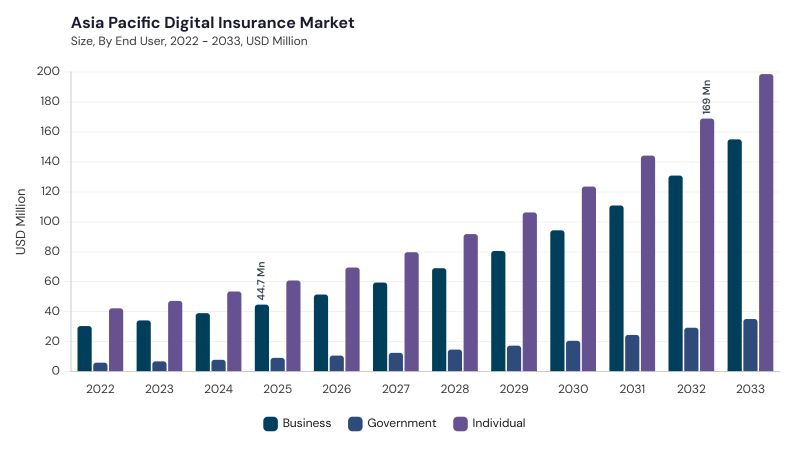
Based on End User, the market is segmented into Individual, Business, and Government. The Individual market dominated the Asia Pacific Digital Insurance Market by End User in 2025, and would continue to be a dominant market till 2033; thereby, achieving a market value of USD 123.5 billion by 2030, growing at a CAGR of 16.2 % during the forecast period. The Business market is expected to witness highest CAGR of 17.1% during (2026 - 2033).
Individual users increasingly rely on mobile applications, self-service portals, AI-assisted customer support, digital KYC, personalized coverage, and instant policy management for life, health, motor, and travel insurance. Business users require digital platforms for commercial protection, employee benefits, cyber coverage, liability management, risk analytics, and automated policy administration. Government users apply digital insurance solutions to public health coverage, social protection, employee benefits, disaster relief, fraud monitoring, and insurance administration, with strong emphasis on scalability, transparency, data security, and financial inclusion.
Based on Insurance Type, the market is segmented into Life & Health and Other Insurance Type. The Life & Health market dominated the Asia Pacific Digital Insurance Market by Insurance Type in 2025, and would continue to be a dominant market till 2033; thereby, achieving a market value of USD 128.7 billion by 2030, growing at a CAGR of 16.3 % during the forecast period. The Other Insurance Type market is expected to witness a CAGR of 17.2% during (2026 - 2033).
Life & Health insurance increasingly incorporates digital onboarding, telemedicine, wellness applications, wearable data, AI-driven underwriting, automated claims, and personalized policy servicing to improve accessibility and customer engagement. Other Insurance Type includes motor, property, travel, accident, commercial, specialty, cyber, and emerging digital asset insurance, where telematics, blockchain, IoT, automated underwriting, and digital claims are improving risk assessment and operational efficiency. Adoption across both categories is influenced by data privacy requirements, digital literacy, regulatory maturity, and differing insurance penetration levels across regional markets.
Based on Enterprise Size, the market is segmented into Small & Medium Enterprises (SMEs) and Large Enterprises. Small & Medium Enterprises increasingly favor affordable, modular, cloud-based, and API-enabled insurance platforms that simplify risk coverage while minimizing administrative and infrastructure requirements.
Large Enterprises require more sophisticated digital ecosystems supporting predictive analytics, cyber protection, cross-border risk management, employee benefits, automated portfolio management, blockchain, and integration with enterprise systems. Adoption across both enterprise groups is being shaped by operational complexity, regulatory compliance, digital maturity, cloud deployment, cybersecurity, and demand for more flexible risk-management solutions.
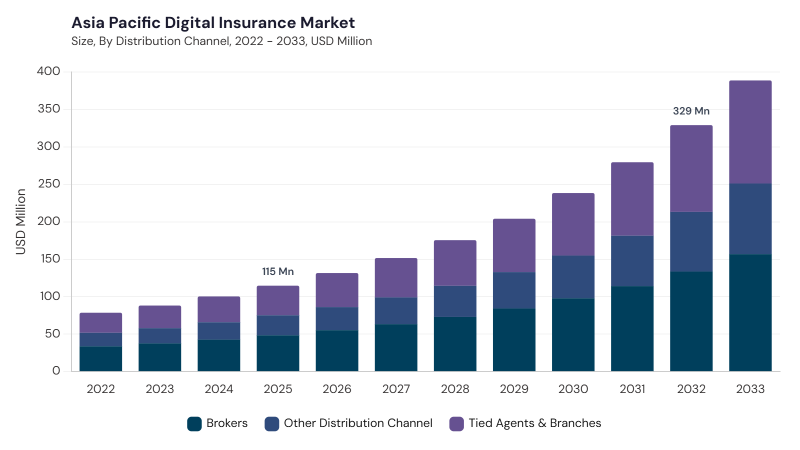
Based on Distribution Channel, the market is segmented into Brokers, Tied Agents & Branches, and Other Distribution Channel. Brokers increasingly use AI-enabled analytics, CRM systems, cloud platforms, and API integration to enhance risk assessment, policy comparison, customer onboarding, and advisory services. Tied Agents & Branches combine established relationships with mobile sales tools, e-signatures, digital policy servicing, and omnichannel engagement, particularly where personal advice remains important.
Other Distribution Channel includes super-apps, online aggregators, InsurTech marketplaces, e-commerce partnerships, fintech platforms, bancassurance interfaces, embedded insurance, and direct digital channels offering convenient and scalable access to standardized insurance products.
Free Valuable Insights: Digital Insurance Market is Predicted to reach USD 1468.6 Billion billion by 2033, at a CAGR of 16.1%
Based on Country, the market is segmented into China, Japan, India, South Korea, Singapore, Malaysia, and Rest of Asia Pacific. The China market dominated the Asia Pacific Digital Insurance Market by Country in 2025, and would continue to be a dominant market till 2033; thereby, achieving a market value of USD 74.1 billion by 2030, growing at a CAGR of 14.9 % during the forecast period. The Japan market is expected to witness a CAGR of 15.9% during (2026 - 2033). Additionally, The India market is expected to witness a CAGR of 17.5% during (2026 - 2033).
Across Asia Pacific, digital insurance adoption is being shaped by AI, embedded insurance, cloud infrastructure, localization, regulatory modernization, and mobile-first engagement. China emphasizes AI-enabled underwriting, open digital ecosystems, InsurTech participation, blockchain, and data governance, while Japan focuses on AI-driven automation, embedded insurance, cloud platforms, and omnichannel customer engagement. India is advancing digital KYC, AI-supported underwriting, microinsurance, mobile distribution, open-data frameworks, and localized products, whereas South Korea emphasizes AI governance, predictive analytics, digital-first customer journeys, and regulatory sandboxes. Singapore focuses on AI, embedded insurance, cloud infrastructure, digital identity, and cybersecurity, while Malaysia emphasizes AI-enabled operations, InsurTech partnerships, digital inclusion, localized offerings, and compliance automation. Rest of Asia Pacific continues to develop embedded insurance, AI-driven underwriting, mobile platforms, cloud-native ecosystems, cybersecurity, and regulatory-compliant digital distribution.

By Component
By End User
By Insurance Type
By Enterprise Size
By Distribution Channel
By Country
Set to reach $238.3 Billion by 2030, growing at 16.7% CAGR during 2026-2033.
China leads with a market value of $74.1 billion by 2030, growing at 14.9% CAGR during 2026-2033.
The Solution segment will achieve $211.0 billion by 2030, growing at 16.2% CAGR during 2026-2033.
The Services segment is expected to witness a CAGR of 21.3% during 2026-2033.
The Japan market is expected to witness a CAGR of 15.9% during 2026-2033.
Life & Health insurance type will reach $128.7 billion by 2030, growing at 16.3% CAGR during 2026-2033.
Our team of dedicated experts can provide you with attractive expansion opportunities for your business.




 Unique Offerings