The sample copy of this report is available for access.
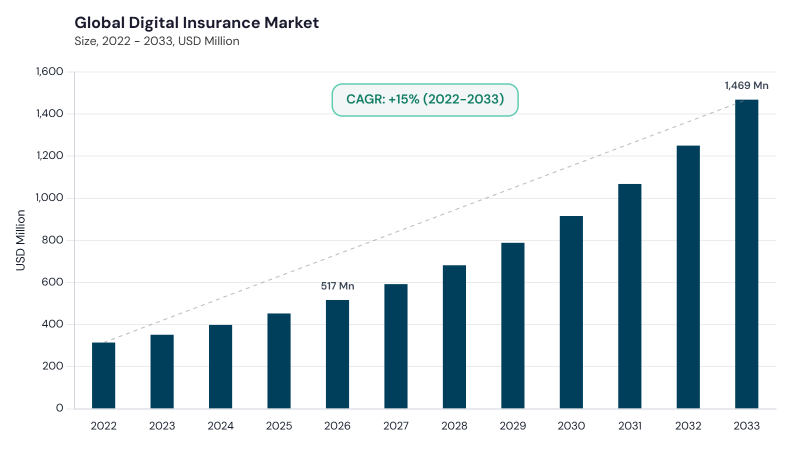
“Global Digital Insurance Market to reach a market value of USD 1,468.62 Million by 2033 growing at a CAGR of 16.1%”
The Global Digital Insurance Market is expected to reach USD 1468.6 billion by 2033, growing at a CAGR of 16.1% during (2026 - 2033).
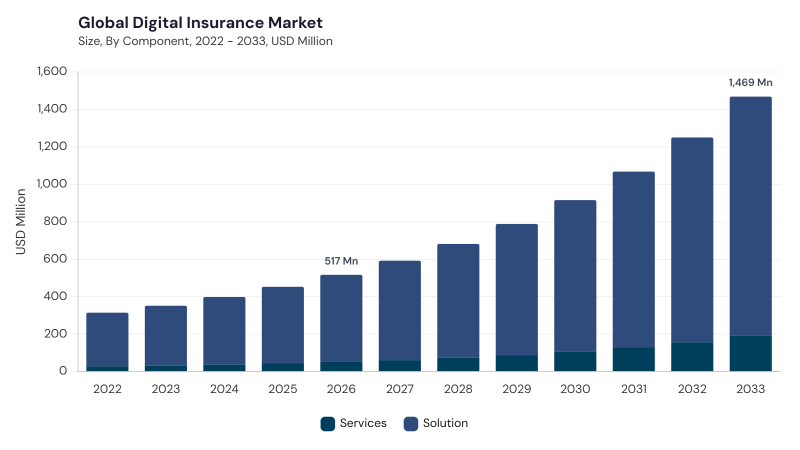
Rising demand for faster policy issuance, personalized coverage, automated claims processing, seamless digital customer experiences, and lower distribution costs is driving the Digital Insurance Market across life, health, property, casualty, commercial, and cyber insurance workflows. Growth is further strengthened by mobile applications, cloud-based platforms, AI-enabled underwriting, self-service portals, telematics, connected devices, embedded insurance, and broader use of data analytics across insurance operations. The market originated from the insurance sector’s shift toward digitization, initially driven by online distribution, automated underwriting, and digital policy administration.
Increasing digital adoption across insurance operations is transforming the way policies are quoted, issued, managed, and claimed. Insurers are using AI, machine learning, data analytics, cloud infrastructure, APIs, mobile applications, and digital self-service tools to reduce manual processing, improve underwriting accuracy, detect fraud, personalize coverage, and accelerate claims resolution. At the same time, customers increasingly expect transparent pricing, instant access, real-time support, and convenient digital policy management. The rise of embedded insurance, telematics-based models, cyber insurance, usage-based coverage, and digital-first distribution is further expanding the market beyond traditional insurance channels.
The competitive environment is shaped by both pure-play digital insurers and traditional insurance groups modernizing through technology, acquisitions, and partnerships. Digital-native companies compete through automated underwriting, mobile-first onboarding, AI-enabled claims, telematics, app-based servicing, embedded distribution, and simplified policy experiences. Established insurers and reinsurers are strengthening their participation by acquiring digital platforms, partnering with insurtech firms, integrating cloud and analytics systems, and expanding digital commercial insurance models. Competition is increasingly defined by technology scalability, customer experience, pricing accuracy, underwriting discipline, cybersecurity capabilities, regulatory compliance, and sustainable claims performance.
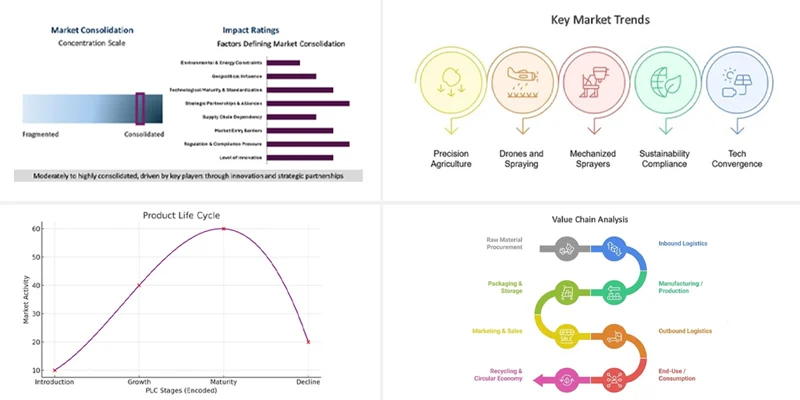

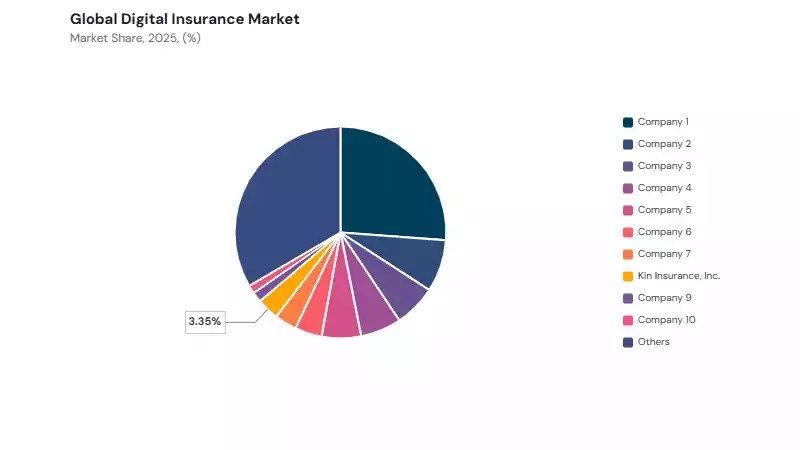
The global Digital Insurance Market is moderately fragmented and digitally native, with competition spread across online-first insurers, telematics-based providers, AI-enabled underwriting companies, cyber-focused digital insurers, embedded insurance platforms, and digitally transformed traditional insurance groups. ZhongAn Online P&C Insurance holds a strong leadership position through its digital-first model, online distribution, automated underwriting, and ecosystem partnerships. Root, Go Digit, Lemonade, and Hippo strengthen the next competitive tier through mobile-first auto insurance, digitally enabled general insurance, AI-based personal insurance, and proactive digital home insurance. Coalition, Munich Re/ERGO through NEXT Insurance, Kin, Marshmallow, and ACKO compete through specialized cyber, small-business, property, motor, and embedded insurance models.
Based on Component, the market is segmented into Solution and Services. The Solution market dominated the Global Digital Insurance Market by Component in 2025, and would continue to be a dominant market till 2033; thereby, achieving a market value of USD 1278.0 billion by 2033, growing at a CAGR of 15.5 % during the forecast period. The Services market is expected to witness a CAGR of 20.5% during (2026 - 2033).
Solution represents the core technology layer of digital insurance, covering software platforms, AI-enabled underwriting tools, claims automation systems, data analytics, fraud detection, customer engagement platforms, and policy administration solutions. These tools help insurers automate workflows, improve risk assessment, reduce processing costs, and deliver faster digital experiences. Services support implementation, consulting, integration, maintenance, managed services, cybersecurity, training, and legacy modernization. Both segments are essential as insurers require robust platforms as well as specialized expertise to deploy, customize, secure, and scale digital insurance systems.
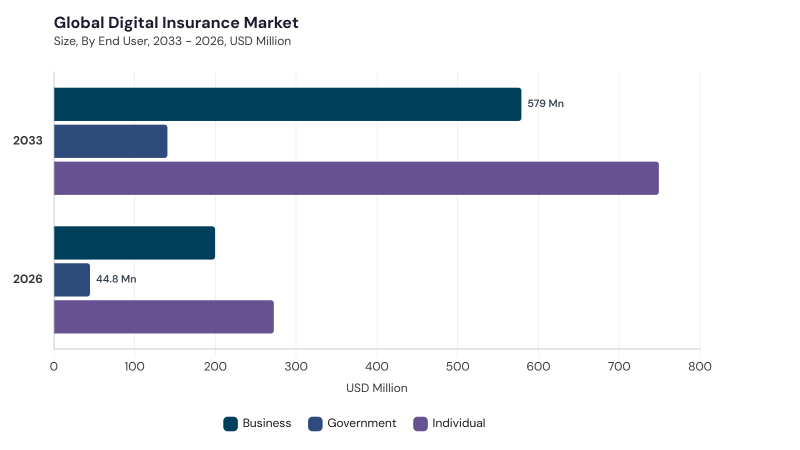
Based on End User, the market is segmented into Individual, Business, and Government. The Individual market dominated the Global Digital Insurance Market by End User in 2025, and would continue to be a dominant market till 2033; thereby, achieving a market value of USD 749.1 billion by 2033, growing at a CAGR of 15.5 % during the forecast period. The Business market is expected to witness highest CAGR of 16.4% during (2026 - 2033).
Individual users form a major demand base as consumers increasingly compare policies, purchase coverage, submit claims, make payments, and manage policies through mobile and web platforms. Business users adopt digital insurance solutions for commercial coverage, employee benefits, cyber insurance, liability protection, and enterprise risk management. Government users rely on digital insurance platforms for public insurance programs, social protection, benefit administration, fraud detection, and data-driven service delivery. Demand across all end users is influenced by digital trust, personalization, regulatory compliance, cybersecurity, and the need for faster insurance access.
Based on Insurance Type, the market is segmented into Life & Health and Other Insurance Type. The Life & Health market dominated the Global Digital Insurance Market by Insurance Type in 2025, and would continue to be a dominant market till 2033; thereby, achieving a market value of USD 783.2 billion by 2033, growing at a CAGR of 15.7 % during the forecast period. The Other Insurance Type market is expected to witness a CAGR of 16.6% during (2026 - 2033).
Life & Health remains a leading insurance category as digital enrollment, mobile policy management, automated underwriting, telehealth-linked services, wellness programs, and AI-supported risk assessment improve customer access and operating efficiency. Other Insurance Type includes property, casualty, motor, travel, cyber, commercial, and specialty insurance products that are increasingly being digitized through telematics, IoT, automated claims, embedded distribution, self-service portals, and real-time data analytics. Both categories are moving toward more personalized, usage-based, and data-driven insurance models.
Based on Enterprise Size, the market is segmented into Small & Medium Enterprises (SMEs) and Large Enterprises. The Small & Medium Enterprises (SMEs) market dominated the Global Digital Insurance Market by Enterprise Size in 2025, and would continue to be a dominant market till 2033; thereby, achieving a market value of USD 859.3 billion by 2033, growing at a CAGR of 15.7 % during the forecast period. The Large Enterprises market is expected to witness a CAGR of 16.6% during (2026 - 2033).
Small & Medium Enterprises increasingly use digital insurance channels to access affordable, scalable, and simplified coverage with lower administrative complexity. Cloud-based systems, automated underwriting, digital quotation, flexible subscription models, and easy policy management make digital insurance attractive for SME users and smaller insurers. Large Enterprises require more sophisticated insurance platforms for complex commercial risks, employee benefits, cyber exposure, compliance, multinational coverage, and integrated risk management. Their adoption is shaped by advanced analytics, API integration, data governance, cybersecurity, and customized insurance workflows.
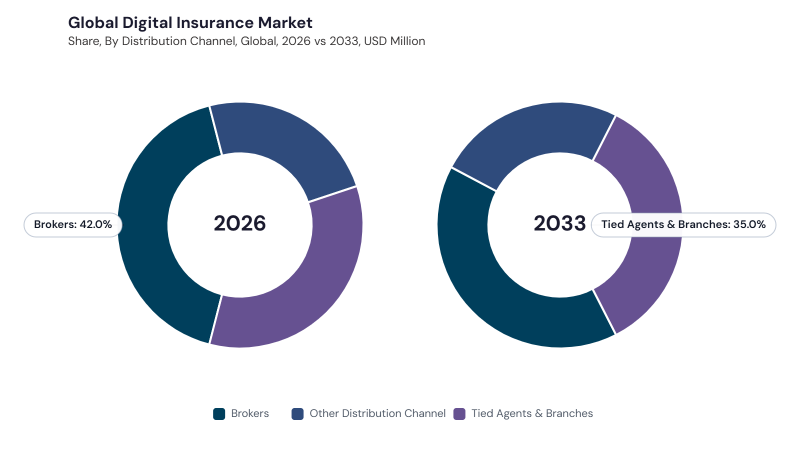
Based on Distribution Channel, the market is segmented into Brokers, Tied Agents & Branches, and Other Distribution Channel. The Brokers market dominated the Global Digital Insurance Market by Distribution Channel in 2025, and would continue to be a dominant market till 2033; thereby, achieving a market value of USD 591.6 billion by 2033, growing at a CAGR of 15.4 % during the forecast period. The Tied Agents & Branches market is expected to witness highest CAGR of 16.5% during (2026 - 2033).
Brokers remain an important channel because they combine advisory support with digital quotation, comparison, customer relationship management, documentation, and policy-servicing tools. Tied Agents & Branches continue to support customers through established insurer relationships while increasingly using digital sales, e-signature, virtual consultation, and servicing platforms. Other Distribution Channel includes direct-to-consumer platforms, embedded insurance, digital marketplaces, bancassurance, aggregators, app-based insurance, and API-led partnerships. These channels reduce friction, improve reach, and allow insurers to place coverage directly into customer purchase journeys.
Free Valuable Insights: Digital Insurance Market Size to reach $1468.6 Billion by 2033
Region-wise, the Digital Insurance Market is analyzed across North America, Europe, Asia Pacific, and LAMEA. The Europe market dominated the Global Digital Insurance Market by Region in 2025, and would continue to be a dominant market till 2033; thereby, achieving a market value of USD 521.9 billion by 2033, growing at a CAGR of 15.5 % during the forecast period. The North America market is expected to witness a CAGR of 15.7% during (2026 - 2033). Additionally, The Asia Pacific market is expected to witness a CAGR of 16.7% during (2026 - 2033).
North America remains a major market due to advanced digital insurance adoption, strong insurtech activity, mature cloud infrastructure, AI-driven underwriting, telematics-based auto insurance, and growing embedded insurance models. Europe is shaped by strict data privacy rules, digital financial-services regulation, insurtech collaboration, cyber insurance demand, and modernization of legacy insurance systems. Asia Pacific is expanding through large digital consumer ecosystems, smartphone penetration, online insurance purchasing, embedded platforms, mobile-first distribution, and strong insurtech growth across China, India, Japan, South Korea, Singapore, and Malaysia. LAMEA is developing steadily as digital financial inclusion, mobile channels, broker modernization, fintech partnerships, and cloud-based insurance platforms improve access to insurance services.
| Report Attribute | Details |
|---|---|
| Market size value in 2026 | USD 516.8 billion |
| Market size forecast in 2033 | USD 1468.6 billion |
| Base Year | 2025 |
| Historical Period | 2022 to 2024 |
| Forecast Period | 2026 to 2033 |
| Revenue Growth Rate | CAGR of 16.1% from 2026 to 2033 |
| Number of Pages | 570 |
| Tables | 810 |
| Report Coverage | Market Trends, Revenue Estimation and Forecast, Segmentation Analysis, Regional and Country Breakdown, Competitive Landscape, Market Share Analysis, Company Profiling, Companies Strategic Developments, SWOT Analysis, Product Life Cycle Analysis, Value Chain Analysis, Market Consolidation Analysis, Key Customer Criteria, Pandemic Impact Analysis, and Winning Imperatives |
| Segments Covered | Component, End User, Insurance Type, Enterprise Size, Distribution Channel, and Region |
| Country Scope |
|
| Companies Included | ZhongAn Online P&C Insurance Co., Ltd.; Root, Inc.; Go Digit General Insurance Limited; Lemonade, Inc.; Hippo Holdings Inc.; Coalition, Inc.; ERGO NEXT Insurance; Kin Insurance, Inc.; Marshmallow Technology Ltd.; ACKO General Insurance Limited |
By Component
By End User
By Insurance Type
By Enterprise Size
By Distribution Channel
By Geography
Expected to reach USD 1468.6 billion by 2033, growing at 16.1% CAGR during 2026-2033.
The Solution segment leads, projected to reach USD 1278.0 billion by 2033.
ZhongAn, Root, Go Digit, Lemonade, Hippo, Coalition, ERGO NEXT, and Kin Insurance are key players.
The Individual segment dominates, expected to reach USD 749.1 billion by 2033.
Europe leads with a market value of USD 521.9 billion by 2033.
Brokers lead, projected to achieve USD 591.6 billion by 2033.
Our team of dedicated experts can provide you with attractive expansion opportunities for your business.








 Unique Offerings