The sample copy of this report is available for access.
The North America Digital Healthcare Supply Chain Management Market would witness market growth of 7.7% CAGR during the forecast period (2026-2033) and is expected to reach USD USD 2.10 Billion by 2032.
The US market dominated the North America Digital Healthcare Supply Chain Management Market by Country in 2025, and would continue to be a dominant market till 2033; thereby, achieving a market value of USD 1.74 Billion by 2033. Canada is expected to witness a CAGR of 10.4% during the forecast period, while Mexico is expected to grow at a CAGR of 9.2%, indicating stronger growth outside the core US base even as the region remains US-led.
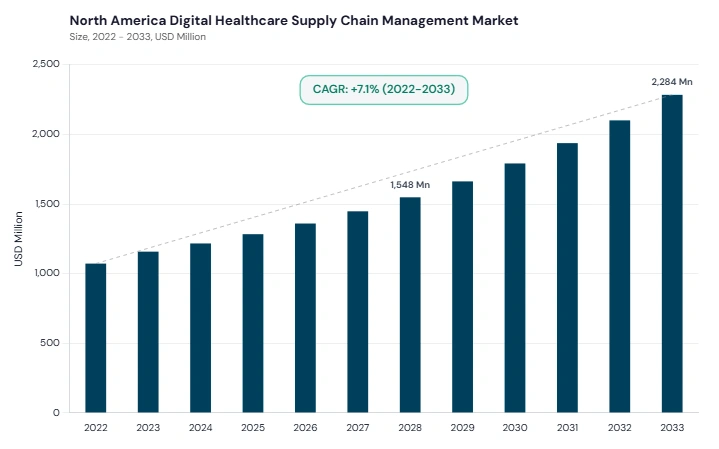
The North America market has evolved around a tightly connected network of healthcare providers, manufacturers, distributors, and digital technology vendors seeking better control over medical product flow and information visibility. What began as a push for better procurement, inventory oversight, and logistics coordination has expanded into broader digital supply chain orchestration. Regulatory accountability, resilience planning, and the need for continuity of care have made digital supply chain tools more central to healthcare operations. This has supported wider use of analytics, ERP integration, and real-time visibility platforms across the region. The result is a mature but still fast-evolving market shaped by both modernization demand and operational complexity.
AI, IoT, blockchain, and integrated ERP tools are becoming increasingly important in North American healthcare supply chains because organizations want better agility, traceability, and visibility. The region is also being shaped by telemedicine growth, personalized care models, and rising pressure to support decentralized delivery and cold-chain-sensitive products. Strategic reshoring and supplier diversification are influencing how digital systems are used to improve resilience and reduce disruption risk. At the same time, budget and compliance pressure is accelerating interest in tools that automate workflows, improve planning accuracy, and reduce waste. These dynamics are keeping the market innovation-led, compliance-aware, and strongly focused on practical operational gains.
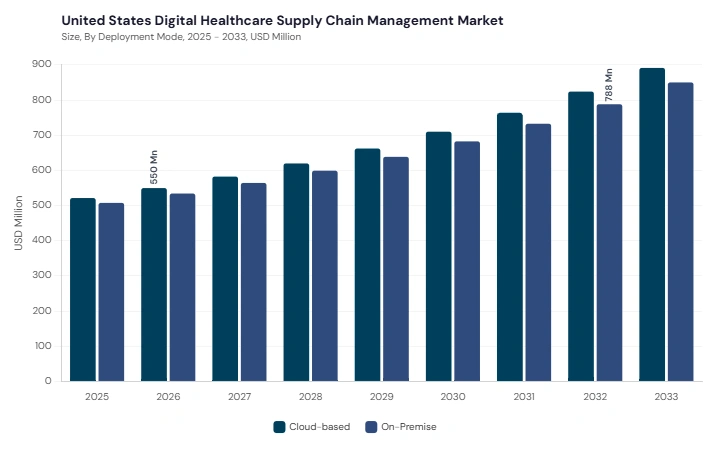
Based on Deployment, the market is segmented into Cloud-based and On-Premise. The Cloud-based market dominated the North America Digital Healthcare Supply Chain Management Market by Deployment in 2025, and would continue to be a dominant market till 2033; thereby, achieving a market value of USD 1.17 Billion by 2033, growing at a CAGR of 7.8% during the forecast period. The On-Premise market is expected to witness a CAGR of 7.5% during 2026-2033. Cloud-based deployment remains ahead because healthcare organizations increasingly need centralized visibility, easier scalability, and faster system-wide coordination across providers, suppliers, and logistics partners. Even so, On-Premise remains relevant where data control, legacy integration, and internal governance requirements are stronger.
Based on Component, the market is segmented into Software, Services, and Hardware. The Software market dominated the North America Digital Healthcare Supply Chain Management Market by Component in 2025, and would continue to be a dominant market till 2033; thereby, achieving a market value of USD 1.10 Billion by 2033, growing at a CAGR of 7.3% during the forecast period. The Hardware market is expected to witness the highest CAGR of 8.3% during 2026-2033, while Services is expected to grow at 7.9%. Software leads because it underpins analytics, planning, visibility, and workflow orchestration across complex healthcare networks. Faster hardware growth reflects rising use of sensors, scanners, RFID, and other real-time tracking infrastructure.
Based on Application, the market is segmented into Inventory Management, Demand Forecasting & Planning, Procurement & Sourcing, Logistics & Distribution Management, Track & Trace / Serialization, Cold Chain Monitoring, and Supplier Relationship Management. The Inventory Management market dominated the North America market in 2025 and is expected to reach USD 563.8 million by 2033, growing at a CAGR of 6.7% during the forecast period. The Procurement & Sourcing market is expected to witness the highest CAGR of 8.1% during 2026-2033. Inventory management remains the core application because providers need tighter stock control, reduced waste, and better availability of essential products. Faster procurement growth shows rising demand for more transparent, data-led supplier management and purchasing optimization
Based on End Use, the market is segmented into Pharmaceutical Companies, Hospitals & Healthcare Providers, Medical Device Companies, Biotechnology & Vaccine Companies, and Diagnostic Laboratories. The Pharmaceutical Companies market dominated the North America market in 2025 and is expected to reach USD 779.8 million by 2033, growing at a CAGR of 6.9% during the forecast period. The Medical Device Companies market is expected to witness the highest CAGR of 8.1% during 2026-2033, while Hospitals & Healthcare Providers is expected to grow at 7.5%. Pharmaceutical companies remain the largest users because of complex regulatory oversight, inventory sensitivity, and broad distribution demands. Faster device-sector growth reflects rising need for digitized coordination across increasingly specialized product supply chains.
Free Valuable Insights: The Global Digital Healthcare Supply Chain Management Market will hit USD 6.44 Billion billion by 2033, at a CAGR of 8.2%
The US remains the anchor market in North America because it combines the region’s broadest healthcare demand base with large pharmaceutical, medical device, and provider networks that require high levels of supply chain visibility and control. Organizations in the US are increasingly investing in connected digital systems to improve planning accuracy, reduce shortages, and strengthen traceability across critical products. Cloud platforms, AI-driven analytics, and real-time monitoring tools are gaining traction, but adoption still depends heavily on integration with established healthcare and enterprise systems. Strong compliance expectations and operational scale keep the market highly structured, while continued modernization supports durable demand for more intelligent and resilient supply chain platforms.

By Component
By Deployment Mode
By Application
By End Use
By Country
Market will grow at 7.7% CAGR during the forecast period (2026-2033).
The US dominates and will achieve a market value of USD 1.74 billion by 2033.
Cloud adoption and demand for improved inventory management across pharmaceutical companies and healthcare providers fuel expansion.
Cloud-based deployment leads the market over on-premise solutions.
Canada grows at 10.4% CAGR during 2026-2033 while Mexico expands at 9.2% CAGR.
Software dominates over services and hardware components in the regional market.
Our team of dedicated experts can provide you with attractive expansion opportunities for your business.




 Unique Offerings