The sample copy of this report is available for access.
The LAMEA Digital Healthcare Supply Chain Management Market would witness market growth of 10.1% CAGR during the forecast period (2026-2033) and would reach a market size of USD 451 Million by 2031.
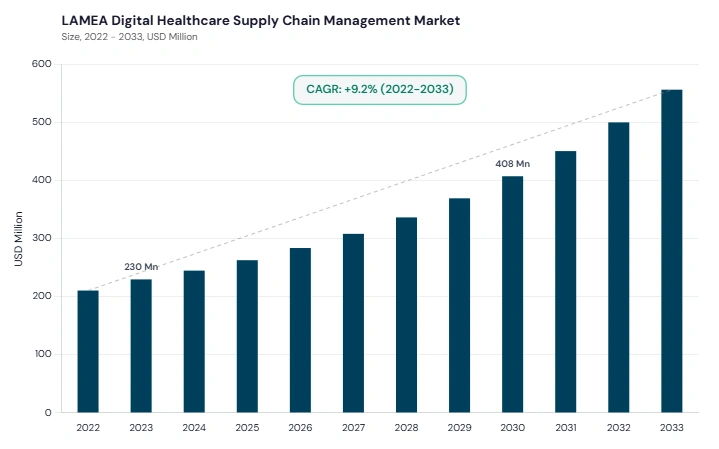
The Brazil market dominated the LAMEA Digital Healthcare Supply Chain Management Market by Country in 2025, and would continue to be a dominant market till 2033; thereby, achieving a market value of around USD 143.0 million by 2033. The LAMEA market is expected to grow from USD 263.2 million in 2025 to USD 557.1 million by 2033. Argentina is expected to witness a CAGR of about 12.0% during the forecast period, while the UAE is expected to grow at roughly 9.2%, reflecting strong growth potential across a broader set of developing healthcare markets.
The LAMEA market has emerged from a more uneven digital starting point, where healthcare supply systems across Latin America, the Middle East, and Africa often faced fragmentation, infrastructure gaps, and inconsistent visibility. Over time, pressure to improve healthcare delivery, product availability, and coordination has pushed stakeholders toward more digital tools for inventory, logistics, and procurement management. The market has gradually expanded from isolated modernization efforts into broader platform-driven supply chain improvement. Real-time monitoring, cloud systems, and analytics are becoming more relevant as organizations work to reduce inefficiency and improve resilience. This has created a market where digital healthcare supply chain management is increasingly viewed as a practical enabler of continuity and control.
LAMEA is being shaped by rising interest in AI, cloud computing, and IoT-based supply chain tools as healthcare systems look for better coordination and stronger visibility. Expanding digital infrastructure and regulatory pressure are also encouraging adoption of solutions that can improve planning, transparency, and responsiveness. Competition often depends on how well providers adapt technology to uneven operating conditions across the region, including differences in infrastructure maturity and implementation readiness. Cost efficiency and deployment practicality therefore matter just as much as feature depth. These dynamics are driving a market that is high-growth, but strongly dependent on execution and regional fit.
Based on Deployment, the market is segmented into Cloud-based and On-Premise. The Cloud-based market dominated the LAMEA Digital Healthcare Supply Chain Management Market by Deployment in 2025, and would continue to be a dominant market till 2033; thereby, achieving a market value of USD 289.5 million by 2033, growing at a CAGR of 10.2% during the forecast period. The On-Premise market is expected to witness a CAGR of 10.0% during 2026-2033. Cloud-based deployment leads because organizations increasingly prefer scalable systems with lower infrastructure burden and easier access across distributed environments. On-Premise remains relevant where control, connectivity limitations, or transition constraints still shape deployment choices.
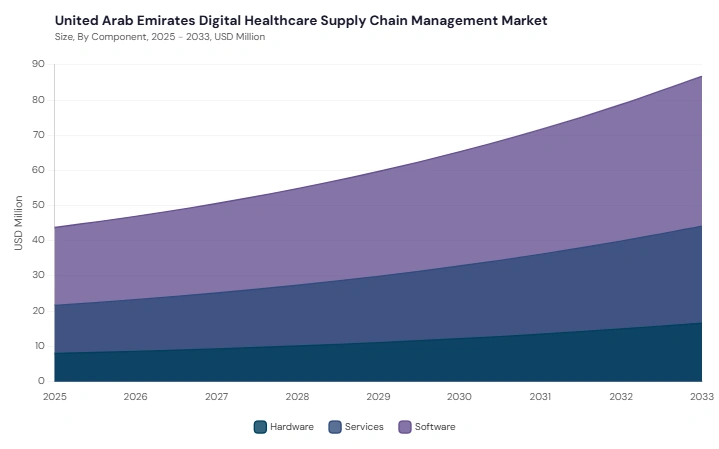
Based on Component, the market is segmented into Software, Services, and Hardware. The Software market dominated the LAMEA Digital Healthcare Supply Chain Management Market by Component in 2025, and would continue to be a dominant market till 2033; thereby, achieving a market value of USD 272.5 million by 2033, growing at a CAGR of 9.7% during the forecast period. The Hardware market is expected to witness the highest CAGR of 10.9% during 2026-2033, while Services is expected to grow at 10.3%. Software remains the lead component because it provides the core visibility, planning, and analytics required for supply modernization. Faster hardware growth reflects growing investment in connected monitoring and tracking tools needed to improve real-time control across more challenging supply environments.
Based on Application, the market is segmented into Inventory Management, Demand Forecasting & Planning, Procurement & Sourcing, Logistics & Distribution Management, Track & Trace / Serialization, Cold Chain Monitoring, and Supplier Relationship Management. The Inventory Management market dominated the LAMEA market in 2025 and is expected to reach USD 139.3 million by 2033, growing at a CAGR of 9.0% during the forecast period. The Procurement & Sourcing market is expected to witness the highest CAGR of 10.5% during 2026-2033. Inventory management leads because healthcare systems across the region need tighter stock control, better supply continuity, and lower waste. Faster procurement growth reflects rising pressure to improve sourcing discipline, supplier coordination, and purchasing transparency.
Based on End Use, the market is segmented into Pharmaceutical Companies, Hospitals & Healthcare Providers, Medical Device Companies, Biotechnology & Vaccine Companies, and Diagnostic Laboratories. The Pharmaceutical Companies market dominated the LAMEA market in 2025 and is expected to reach USD 192.7 million by 2033, growing at a CAGR of 9.3% during the forecast period. The Medical Device Companies market is expected to witness the highest CAGR of 10.5% during 2026-2033, while Hospitals & Healthcare Providers is expected to grow at 9.8%. Pharmaceutical companies remain the largest users because of the need for better traceability, distribution reliability, and regulatory support. Faster medical device growth points to rising demand for more structured, technology-enabled supply operations across specialized healthcare segments.
Free Valuable Insights: Digital Healthcare Supply Chain Management Market Size Worth USD 6.44 Billion billion by 2033
Brazil remains the leading country market in LAMEA because it combines the region’s broadest market base with increasing need for more structured and reliable healthcare supply chain operations. Organizations in the country are investing more in digital platforms that can improve inventory control, procurement coordination, and visibility across distributed healthcare settings. The market is also supported by growing demand for better traceability and stronger planning in pharmaceutical and provider networks. While infrastructure and execution challenges still matter, the direction of travel is clearly toward more connected and resilient supply chain models. That makes Brazil both the regional anchor and an important test case for wider digital healthcare supply chain adoption across LAMEA.

By Component
By Deployment Mode
By Application
By End Use
By Country
Market will grow at 10.1% CAGR during the forecast period (2026-2033).
Brazil dominated in 2025 and will remain the leader, reaching USD 143.0 million by 2033.
Argentina shows the highest growth at 12.0% CAGR during 2026-2033, while UAE grows at 9.2%.
Cloud-based deployment leads the LAMEA digital healthcare supply chain management market.
Software dominates the component segment in LAMEA digital healthcare supply chain management.
Our team of dedicated experts can provide you with attractive expansion opportunities for your business.




 Unique Offerings