The sample copy of this report is available for access.
“Global Digital Healthcare Supply Chain Management Market to reach a market value of USD 6.44 Billion by 2033 growing at a CAGR of 8.2%”
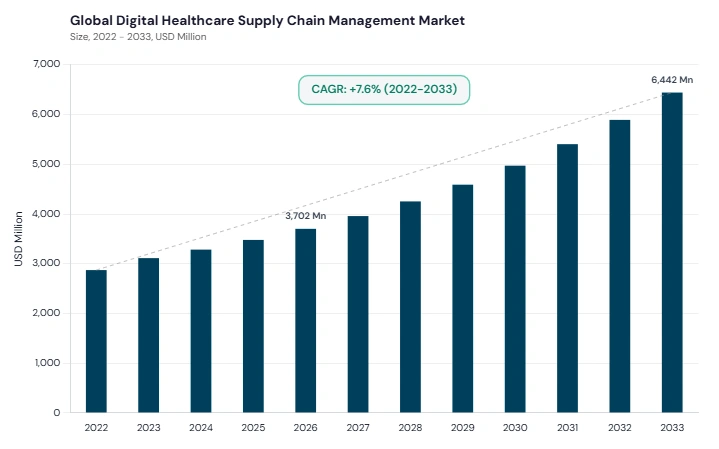
The Global Digital Healthcare Supply Chain Management Market size is expected to reach USD 6.44 Billion by 2033, rising at a market growth of 8.2% CAGR during the forecast period.
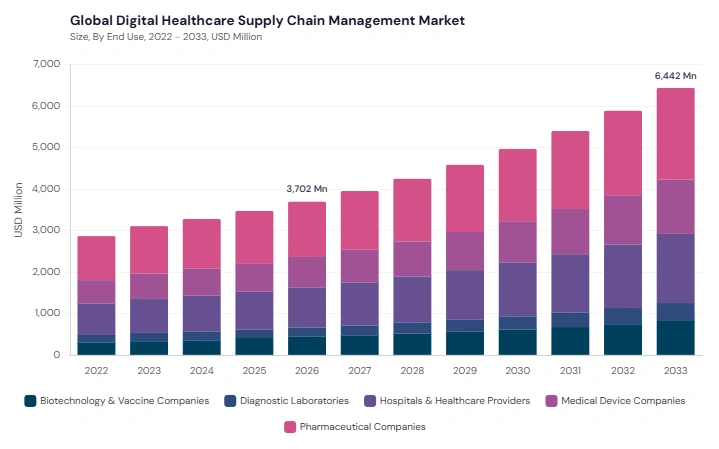
The market is gaining momentum as healthcare providers, distributors, and technology vendors push for better visibility, stronger coordination, and faster decision-making across supply chain operations. Growing use of AI, cloud platforms, automation, and data-driven planning is steadily reshaping how critical healthcare supplies are sourced, tracked, and delivered.
The digital healthcare supply chain management market has evolved from basic procurement and inventory support into a broader digital operating layer that connects manufacturers, distributors, hospitals, and healthcare providers. It now plays a central role in managing pharmaceuticals, medical devices, diagnostics, and temperature-sensitive products through more connected and transparent workflows. Adoption is expanding as healthcare systems deal with rising product complexity, stricter compliance requirements, and greater pressure to avoid shortages, delays, and waste. As a result, organizations are investing in digital platforms that improve traceability, forecasting, logistics coordination, and supply continuity across increasingly complex healthcare networks.
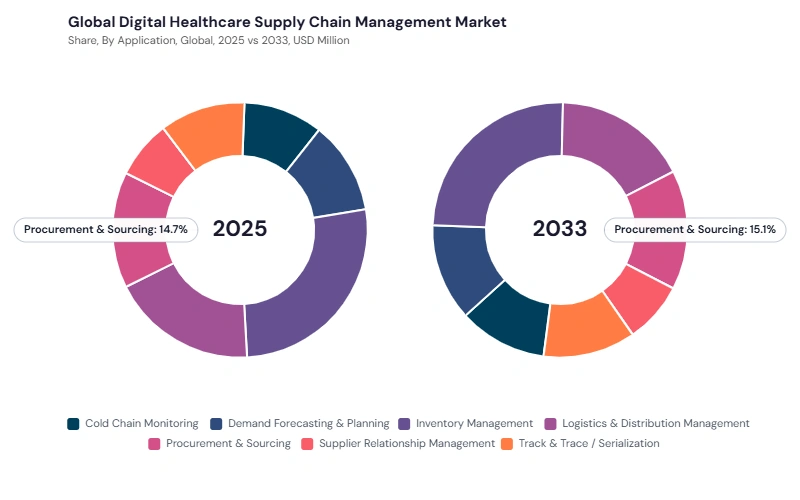
The major strategies followed by market participants are product launches, partnerships, collaborations, and cloud-led expansion initiatives. Companies are focusing on AI-enabled analytics, RFID automation, blockchain-based traceability, and broader ecosystem collaboration to improve healthcare supply visibility, compliance, and responsiveness across procurement, warehousing, and distribution activities.
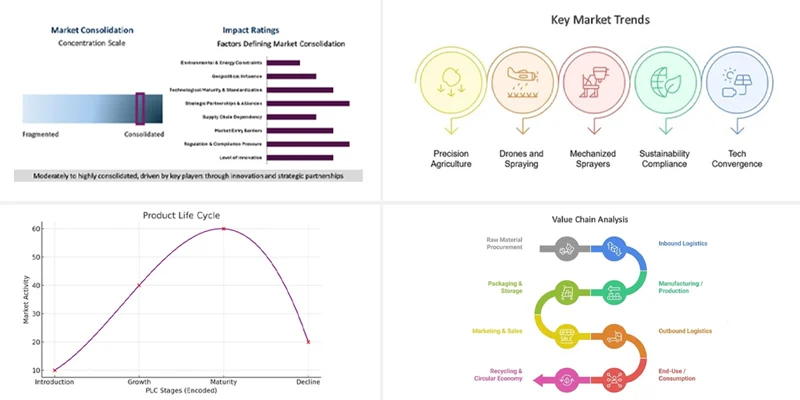

The global digital healthcare supply chain management market shows a hybrid and moderately fragmented competitive structure. The top ten companies collectively account for approximately 74.54% of market revenue, while the remaining 25.46% is held by other players. This reflects a market where established healthcare distribution leaders and enterprise technology companies both hold meaningful influence.
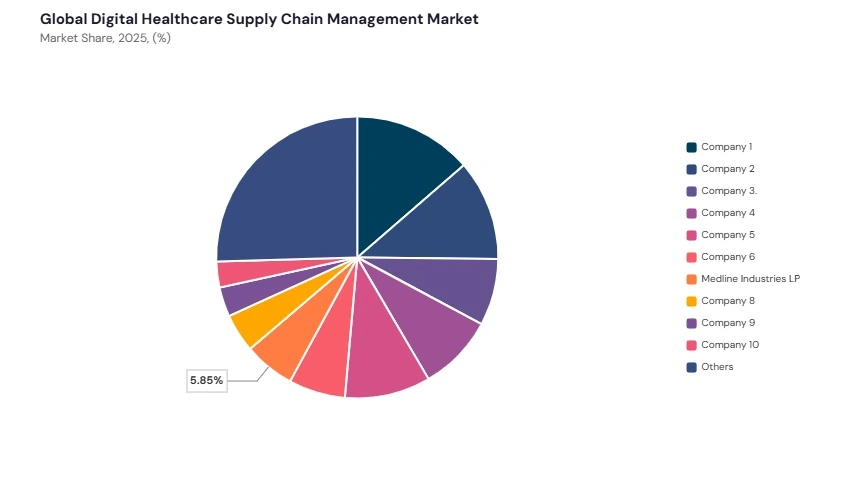
McKesson Corporation leads with about 13.64%, followed by Cardinal Health. SAP, Oracle, and IBM form a strong technology-led competitive cluster. Siemens Healthineers and Medline Industries add healthcare system and device-linked strength, while Henry Schein, Global Healthcare Exchange, and Tecsys remain important mid-tier players in procurement, inventory, and collaborative supply chain platforms. Future competitive shifts are likely to be shaped by AI adoption, cloud integration, stronger data interoperability, and tighter coordination between supply chain and clinical systems.
By deployment mode, the market is segmented into Cloud-based and On-Premise. The Cloud-based segment led the market in 2025 and is expected to retain its dominance through 2033, supported by the need for centralized visibility, faster deployment, easier scalability, and stronger coordination across distributed healthcare networks. Cloud adoption is also benefiting from growing demand for real-time access, lower infrastructure burden, and better integration across suppliers, providers, and logistics partners.
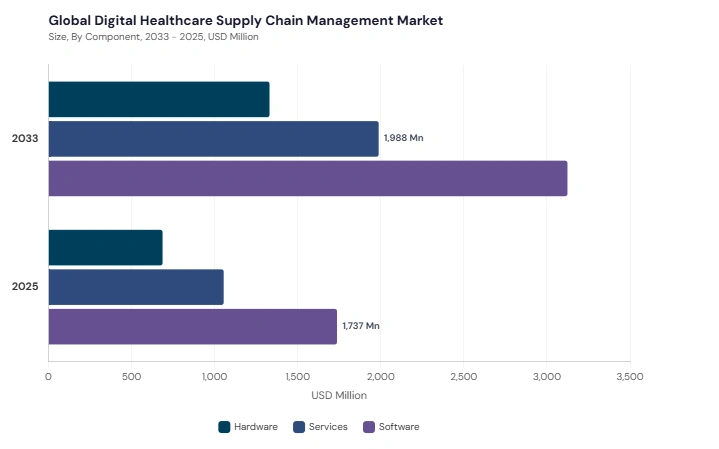
Based on component, the market is divided into Software, Services, and Hardware. Software accounted for the leading share in 2025 and is expected to remain the dominant segment through 2033 because it serves as the core layer for analytics, planning, visibility, and workflow orchestration across the healthcare supply chain. Services continue to grow as implementation and integration needs rise, while hardware demand is supported by scanners, sensors, RFID infrastructure, and other tracking-enablement tools.
By end use, the market is segmented into Pharmaceutical Companies, Hospitals & Healthcare Providers, Medical Device Companies, Biotechnology & Vaccine Companies, and Diagnostic Laboratories. Pharmaceutical Companies led the market in 2025 due to the complexity of regulated product movement, inventory sensitivity, and the need for stronger visibility across global sourcing and distribution networks. Medical Device Companies are expected to register the fastest growth, reflecting rising digitalization needs across more specialized and compliance-heavy product supply chains.
The market is moderately fragmented but highly competitive, with large healthcare distributors, enterprise software providers, and specialized digital platform vendors all shaping the landscape. Competition centers on the ability to deliver real-time visibility, predictive analytics, inventory optimization, and stronger coordination across supply chain stakeholders.
Innovation is strongly tied to AI, cloud infrastructure, automation, and blockchain-enabled transparency. Vendors are also differentiating themselves through interoperability, integration with healthcare and ERP systems, and compliance-focused digital capabilities that support secure and traceable healthcare logistics.
Regional positioning and pricing strategy also matter. Companies increasingly localize support, adapt platforms for regulatory environments, and use subscription-based or scalable cloud pricing models to serve both large healthcare networks and more resource-constrained providers.
Digital Healthcare Supply Chain Management Market Coverage:
| Report Attribute | Details |
|---|---|
| Market Size value in 2026 | USD 3.70 Billion |
| Market size forecast in 2033 | USD 6.44 Billion |
| Base Year | 2025 |
| Historical period | 2022-2024 |
| Forecast Period | 2026-2033 |
| Revenue Growth Rate | 8.2% CAGR during 2026-2033 |
| Number of Pages | 729 |
| Tables | 840 |
| Report Coverage | Market size and forecast, drivers, restraints, opportunities, challenges, trends, competition analysis, market share analysis, recent strategies, and segmentation analysis |
| Segments Covered | By Component, By Deployment Mode, By Application, By End Use, and By Region |
| Regional Scope | North America, Europe, Asia Pacific, and LAMEA |
| Country Scope | North America (US, Canada, Mexico, and Rest of North America); Europe (Germany, UK, France, Russia, Spain, Italy, and Rest of Europe); Asia Pacific (Japan, China, India, South Korea, Singapore, Malaysia, and Rest of Asia Pacific); LAMEA (Brazil, Argentina, UAE, Saudi Arabia, South Africa, Nigeria, and Rest of LAMEA) |
| Companies Included | McKesson Corporation, Cardinal Health, SAP SE, Oracle Corporation, IBM Corporation, Siemens Healthineers, Medline Industries, Henry Schein, Global Healthcare Exchange, Tecsys |
By Component
By Deployment Mode
By Application
By End Use
By Geography
Valued at USD 3.70 billion in 2026, reaching USD 6.44 billion by 2033 at 8.2% CAGR during 2026-2033.
Software segment dominates, achieving USD 3.12 billion by 2033 through automation and analytics capabilities.
North America (US, Canada, Mexico) and Europe (Germany, UK) represent the primary regional markets.
Cloud-based segment leads, projected to hit USD 3.31 billion by 2033 through scalability and remote accessibility.
AI integration, digital twin technology expansion, and automation proliferation are accelerating supply chain transformation.
Pharmaceutical companies lead at 7.5% CAGR during 2026-2033, needing efficient distribution and regulatory compliance.
Our team of dedicated experts can provide you with attractive expansion opportunities for your business.








 Unique Offerings