The sample copy of this report is available for access.
The North America DC Circuit Breaker Market is expected to reach USD 2375.8 million by 2032, growing at a CAGR of 11.3% during (2026 - 2033).
The North America DC Circuit Breaker Market evolved from conventional electrical protection devices used in industrial and renewable-energy applications into advanced solid-state, hybrid, and digitally controlled protection systems. Rising deployment of solar photovoltaic systems, battery storage, EV charging infrastructure, data centers, and DC transmission networks increased requirements for faster fault interruption and improved arc management. Advances in semiconductor technology, digital controls, sensing, and power electronics further enhanced breaker response and system reliability. The market now increasingly supports smart-grid integration, high-voltage DC networks, predictive maintenance, and complex distributed power architectures.
Renewable integration, EV infrastructure expansion, HVDC development, smart circuit breakers, and infrastructure modernization are shaping current market development. Growing solar, wind, battery storage, and high-power charging installations are increasing demand for specialized DC fault protection with rapid interruption and improved arc suppression. Digital breakers incorporating sensors, IoT connectivity, remote diagnostics, and predictive maintenance are supporting more proactive asset management. Grid resilience initiatives, high-voltage transmission investment, data-center electrification, smart microgrids, and stricter safety requirements are also encouraging development of more responsive, modular, efficient, and digitally integrated circuit protection technologies.
Based on Type, the market is segmented into Solid State and Hybrid. The Solid State market dominated the North America DC Circuit Breaker Market by Type in 2025, and would continue to be a dominant market till 2033; thereby, achieving a market value of USD 1309.5 million by 2032, growing at a CAGR of 10.8 % during the forecast period. The Hybrid market is expected to witness a CAGR of 11.9% during (2026 - 2033).
Solid State circuit breakers use semiconductor technology to provide extremely rapid and precise fault interruption without mechanical switching components, supporting EV charging, microgrids, energy storage, and digitally controlled power networks. Their advantages include faster response, lower mechanical wear, and easier integration with monitoring and automation systems, although higher cost and system-integration complexity remain considerations. Hybrid circuit breakers combine mechanical isolation with semiconductor switching to balance interruption speed, conduction efficiency, reliability, and cost. Their suitability for medium- and high-voltage DC systems makes them relevant for renewable energy integration, industrial power distribution, and advanced transmission applications.
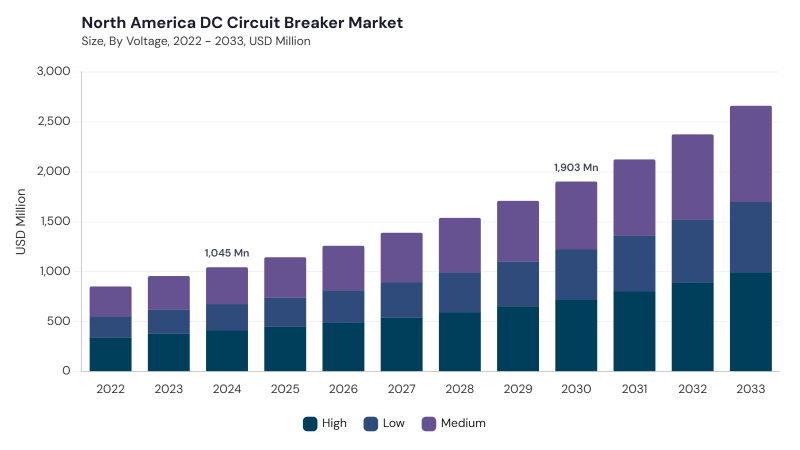
Based on Voltage, the market is segmented into High, Medium, and Low. The High market dominated the North America DC Circuit Breaker Market by Voltage in 2025, and would continue to be a dominant market till 2033; thereby, achieving a market value of USD 891.0 million by 2032, growing at a CAGR of 10.6 % during the forecast period. The Medium market is expected to witness a CAGR of 11.6% during (2026 - 2033). The Low market is expected to witness a CAGR of 11.8% during (2026 - 2033).
High-voltage DC circuit breakers support HVDC transmission and large-scale interconnections requiring ultra-fast fault detection, high interrupting capacity, and sophisticated insulation and cooling systems. Medium-voltage breakers serve industrial facilities, data centers, battery energy storage systems, microgrids, renewable installations, and utility networks requiring robust fault isolation and advanced control. Low-voltage breakers protect building-level energy storage, telecommunications equipment, solar systems, EV charging installations, and localized DC networks. Across all voltage classes, evolving power electronics, digital monitoring, arc-control technologies, and stricter safety requirements are improving breaker performance and application flexibility.
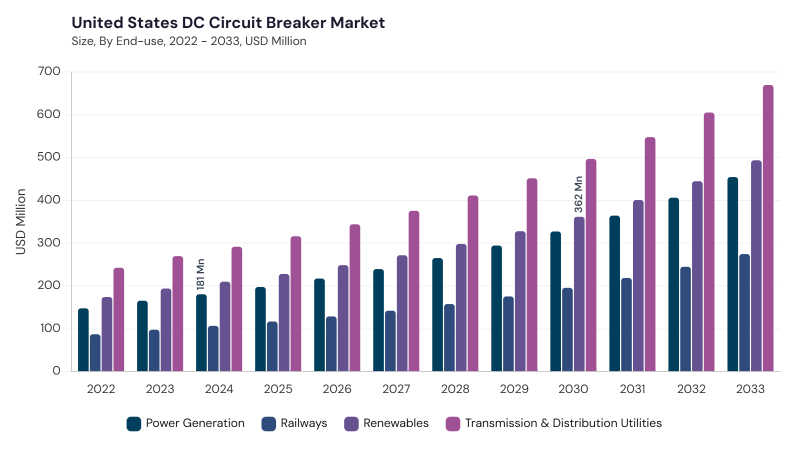
Based on End-use, the market is segmented into Transmission & Distribution Utilities, Renewables, Power Generation, and Railways. Transmission & Distribution Utilities use DC breakers for HVDC lines, substations, grid reinforcement, fault isolation, and integration of distributed energy resources, with reliability and rapid interruption remaining critical requirements.
Renewables relies on specialized DC protection for solar PV arrays, battery storage, inverter-based systems, and bidirectional power flows, where arc-fault management and smart monitoring improve safety. Power Generation uses DC breakers across control circuits, busbars, auxiliary systems, storage-linked facilities, and modernized plant networks. Railways applies high-durability DC protection to traction systems, overhead lines, third rails, and onboard electrical systems, supported by transit electrification and modernization initiatives.
Based on Insulation, the market is segmented into Vacuum and Gas. Vacuum-insulated DC circuit breakers provide rapid arc extinction, limited contact wear, compact installation, and environmentally favorable operation, making them relevant for renewable energy, data centers, battery storage, and medium-voltage applications. Their adoption is strengthened by sustainability considerations and demand for long-life, low-maintenance equipment.
Gas-insulated breakers provide strong dielectric and arc-quenching capabilities for high-voltage and high-capacity systems, including utility substations and specialized infrastructure. However, environmental concerns related to conventional insulating gases are encouraging reduced gas volumes, sealed designs, and development of alternative insulation technologies while preserving high-voltage performance.
Free Valuable Insights: The Global DC Circuit Breaker Market will hit USD 10.6 Billion billion by 2033, at a CAGR of 11.5%
Based on Country, the market is segmented into US, Canada, Mexico, and Rest of North America. The US market dominated the North America DC Circuit Breaker Market by Country in 2025, and would continue to be a dominant market till 2033; thereby, achieving a market value of USD 1701.2 million by 2032, growing at a CAGR of 10.5 % during the forecast period. The Canada market is expected to witness a CAGR of 13.2% during (2026 - 2033). Additionally, The Mexico market is expected to witness a CAGR of 12.6% during (2026 - 2033).
Across North America, DC circuit breaker adoption is being shaped by renewable energy deployment, smart-grid modernization, electric mobility, digital protection, and higher-voltage DC infrastructure. The US emphasizes smart-grid integration, solid-state and hybrid technologies, renewable and battery-storage protection, EV charging, and compliance-focused product innovation, while Canada focuses on smart breakers, renewable integration, advanced arc management, simulation-led design, and precise DC system protection. Mexico is advancing renewable energy installations, data-center infrastructure, predictive maintenance, smart circuit breakers, localization, and grid modernization, whereas Rest of North America continues to develop solid-state and hybrid breakers, smart monitoring, modular designs, energy-storage protection, renewable integration, and compact DC solutions suited to evolving infrastructure requirements.

By Type
By Voltage
By End-use
By Insulation
By Country
Set to reach $2375.8 Million by 2032, growing at 11.3% CAGR during 2026-2033.
The US leads with $1701.2 million by 2032, growing at a 10.5% CAGR during 2026-2033.
Solid State segment dominates, reaching $1309.5 million by 2032 with a 10.8% CAGR during 2026-2033.
Hybrid segment is expected to witness a CAGR of 11.9% during 2026-2033.
The Canada market is expected to witness a CAGR of 13.2% during 2026-2033.
High Voltage segment achieves $891.0 million by 2032, growing at a 10.6% CAGR during 2026-2033.
Our team of dedicated experts can provide you with attractive expansion opportunities for your business.




 Unique Offerings