The sample copy of this report is available for access.
“Global DC Circuit Breaker Market to reach a market value of USD 10,603.33 Million by 2033 growing at a CAGR of 11.5%”
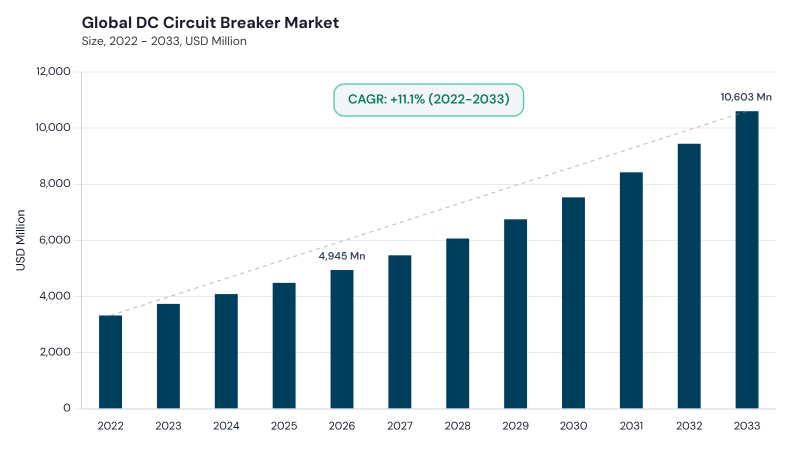
The Global DC Circuit Breaker Market is expected to reach USD 10.6 billion by 2033, growing at a CAGR of 11.5% during (2026 - 2033).
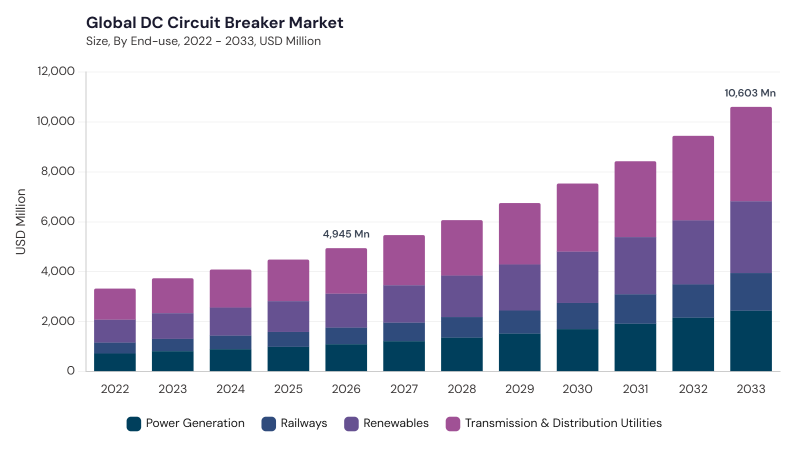
DC circuit breaker market is witnessing expansion because of growing deployment of battery storage, renewable energy systems, HVDC transmission, EV charging infrastructure, DC microgrids, industrial DC power networks, and data centers. The need for overload protection, faster fault isolation, and safer uninterrupted power delivery is encouraging adoption of hybrid, solid-state, smart, compact, and high-voltage protection systems. DC circuit breaker market emerged with early direct current distribution systems using mechanical breakers to protect low-voltage circuits. Thermal devices and fuses evolved into vacuum interrupters, molded case breakers, and higher-capacity switching systems. Semiconductor-based solid-state breakers marked a major shift by allowing faster interruption with reduced arc energy and lower wear.
Growing demand for high-power DC protection is supporting the market growth as battery storage, renewable energy systems, rail traction, data centers, EV fast charging, industrial DC grids, and HVDC transmission require dependable and fast interruption of DC fault currents. Market growth is driven by digital diagnostics, smart monitoring, bidirectional current management, predictive maintenance, and surged adoption of hybrid and solid-state protection technologies.
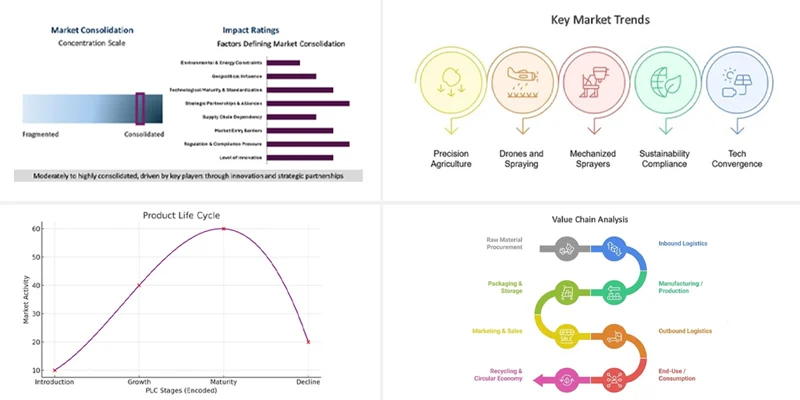
Market competition is technology-intensive and moderately fragmented with industrial automation companies, electrical equipment manufacturers, circuit protection specialists, and regional DC breaker suppliers competing across applications and voltage classes. Market players are positioning themselves ahead through current rating, interruption speed, product reliability, safety certification, compact design, cost efficiency, digital monitoring, and smart-grid integration. Market competition relies on energy-storage capabilities, renewable-energy exposure, higher-voltage DC protection, EV infrastructure participation, regional service support, and hybrid breaker commercialization.

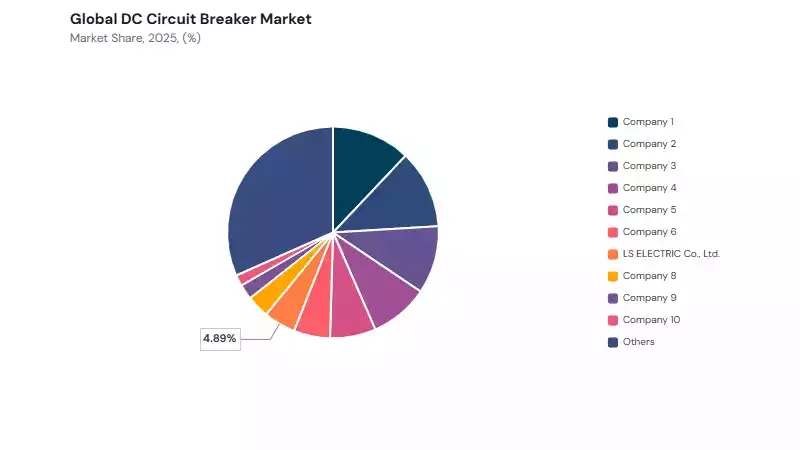
DC circuit breaker market is experiencing competitive landscape driven by market players including Eaton Corporation plc, Schneider Electric SE, and ABB Ltd. These players maintain strong positions because of global distribution networks, electrical protection portfolios, data-center infrastructure capabilities, renewable energy exposure, and well-established utility and industrial customer relationships. LS ELECTRIC, Fuji Electric, Mitsubishi Electric, Reunert, and Terasaki strengthens the competitive landscape through railways, regional strength, industrial expertise, specialized DC protection solutions, and renewable energy.
Based on Type, the market is segmented into Solid State and Hybrid. The Solid State market dominated the Global DC Circuit Breaker Market by Type in 2025, and would continue to be a dominant market till 2033; thereby, achieving a market value of USD 5.8 billion by 2033, growing at a CAGR of 11 % during the forecast period. The Hybrid market is expected to witness a CAGR of 12.1% during (2026 - 2033).
Solid State leads the market due to rapid switching capability, contactless interruption, reduced mechanical wear, improved reliability, and suitability for advanced DC power systems. These breakers are increasingly relevant across renewable energy, EV charging, data centers, microgrids, and high-power electronic architectures where fast fault isolation is required. Hybrid breakers also remain important because they combine semiconductor switching with mechanical isolation, offering a balance between response speed, operational efficiency, durability, and cost. This makes hybrid designs attractive for medium- and high-voltage DC systems where both performance and lifecycle efficiency matter.
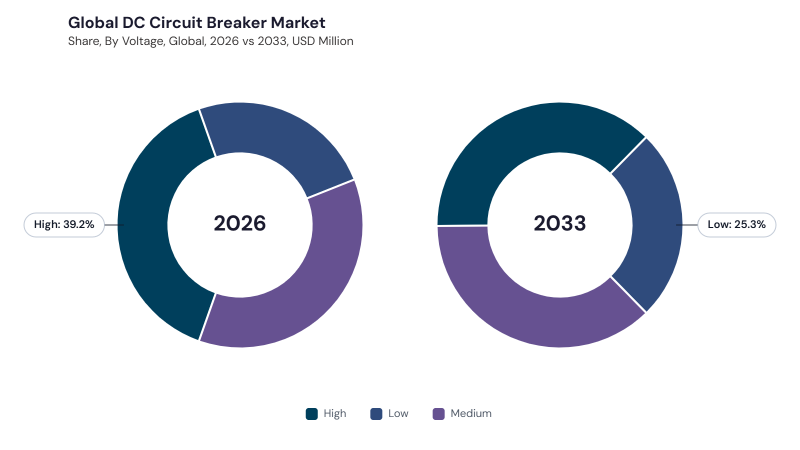
Based on Voltage, the market is segmented into High, Medium, and Low. The High market dominated the Global DC Circuit Breaker Market by Voltage in 2025, and would continue to be a dominant market till 2033; thereby, achieving a market value of USD 3.9 billion by 2033, growing at a CAGR of 10.8 % during the forecast period. The Medium market is expected to witness a CAGR of 11.9% during (2026 - 2033). The Low market is expected to witness a CAGR of 12.1% during (2026 - 2033).
High voltage dominates the market due to increasing investment in HVDC transmission, long-distance power transfer, grid interconnection, large-scale renewable evacuation, and power infrastructure modernization. Medium voltage demand is supported by renewable energy farms, industrial power networks, transportation systems, microgrids, and distribution infrastructure requiring reliable DC fault interruption. Low voltage applications remain important across battery storage, distributed energy systems, telecommunications equipment, building-level DC systems, EV charging equipment, and localized DC networks. Increasing electrification is stimulating innovation across all voltage classes.
Based on End-use, the market is segmented into Transmission & Distribution Utilities, Renewables, Power Generation, and Railways. The Transmission & Distribution Utilities market dominated the Global DC Circuit Breaker Market by End-use in 2025, and would continue to be a dominant market till 2033; thereby, achieving a market value of USD 3.7 billion by 2033, growing at a CAGR of 11 % during the forecast period. The Renewables market is expected to witness a CAGR of 11.3% during (2026 - 2033). Additionally, The Power Generation market is expected to witness highest CAGR of 12.1% during (2026 - 2033).
Transmission & Distribution Utilities dominate the market due to grid modernization, DC transmission expansion, reliability improvement, and the need for dependable protection in large-scale electrical infrastructure. Renewables represent a major growth area as solar, wind, and battery energy storage systems require specialized DC switching, bidirectional current management, arc fault protection, and safe disconnection. Power Generation uses DC circuit breakers for protection across generation-side equipment, auxiliary systems, and storage-linked facilities. Railways remain an important niche, supported by traction power networks, metro expansion, railway electrification, and modernization of DC rail infrastructure.
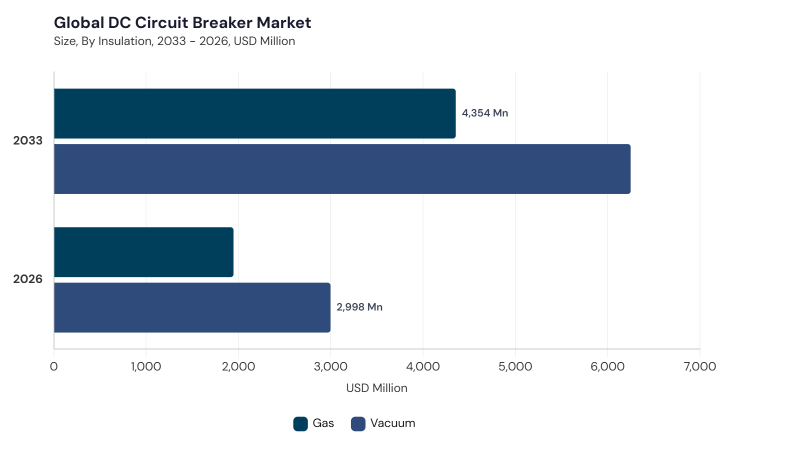
Based on Insulation, the market is segmented into Vacuum and Gas. The Vacuum market dominated the Global DC Circuit Breaker Market by Insulation in 2025, and would continue to be a dominant market till 2033; thereby, achieving a market value of USD 6.2 billion by 2033, growing at a CAGR of 11.1 % during the forecast period. The Gas market is expected to witness a CAGR of 12.2% during (2026 - 2033).
Vacuum insulation leads the market because it offers strong dielectric performance, efficient arc interruption, lower maintenance requirements, operational durability, and reduced dependence on high-impact insulating gases. It is widely relevant across medium-voltage DC systems, renewable installations, industrial infrastructure, energy storage, railways, and data-center protection. Gas insulation remains significant in high-voltage and specialized equipment where dielectric strength, compact design, and proven arc-quenching performance are important. However, environmental concerns around conventional insulating gases are encouraging product development around vacuum interruption and alternative gas technologies.
Free Valuable Insights: DC Circuit Breaker Market Size to reach $10.6 Billion by 2033
Region-wise, the DC Circuit Breaker Market is analyzed across North America, Europe, Asia Pacific, and LAMEA. In 2025, the Asia Pacific region witnessed the largest share in the DC circuit breaker market and is estimated to remain at same position till 2033, by gathering a market value of USD 4.4 billion, expanding at a CAGR of 11.9%. The Europe market is predicted to expand at a CAGR of 10.7% during 2026-2033. Moreover, the North America region is predicted to grow at a CAGR of 11.3% during the forecast period.
APAC led the market because of renewable energy integration, expanding electricity networks, data center investments, industrial electrification, and transmission infrastructure development. Europe is driven by renewable power deployment, grid modernization, offshore wind integration, railway electrification, and accelerating preference for lower-impact electrical technologies. North America region is developing in leu of aging grid upgrades, battery energy storage, renewable generation expansion, grid resilience programs, and EV charging networks. Moreover, LAMEA market is expanding with support of renewable projects, electricity infrastructure developments, transmission upgrades, and modernization of utility networks.
| Report Attribute | Details |
|---|---|
| Market size value in 2026 | USD 4.9 billion |
| Market size forecast in 2033 | USD 10.6 billion |
| Base Year | 2025 |
| Historical Period | 2022 to 2024 |
| Forecast Period | 2026 to 2033 |
| Revenue Growth Rate | CAGR of 11.5% from 2026 to 2033 |
| Number of Pages | 592 |
| Tables | 690 |
| Report Coverage | Market Trends, Revenue Estimation and Forecast, Segmentation Analysis, Regional and Country Breakdown, Competitive Landscape, Market Share Analysis, Company Profiling, Companies Strategic Developments, SWOT Analysis, Product Life Cycle Analysis, Value Chain Analysis, Market Consolidation Analysis, Key Customer Criteria, Pandemic Impact Analysis, and Winning Imperatives |
| Segments Covered | Type, Voltage, End-use, Insulation, Region |
| Country Scope |
|
| Companies Included | Schneider Electric SE, ABB Ltd., Eaton Corporation plc, CHINT Group Co., Ltd., Siemens AG, Mitsubishi Electric Corporation, LS ELECTRIC Co., Ltd., Fuji Electric Co., Ltd., Terasaki Electric Co., Ltd., and Reunert Limited |
By Type
By Voltage
By End-use
By Insulation
By Geography
The market is expected to reach USD 10.6 billion by 2033, growing at 11.5% CAGR during 2026-2033.
Solid State segment leads, projected to hit USD 5.8 billion by 2033.
Schneider Electric SE, ABB Ltd., Eaton Corporation plc, and CHINT Group Co., Ltd. are key players.
Asia Pacific leads with a market value of USD 4.4 billion by 2033.
Advanced safety needs and demand from renewable energy and electric mobility sectors drive growth.
Vacuum segment leads, projected to reach USD 6.2 billion by 2033.
Our team of dedicated experts can provide you with attractive expansion opportunities for your business.








 Unique Offerings