The sample copy of this report is available for access.
The Europe DC Circuit Breaker Market is expected to reach USD 2695.4 million by 2031, growing at a CAGR of 10.7% during (2026 - 2033).
The Europe DC Circuit Breaker Market evolved from mechanically operated protection devices adapted from AC systems into advanced solid-state, hybrid, vacuum, and digitally enabled DC protection technologies. Increasing deployment of photovoltaic systems, battery energy storage, EV infrastructure, data centers, and HVDC networks expanded the need for faster and more reliable DC fault interruption. Power electronics and semiconductor technologies further improved response speed, control precision, and system integration. The market now supports Europe’s broader energy transition through sophisticated protection solutions designed for renewable integration, cross-border transmission, decentralized power networks, and digitally managed electrical infrastructure.
Digital monitoring, renewable integration, HVDC expansion, modular breaker architectures, and environmental compliance are shaping current market development. Sensor-equipped breakers increasingly support real-time condition monitoring, predictive maintenance, and remote diagnostics, while solid-state and hybrid technologies improve rapid fault isolation across increasingly complex DC grids. Offshore wind connections, EV charging networks, battery storage, microgrids, and distributed generation are expanding demand for scalable and high-performance protection. Regulatory pressure to reduce environmental impact is also strengthening adoption of vacuum and SF6-free alternatives, encouraging manufacturers to prioritize sustainability alongside safety, interoperability, and operational reliability.
Based on Type, the market is segmented into Solid State and Hybrid. The Solid State market dominated the Europe DC Circuit Breaker Market by Type in 2025, and would continue to be a dominant market till 2033; thereby, achieving a market value of USD 1212.4 million by 2031, growing at a CAGR of 10.3 % during the forecast period. The Hybrid market is expected to witness a CAGR of 11.4% during (2026 - 2033).
Solid State circuit breakers use semiconductor devices to interrupt DC faults electronically without moving parts, enabling extremely fast response, reduced mechanical wear, and precise control within renewable energy systems, EV charging networks, and modern DC grids. Advances in silicon carbide and gallium nitride technologies are improving efficiency and thermal performance while supporting gas-free operation. Hybrid circuit breakers combine semiconductor switching with mechanical isolation to balance interruption speed, durability, energy efficiency, and cost. Their suitability for HVDC transmission, submarine interconnectors, renewable integration, and multi-terminal DC grids supports their role as a practical bridge between conventional and fully electronic protection technologies.
Based on Voltage, the market is segmented into High, Medium, and Low. The High market dominated the Europe DC Circuit Breaker Market by Voltage in 2025, and would continue to be a dominant market till 2033; thereby, achieving a market value of USD 826.7 million by 2031, growing at a CAGR of 10 % during the forecast period. The Medium market is expected to witness a CAGR of 11.1% during (2026 - 2033). The Low market is expected to witness a CAGR of 11.3% during (2026 - 2033).
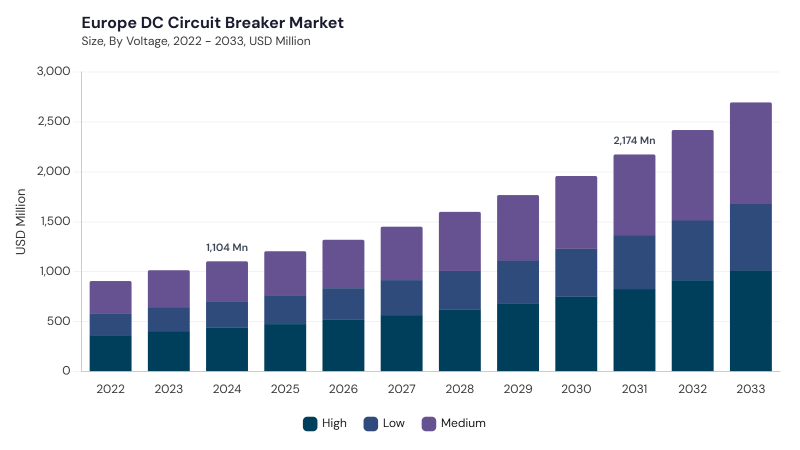
High-voltage DC breakers support HVDC interconnectors, offshore wind transmission, multi-terminal grids, and large-scale cross-border electricity networks requiring rapid interruption of substantial fault currents. Medium-voltage breakers serve industrial systems, renewable clusters, battery storage, microgrids, and EV-related infrastructure where adaptable protection and fast response are important. Low-voltage breakers protect residential solar systems, telecommunications equipment, building-level DC networks, data centers, IoT devices, and localized energy systems. Across these voltage classes, advances in digital monitoring, arc suppression, power electronics, and modular system design are improving reliability and integration flexibility.
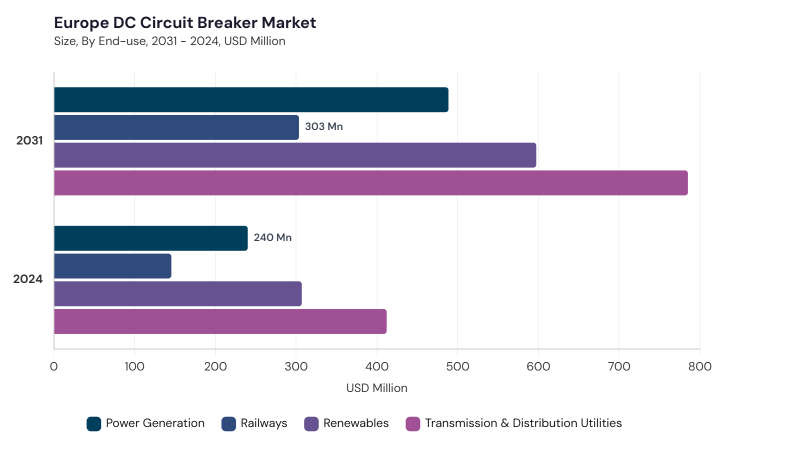
Based on End-use, the market is segmented into Transmission & Distribution Utilities, Renewables, Power Generation, and Railways. Transmission & Distribution Utilities use DC breakers across substations, HVDC links, distribution nodes, and grid interconnectors to support fault isolation, network resilience, and cross-border power exchange. Renewables relies on specialized DC protection for solar farms, wind converter systems, battery energy storage, and bidirectional power flows, where rapid interruption and advanced arc management are essential.
Power Generation applies DC breakers to generators, excitation systems, DC busbars, auxiliary networks, and modernized plant configurations requiring high operational continuity. Railways uses specialized breakers across traction substations, overhead systems, and onboard equipment, supported by electrification, metro modernization, regenerative braking, and European low-emission transport initiatives.
Based on Insulation, the market is segmented into Vacuum and Gas. Vacuum-insulated DC circuit breakers provide rapid arc extinction, high dielectric strength, compact installation, reduced maintenance, and gas-free operation, supporting medium- and high-voltage applications across renewable integration, urban substations, industrial systems, and offshore infrastructure. Their environmental profile aligns strongly with Europe’s sustainability objectives and growing preference for SF6-free equipment.
Gas-insulated breakers remain relevant in high- and ultra-high-voltage systems where strong dielectric and arc-quenching performance are required, particularly in established HVDC infrastructure and space-constrained installations. However, tightening environmental requirements are driving development of lower-GWP gases, reduced gas volumes, and alternative insulation technologies.
Free Valuable Insights: The Worldwide DC Circuit Breaker Market is projected to reach USD 10.6 Billion billion by 2033, at a CAGR of 11.5%
Based on Country, the market is segmented into Germany, UK, France, Russia, Spain, Italy, and Rest of Europe. The Germany market dominated the Europe DC Circuit Breaker Market by Country in 2025, and would continue to be a dominant market till 2033; thereby, achieving a market value of USD 461.1 million by 2031, growing at a CAGR of 9.3 % during the forecast period. The UK market is expected to witness a CAGR of 9.6% during (2026 - 2033). Additionally, The France market is expected to witness a CAGR of 11.5% during (2026 - 2033).
Across Europe, DC circuit breaker adoption is being shaped by renewable integration, HVDC development, smart-grid digitalization, EV infrastructure, environmental compliance, and advanced fault-interruption technologies. Germany emphasizes smart breakers, vacuum technologies, semiconductor-based protection, predictive maintenance, and renewable-grid integration, while the UK focuses on EV charging, digital monitoring, sustainable insulation, grid resilience, and replacement of SF6-based equipment. France is advancing semiconductor-based interruption, medium- and high-voltage DC networks, smart protection, offshore wind integration, and digital diagnostics, whereas Russia emphasizes smart breakers, HVDC applications, localized designs, environmental robustness, and industrial grid modernization. Spain focuses on solar integration, IoT-enabled breakers, smart-grid functionality, localized manufacturing, and stricter safety compliance, while Italy emphasizes solid-state technologies, predictive maintenance, semiconductor innovation, EV charging, and intelligent energy-management integration. Rest of Europe continues to develop SF6-free breakers, offshore wind protection, HVDC interconnection, smart monitoring, hybrid technologies, and environmentally sustainable DC protection architectures.

By Type
By Voltage
By End-use
By Insulation
By Country
Set to reach $2695.4 Million by 2031, growing at 10.7% CAGR during 2026-2033.
Germany leads with $461.1 million by 2031, growing at a CAGR of 9.3% during 2026-2033.
Rising demand for solid state circuit breakers, reaching $1212.4 million by 2031 at 10.3% CAGR during 2026-2033.
High voltage segment reaches $826.7 million by 2031, growing at a 10% CAGR during 2026-2033.
The UK market is expected to witness a CAGR of 9.6% during 2026-2033.
The hybrid segment is expected to witness a CAGR of 11.4% during 2026-2033.
Our team of dedicated experts can provide you with attractive expansion opportunities for your business.




 Unique Offerings