The North America Data Center Access Control Market is expected to reach USD 1.1 Billion by 2032, growing at a CAGR of 9.6% during (2026 – 2033).
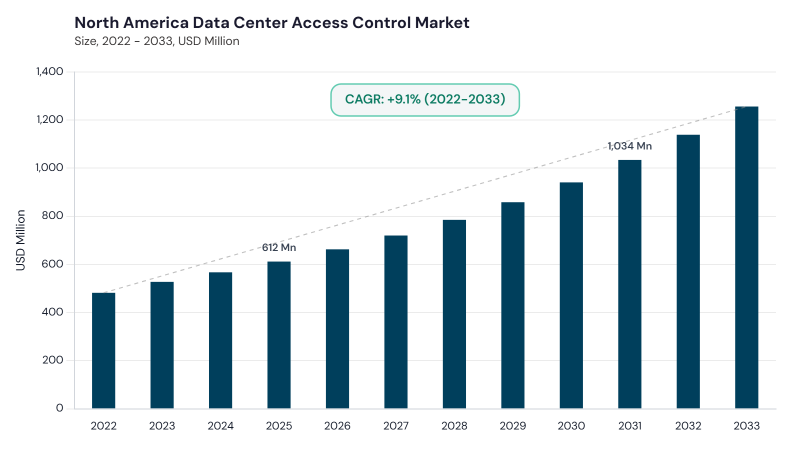
The North America Data Center Access Control Market has evolved from basic physical security methods into a highly integrated security ecosystem designed to protect mission-critical digital infrastructure. In the early stage, data centers relied on mechanical locks, guards, visitor logs, and basic card-based entry systems to restrict unauthorized access. As enterprise computing, colocation facilities, cloud platforms, and hyperscale infrastructure expanded, these conventional systems became insufficient for managing complex security risks. The market gradually shifted toward electronic access cards, biometric authentication, centralized access management, real-time monitoring, video integration, and role-based access controls.
The market is currently shaped by hyperscale data center expansion, rising cyber-physical threats, stricter compliance expectations, AI-enabled security analytics, biometric adoption, and the convergence of physical and cybersecurity systems. Data center operators require access control systems that can manage employees, visitors, vendors, maintenance teams, and tenants across multiple security zones without interrupting uptime. Demand is increasing for multi-factor authentication, mobile credentials, biometric readers, AI-based anomaly detection, audit-ready access logs, and interoperable platforms that connect with surveillance, identity management, intrusion detection, and building automation systems.
Based on Component, the market is segmented into Hardware, Software, and Services. The Hardware market dominated the North America Data Center Access Control Market by Component in 2025, and would continue to be a dominant market till 2033; thereby, achieving a market value of USD 606.5 Million by 2032, growing at a CAGR of 9.2 % during the forecast period. The Software market is expected to witness a CAGR of 9.9% during (2026 - 2033). The Services market is expected to witness a CAGR of 10.1% during (2026 - 2033).
Hardware holds the leading position as data centers require physical access devices such as biometric scanners, card readers, electronic locks, turnstiles, access panels, security cameras, sensors, and perimeter control equipment. These components form the first operational layer for restricting entry into data center campuses, server rooms, cages, cabinets, and critical zones. Software is gaining strong importance because operators need centralized platforms for identity verification, access authorization, real-time monitoring, visitor management, reporting, and audit trail generation. Software also supports integration with broader security systems, identity management platforms, and facility management tools. Services are essential for consulting, system design, installation, integration, maintenance, managed access control, upgrades, and compliance support, especially as data center security systems become more advanced and interconnected.
Based on Application, the market is segmented into Facility Entry Control, Critical Room Security, Perimeter Security, and Rack & Cabinet-Level Security. The Facility Entry Control market dominated the North America Data Center Access Control Market by Application in 2025, and would continue to be a dominant market till 2033; thereby, achieving a market value of USD 341.4 Million by 2032, growing at a CAGR of 8.7 % during the forecast period. The Critical Room Security market is expected to witness a CAGR of 9.8% during (2026 - 2033). The Rack & Cabinet-Level Security market is expected to witness a CAGR of 10% during (2026 - 2033).
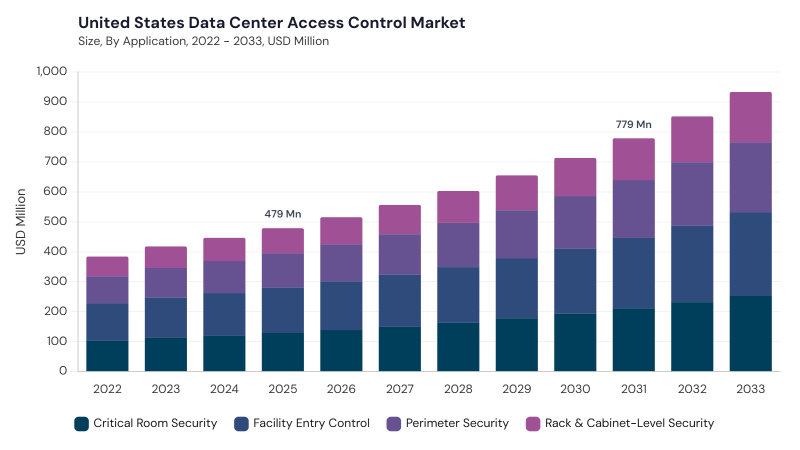
Facility Entry Control leads the market as it acts as the first security checkpoint for managing access to data center premises, main entrances, reception zones, loading areas, and controlled internal pathways. These systems commonly use smart cards, biometric verification, visitor authentication, and multi-factor access processes to prevent unauthorized entry. Critical Room Security is important for protecting server rooms, network vaults, power distribution areas, and highly sensitive operational spaces where access must be tightly restricted. Perimeter Security protects the external boundary of data center facilities through fences, gates, surveillance, motion detection, and integrated alerts. Rack & Cabinet-Level Security is becoming more important in colocation and multi-tenant data centers where access must be controlled at a granular level to protect individual equipment, customer racks, and sensitive hardware from tampering or unauthorized handling.
Based on Data Center, the market is segmented into Hyperscale Data Centers, Colocation Data Centers, Enterprise Data Centers, and HPC & Edge Data Centers. Hyperscale Data Centers hold the dominant position because large cloud providers and internet-scale operators require advanced, automated, and highly scalable access control systems to protect large facilities with high personnel movement and critical workloads. These facilities use biometric authentication, multi-factor access, AI-based monitoring, centralized control platforms, and layered physical security to manage risk.
Colocation Data Centers need flexible access control systems that can support multiple tenants, segmented access rights, shared facility security, visitor tracking, and customer-specific audit requirements. Enterprise Data Centers use access control to protect internal IT assets, business applications, and proprietary data while aligning security policies with industry requirements. HPC & Edge Data Centers are gaining relevance as distributed computing, low-latency applications, AI workloads, and edge infrastructure create demand for remote-managed, compact, resilient, and automated access control systems across smaller or decentralized sites.
Based on Control, the market is segmented into Card-Based Access Control, Biometric Access Control, Mobile Credential Access Control, PIN/Keypad-Based Access Control, and Other Control. Card-Based Access Control remains the leading control type due to its wide use, cost efficiency, scalability, and compatibility with existing data center security infrastructure. Smart cards and RFID-based credentials are commonly used for routine staff access, visitor handling, and internal zone control. Biometric Access Control is gaining strong adoption in high-security areas because fingerprint, facial, iris, and palm-based systems provide stronger identity assurance and reduce risks related to lost, stolen, or shared credentials.
Mobile Credential Access Control is expanding as operators prefer smartphone-based access, remote credential issuance, faster revocation, and touchless entry management. PIN/Keypad-Based Access Control remains useful as a secondary or backup authentication layer, especially in internal areas and maintenance zones. Other Control includes emerging approaches such as QR-based temporary access, proximity fobs, voice recognition, and blockchain-enabled identity verification for specialized data center environments.
Free Valuable Insights: The Global Data Center Access Control Market will hit USD 3.4 Billion billion by 2033, at a CAGR of 10.1%
Based on Country, the market is segmented into US, Canada, Mexico, and Rest of North America. The US market dominated the North America Data Center Access Control Market by Country in 2025, and would continue to be a dominant market till 2033; thereby, achieving a market value of USD 851.8 Million by 2032, growing at a CAGR of 8.9 % during the forecast period. The Canada market is expected to witness a CAGR of 11.9% during (2026 - 2033). Additionally, The Mexico market is expected to witness a CAGR of 11% during (2026 - 2033).
The US remains the leading country market due to its large concentration of hyperscale data centers, colocation facilities, cloud service providers, enterprise IT infrastructure, and major data center hubs. Access control adoption in the US is supported by zero-trust security models, AI-enabled monitoring, regulatory compliance, insider threat prevention, and strong investment in cloud and edge infrastructure. Canada is gaining demand through hyperscale development, data privacy requirements, AI-driven data center workloads, and increasing need for software-defined and compliance-ready access control platforms. Mexico is developing as a growing data center market, supported by expanding cloud capacity, data sovereignty needs, facility growth in key hubs, AI-based access control adoption, and rising demand for secure digital infrastructure.

By Component
By Application
By Data Center
By Control
By Country
Set to reach USD 1.1 Billion by 2032, growing at 9.6% CAGR during 2026-2033.
The US leads with USD 851.8 Million by 2032, growing at 8.9% CAGR during 2026-2033.
Rising enterprise cloud adoption and AI-driven workloads are the main catalysts.
Hardware segment to reach USD 606.5 Million by 2032, with a 9.2% CAGR during 2026-2033.
The Canada market is expected to witness a CAGR of 11.9% during 2026-2033.
Facility Entry Control to reach USD 341.4 Million by 2032, growing at 8.7% CAGR during 2026-2033.
Our team of dedicated experts can provide you with attractive expansion opportunities for your business.




 Unique Offerings