“Global Data Center Access Control Market to reach a market value of USD 3354.25 Million by 2033 growing at a CAGR of 10.1%”
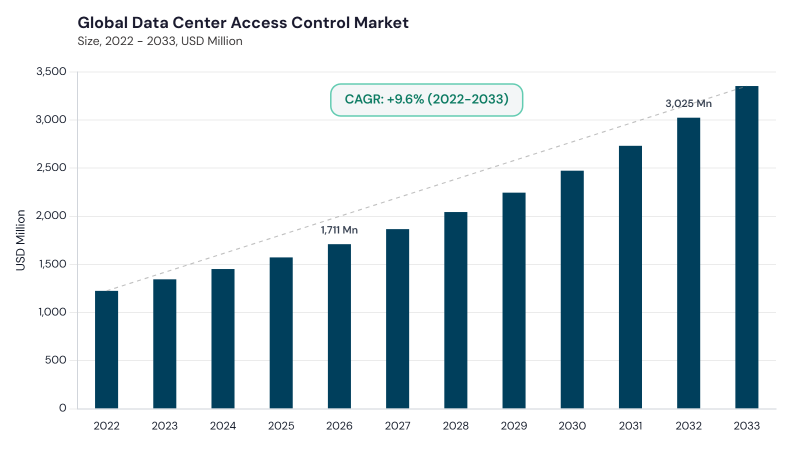
The Global Data Center Access Control Market is expected to reach USD 3.4 Billion by 2033, growing at a CAGR of 10.1% during (2026 – 2033).
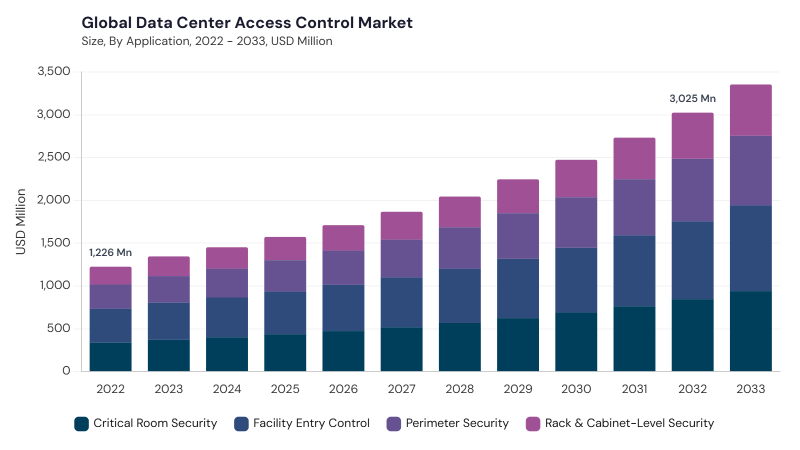
The Data Center Access Control Market is expanding as organizations focus on protecting critical IT infrastructure, sensitive data, and mission-critical data center environments from unauthorized access. Rising growth of cloud computing, hyperscale facilities, colocation data centers, edge infrastructure, and enterprise server environments is increasing the need for secure entry management and real-time access monitoring. The market started with basic mechanical locks, manual surveillance, and guarded entry points. Over time, access control evolved into electronic key cards, biometric readers, centralized monitoring platforms, mobile credentials, and multi-factor authentication systems. Presently, the market is shaped by the convergence of physical security and cybersecurity, cloud-managed access control, biometric authentication, zero-trust security, and regulatory compliance.
The Data Center Access Control Market is witnessing strong expansion as data centers increasingly become critical infrastructure for cloud computing, enterprise applications, AI workloads, digital transactions, edge computing, and sensitive data storage. Access control solutions help operators secure facility entry points, critical rooms, perimeter boundaries, server racks, cabinets, and multi-tenant environments through card-based systems, biometrics, mobile credentials, PIN/keypad systems, electronic locks, surveillance integration, and centralized access management. The market is also benefiting from rising demand for audit trails, identity verification, real-time alerts, remote monitoring, and integration between physical access systems and cybersecurity platforms.
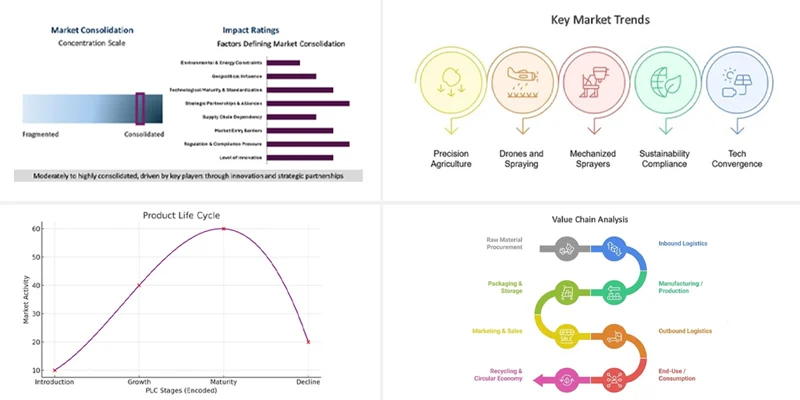
The Data Center Access Control Market is characterized by a moderately consolidated and security infrastructure-driven competitive environment consisting of building automation companies, physical access control vendors, biometric technology providers, electronic lock manufacturers, data center infrastructure providers, and integrated security solution providers. Competition is centered on biometric accuracy, mobile credential support, access management software, cloud-based monitoring, cybersecurity integration, compliance readiness, scalability, interoperability, and reliability in 24/7 data center environments. Global companies compete through broad integrated platforms and service networks, while specialized players compete through biometric innovation, rack-level security, localized deployment, and high-security access control expertise.

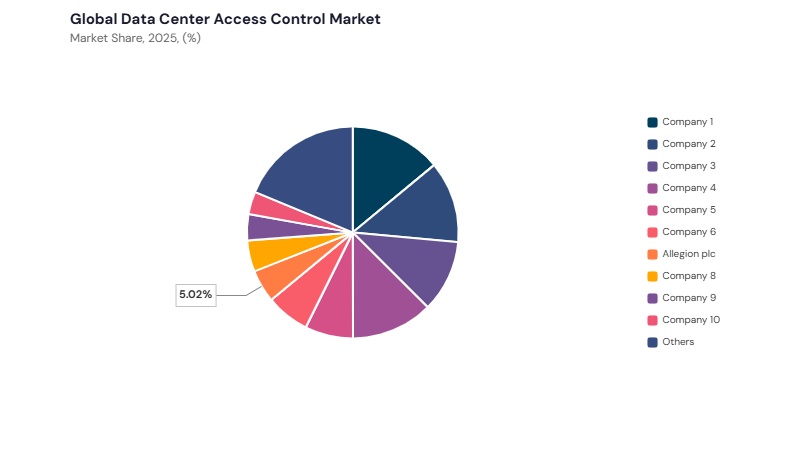
The global Data Center Access Control Market exhibits a moderately consolidated and security infrastructure-driven competitive structure, led by major access control vendors, building automation companies, biometric technology providers, and integrated physical security solution providers. Johnson Controls International plc holds a leading position in the market, supported by its integrated building management platforms, enterprise-grade access control systems, biometric solutions, and strong presence across hyperscale, enterprise, and colocation facilities. ASSA ABLOY AB, including HID Global, also maintains a strong position through its broad portfolio of smart cards, mobile credentials, identity management, biometric authentication, and secure access technologies. Honeywell International Inc., Schneider Electric SE, dormakaba Holding AG, Bosch Security Systems GmbH, Allegion plc, Siemens AG, Suprema Inc., and Gallagher Group Limited also represent important participants in the market.
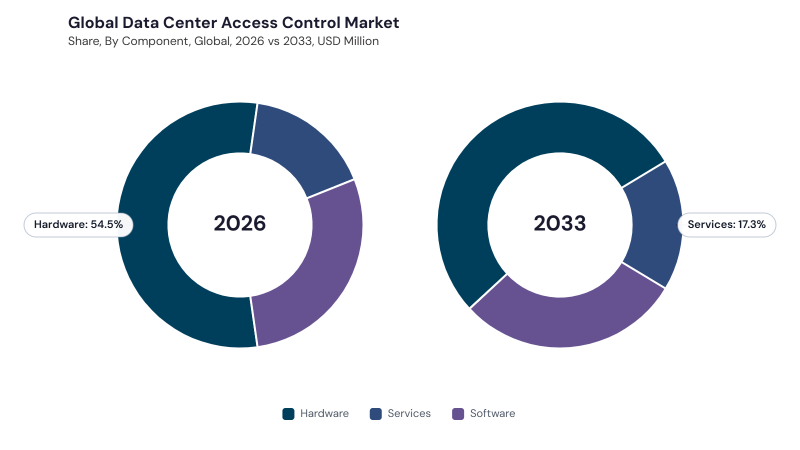
Based on Component, the market is segmented into Hardware, Software, and Services. The Hardware market dominated the Global Data Center Access Control Market by Component in 2025, and would continue to be a dominant market till 2033; thereby, achieving a market value of USD 1.8 Billion by 2033, growing at a CAGR of 9.7 % during the forecast period. The Software market is expected to witness a CAGR of 10.5% during (2026 - 2033). The Services market is expected to witness a CAGR of 10.6% during (2026 - 2033).
Hardware forms the physical foundation of the Data Center Access Control Market as operators deploy biometric readers, card readers, electronic locks, turnstiles, control panels, surveillance cameras, and access devices to secure entry points and sensitive areas. Software is gaining strong importance as data centers need centralized access authorization, identity management integration, real-time monitoring, audit trails, alerting, and analytics-driven security operations. Services also play a key role as operators require consulting, installation, integration, maintenance, managed security support, and periodic system upgrades. As data center environments become more complex, hardware, software, and services are increasingly being combined into integrated access control ecosystems that support security, compliance, and operational continuity.
Based on Application, the market is segmented into Facility Entry Control, Critical Room Security, Perimeter Security, and Rack & Cabinet-Level Security. The Facility Entry Control market dominated the Global Data Center Access Control Market by Application in 2025, and would continue to be a dominant market till 2033; thereby, achieving a market value of USD 1.0 Billion by 2033, growing at a CAGR of 9.2 % during the forecast period. The Critical Room Security market is expected to witness a CAGR of 10.3% during (2026 - 2033). The Rack & Cabinet-Level Security market is expected to witness a CAGR of 10.6% during (2026 - 2033).
Facility entry control represents the first layer of data center security as it regulates access to main entrances, lobbies, gates, visitor areas, and controlled facility access points. Critical room security focuses on protecting server rooms, network hubs, power rooms, disaster recovery areas, and sensitive operational spaces through stronger authentication and monitoring. Perimeter security helps protect external boundaries using gates, fencing, surveillance, motion detection, and intrusion monitoring. Rack & cabinet-level security is becoming increasingly important as operators require granular protection for individual server racks, tenant equipment, and sensitive hardware assets, especially in colocation and edge data center environments.
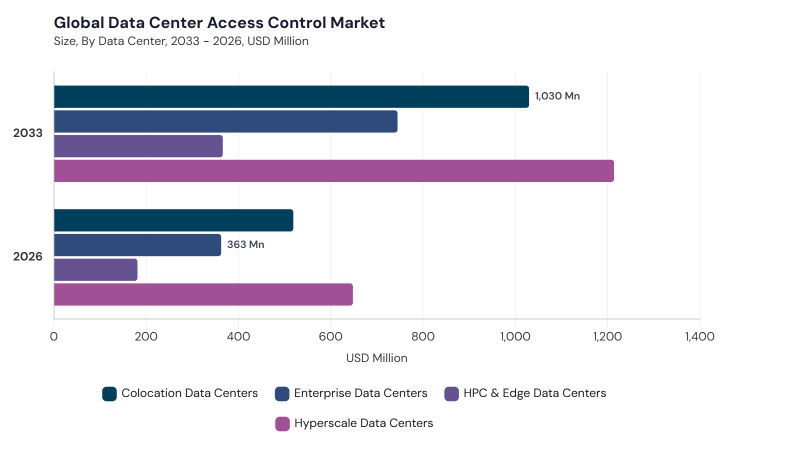
Based on Data Center, the market is segmented into Hyperscale Data Centers, Colocation Data Centers, Enterprise Data Centers, and HPC & Edge Data Centers. The Hyperscale Data Centers market dominated the Global Data Center Access Control Market by Data Center in 2025, and would continue to be a dominant market till 2033; thereby, achieving a market value of USD 1.2 Billion by 2033, growing at a CAGR of 9.4 % during the forecast period. The Colocation Data Centers market is expected to witness a CAGR of 10.3% during (2026 - 2033). Additionally, The Enterprise Data Centers market is expected to witness highest CAGR of 10.8% during (2026 - 2033).
Hyperscale data centers require highly scalable, automated, and integrated access control systems due to their large physical footprints, high personnel traffic, and mission-critical cloud workloads. Colocation data centers need flexible access management to support multi-tenant environments, tenant-specific access privileges, secure visitor management, and detailed auditability. Enterprise data centers rely on access control to protect proprietary applications, internal infrastructure, corporate data, and regulated business operations. HPC & edge data centers are creating demand for compact, remotely manageable, and resilient access control systems that can secure distributed, latency-sensitive, and often unmanned facilities.
Based on Control, the market is segmented into Card-Based Access Control, Biometric Access Control, Mobile Credential Access Control, PIN/Keypad-Based Access Control, and Other Control. The Card-Based Access Control market dominated the Global Data Center Access Control Market by Control in 2025, and would continue to be a dominant market till 2033; thereby, achieving a market value of USD 1.0 Billion by 2033, growing at a CAGR of 8.6 % during the forecast period. The Biometric Access Control market is expected to witness a CAGR of 9.9% during (2026 - 2033). Additionally, The Mobile Credential Access Control market is expected to witness highest CAGR of 11% during (2026 - 2033).
Card-based access control remains widely used due to its cost efficiency, familiarity, scalability, and compatibility with existing enterprise security systems. Biometric access control is gaining strong adoption in high-security data center areas because fingerprint, facial recognition, iris recognition, and other biometric methods reduce risks associated with stolen or shared credentials. Mobile credential access control is expanding as operators adopt smartphones, wearables, NFC, Bluetooth Low Energy, and cloud-based credential management for flexible access administration. PIN/keypad-based access control continues to support selected internal zones and secondary authentication needs. Other control methods, including behavioral biometrics, QR-based temporary access, voice recognition, and blockchain-enabled identity verification, are emerging for specialized and high-security use cases.
Free Valuable Insights: Data Center Access Control Market Size to reach $3.4 Billion by 2033
Region-wise, the Data Center Access Control Market is analyzed across North America, Europe, Asia Pacific, and LAMEA. The North America market dominated the Global Data Center Access Control Market by Region in 2025, and would continue to be a dominant market till 2033; thereby, achieving a market value of USD 1.3 Billion by 2033, growing at a CAGR of 9.6 % during the forecast period. The Asia Pacific market is expected to witness a CAGR of 10.7% during (2026 - 2033). Additionally, The Europe market is expected to witness a CAGR of 9.7% during (2026 - 2033).
North America is supported by strong hyperscale data center expansion, mature cloud infrastructure, high cybersecurity investments, strict regulatory expectations, and early adoption of biometric and AI-enabled access systems. Europe is driven by data sovereignty requirements, GDPR-led compliance, DORA-related operational resilience needs, and rising demand for audit-ready access control platforms. Asia Pacific is witnessing strong growth due to rapid cloud adoption, expanding edge data centers, rising digital service demand, regulatory data localization requirements, and growing investment in AI-enabled security infrastructure. LAMEA is gradually expanding as data center construction increases across Latin America, the Middle East, and Africa, supported by digital transformation, colocation growth, cybersecurity awareness, and demand for scalable physical security solutions.
| Report Attribute | Details |
|---|---|
| Market size value in 2026 | USD 1.7 Billion |
| Market size forecast in 2033 | USD 3.4 Billion |
| Base Year | 2025 |
| Historical Period | 2022 to 2024 |
| Forecast Period | 2026 to 2033 |
| Revenue Growth Rate | CAGR of 10.1% from 2026 to 2033 |
| Number of Pages | 692 |
| Tables | 840 |
| Report Coverage | Market Trends, Revenue Estimation and Forecast, Segmentation Analysis, Regional and Country Breakdown, Competitive Landscape, Market Share Analysis, Company Profiling, Companies Strategic Developments, SWOT Analysis, Product Life Cycle Analysis, Value Chain Analysis, Market Consolidation Analysis, Key Customer Criteria, Pandemic Impact Analysis, and Winning Imperatives |
| Segments Covered | Component, Application, Data Center, Control, Region |
| Country Scope |
|
| Companies Included | Johnson Controls International plc, ASSA ABLOY AB, Honeywell International Inc., Schneider Electric SE, dormakaba Holding AG, Bosch Security Systems GmbH, Allegion plc, Siemens AG, Suprema Inc., and Gallagher Group Limited |
By Component
By Application
By Data Center
By Control
By Geography
Expected to reach USD 3.4 Billion by 2033, growing at 10.1% CAGR during 2026-2033.
Hardware segment leads, projected to achieve USD 1.8 Billion by 2033.
Johnson Controls, ASSA ABLOY, Honeywell, Schneider Electric, and dormakaba are key players.
Facility Entry Control dominates, expected to reach USD 1.0 Billion by 2033.
North America leads, projected to reach USD 1.3 Billion by 2033.
Hyperscale Data Centers lead, expected to reach USD 1.2 Billion by 2033.
Our team of dedicated experts can provide you with attractive expansion opportunities for your business.








 Unique Offerings