The sample copy of this report is available for access.
The LAMEA Data Center Access Control Market is expected to reach USD 222.1 million by 2029, growing at a CAGR of 11.6% during (2026 – 2033).
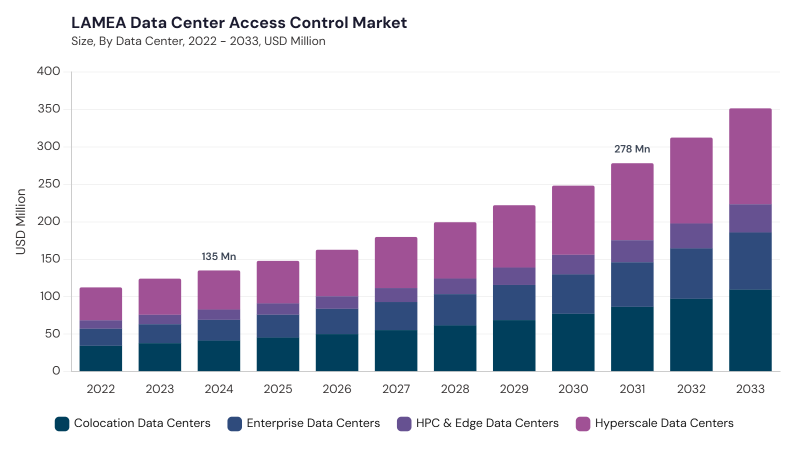
The LAMEA Data Center Access Control Market has developed from basic physical security systems into a more advanced access management ecosystem supporting secure digital infrastructure across Latin America, the Middle East, and Africa. In the early stage, data centers in the region relied on mechanical locks, security guards, badge-based entry, and simple PIN systems to restrict unauthorized movement. As cloud adoption, enterprise digitization, financial technology, telecom expansion, and government digital infrastructure grew, these traditional approaches became insufficient for securing critical data center environments. The market gradually advanced toward electronic access systems, biometric authentication, multi-factor verification, centralized monitoring, smart locks, and cloud-connected access control platforms.
The current market is shaped by growing cloud infrastructure, rising cybersecurity concerns, IoT-enabled security systems, regulatory pressure, data sovereignty needs, and the expansion of hyperscale, colocation, enterprise, and edge data centers. LAMEA markets differ widely in terms of infrastructure readiness, investment capacity, compliance maturity, and access to skilled security professionals, which creates demand for solutions that are scalable, cost-efficient, flexible, and locally adaptable. Operators are increasingly adopting biometric verification, mobile credentials, AI-driven anomaly detection, remote access management, cloud-based platforms, and integrated systems that connect physical access control with cybersecurity tools. As data centers expand across Brazil, the UAE, Saudi Arabia, South Africa, Nigeria, and other regional markets, access control solutions are becoming more intelligent, interoperable, compliance-ready, and suitable for both large-scale and emerging data center environments.
Based on Component, the market is segmented into Hardware, Software, and Services. The Hardware market dominated the LAMEA Data Center Access Control Market by Component in 2025, and would continue to be a dominant market till 2033; thereby, achieving a market value of USD 121.0 million by 2029, growing at a CAGR of 11.2 % during the forecast period. The Software market is expected to witness a CAGR of 12% during (2026 - 2033). The Services market is expected to witness a CAGR of 12.3% during (2026 - 2033).
Hardware holds the leading position as data centers require physical security devices such as biometric scanners, card readers, electronic locks, smart turnstiles, PIN terminals, access panels, surveillance cameras, sensors, and perimeter access equipment. These devices provide the direct layer of protection for facility entrances, server rooms, cabinets, restricted areas, and sensitive operational zones. Software is becoming increasingly important as operators need centralized control platforms for identity verification, access permissions, monitoring, audit logs, visitor management, incident alerts, and security analytics. Software also supports cloud-based access control, AI-enabled threat detection, and integration with broader IT security and facility systems. Services play a critical role because many data center operators require consulting, system design, installation, integration, managed services, compliance support, maintenance, training, and upgrades to ensure reliable performance and long-term security effectiveness.
Based on Application, the market is segmented into Facility Entry Control, Critical Room Security, Perimeter Security, and Rack & Cabinet-Level Security. The Facility Entry Control market dominated the LAMEA Data Center Access Control Market by Application in 2025, and would continue to be a dominant market till 2033; thereby, achieving a market value of USD 69.0 million by 2029, growing at a CAGR of 10.7 % during the forecast period. The Critical Room Security market is expected to witness a CAGR of 11.8% during (2026 - 2033). The Rack & Cabinet-Level Security market is expected to witness a CAGR of 12.1% during (2026 - 2033).
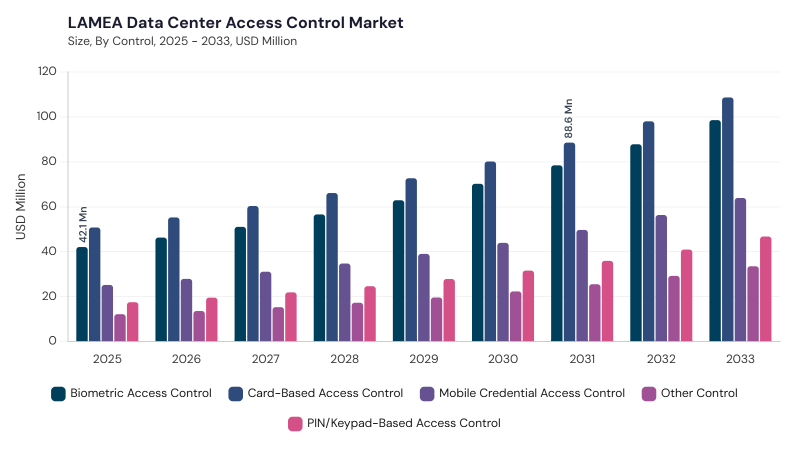
Facility Entry Control leads the market as it serves as the first access layer for managing entry into data center premises, reception zones, staff access points, visitor checkpoints, delivery areas, and controlled internal pathways. These systems commonly use smart cards, biometric verification, multi-factor authentication, mobile credentials, and visitor management tools to prevent unauthorized access. Critical Room Security is important because server rooms, network operation centers, power distribution rooms, and other sensitive zones require stricter authorization and continuous monitoring. Perimeter Security supports external facility protection through fencing, vehicle gates, intrusion sensors, surveillance, motion detection, and automated alerts. Rack & Cabinet-Level Security is gaining relevance in colocation, hyperscale, and multi-tenant data centers where individual racks, customer equipment, and cabinets need granular protection against tampering, theft, and unauthorized handling.
Based on Data Center, the market is segmented into Hyperscale Data Centers, Colocation Data Centers, Enterprise Data Centers, and HPC & Edge Data Centers. Hyperscale Data Centers hold the dominant position as large cloud service providers, telecom operators, digital platforms, and enterprise technology firms require highly scalable and automated access control systems for large facilities and critical workloads. These facilities require biometric authentication, AI-based monitoring, centralized credentialing, multi-factor access, real-time surveillance, and layered security policies to manage large staff, contractors, vendors, and operational teams.
Colocation Data Centers are also important because they need tenant-specific access rights, segmented facility permissions, rack-level controls, visitor tracking, and audit-ready access logs. Enterprise Data Centers use access control to protect corporate IT infrastructure, business applications, internal data, and regulated operations. HPC & Edge Data Centers are gaining attention as telecom expansion, smart city projects, AI workloads, industrial automation, and low-latency computing create demand for remote-managed, compact, secure, and adaptable access systems across distributed locations.
Based on Control, the market is segmented into Card-Based Access Control, Biometric Access Control, Mobile Credential Access Control, PIN/Keypad-Based Access Control, and Other Control. Card-Based Access Control remains the leading control type due to its affordability, broad installed base, ease of deployment, user familiarity, and compatibility with existing access infrastructure. RFID cards and smart cards are widely used for staff entry, visitor access, restricted zone management, and internal movement tracking. Biometric Access Control is gaining strong adoption in high-security data center areas because fingerprint, iris, facial, and other biometric systems provide stronger identity verification and reduce risks related to shared, stolen, or misplaced credentials.
Mobile Credential Access Control is expanding as data center operators adopt smartphone-based credentials, touchless access, remote provisioning, quick revocation, and cloud-managed access workflows. PIN/Keypad-Based Access Control remains useful as a low-cost or secondary authentication layer, especially for smaller facilities, backup access points, and selected internal zones. Other Control includes emerging and hybrid technologies such as behavioral analytics, proximity tokens, blockchain-based access logs, QR-based temporary access, and AI-enabled adaptive access systems.
Free Valuable Insights: The Global Data Center Access Control Market will hit USD 3.4 Billion billion by 2033, at a CAGR of 10.1%
Based on Country, the market is segmented into Brazil, Argentina, UAE, Saudi Arabia, South Africa, Nigeria, and Rest of LAMEA. The Brazil market dominated the LAMEA Data Center Access Control Market by Country in 2025, and would continue to be a dominant market till 2033; thereby, achieving a market value of USD 50.2 million by 2029, growing at a CAGR of 10.1 % during the forecast period. The Argentina market is expected to witness a CAGR of 13% during (2026 - 2033). Additionally, The UAE market is expected to witness a CAGR of 10.7% during (2026 - 2033).
Brazil remains the leading country market due to its expanding data center base, growing cloud adoption, financial digitalization, data privacy requirements, and increasing use of AI-assisted access control and centralized monitoring systems. Argentina is gaining traction through cloud service adoption, evolving data protection practices, localized access control requirements, and growing demand for audit-ready security platforms. The UAE shows strong potential due to its role as a regional digital infrastructure hub, high cloud investment, smart city initiatives, data sovereignty focus, and adoption of AI-powered and biometric access systems. Saudi Arabia is advancing through Vision 2030-linked digital transformation, hyperscale and edge data center growth, localization priorities, and demand for integrated access control aligned with cybersecurity frameworks. South Africa contributes through cloud adoption, data protection compliance, enterprise digital infrastructure, and use of biometric and AI-enabled security systems. Nigeria is emerging through fintech growth, telecom expansion, cloud adoption, rising data protection awareness, and increasing need for scalable and cost-effective access control solutions.

By Component
By Application
By Data Center
By Control
By Country
Set to reach USD 222.1 million by 2033, growing at 11.6% CAGR during 2026-2033.
Brazil leads with USD 50.2 million by 2029, growing at 10.1% CAGR during the forecast period.
Rising demand for software solutions, with a 12% CAGR during 2026-2033, drives growth.
Hardware segment to reach USD 121.0 million by 2029, growing at 11.2% CAGR during the forecast period.
The UAE market is expected to witness a CAGR of 10.7% during 2026-2033.
Rack & Cabinet-Level Security market is expected to witness a 12.1% CAGR during 2026-2033.
Our team of dedicated experts can provide you with attractive expansion opportunities for your business.




 Unique Offerings