The sample copy of this report is available for access.
The North America Continuous Emission Monitoring Systems Market is expected to reach USD 2779.4 million by 2032, growing at a CAGR of 10.3% during (2026 - 2033).
The North America Continuous Emission Monitoring Systems Market evolved from basic industrial stack-monitoring practices driven by environmental compliance toward highly automated systems capable of continuous, real-time pollutant measurement and reporting. Early installations relied on relatively basic gas analyzers, periodic calibration, and limited data automation, while advances in sensor accuracy, automated calibration, digital controls, telemetry, and data acquisition progressively improved reliability. Integration of cloud platforms, artificial intelligence, and advanced analytics has further transformed CEMS from primarily compliance-oriented equipment into proactive environmental-management infrastructure. The market now combines regulatory monitoring, process optimization, predictive maintenance, digital reporting, and operational transparency across power generation, oil and gas, manufacturing, chemicals, cement, and other industrial activities.
AI-driven analytics, multi-parameter sensing, cloud-based monitoring, and stronger industrial environmental accountability are shaping current market development. Operators increasingly require real-time anomaly detection, predictive maintenance, remote data access, automated compliance reporting, and integrated measurement of multiple pollutants through increasingly connected monitoring architectures. Tightening emission requirements and growing focus on methane, greenhouse gases, hazardous pollutants, and sustainability reporting are encouraging upgrades of aging monitoring infrastructure. IoT connectivity, advanced spectroscopy, digital data acquisition, remote diagnostics, and predictive emissions analytics are further improving operational visibility. However, high installation and lifecycle costs, regulatory complexity, calibration requirements, data integration challenges, cybersecurity concerns, and legacy-system compatibility continue to influence adoption.
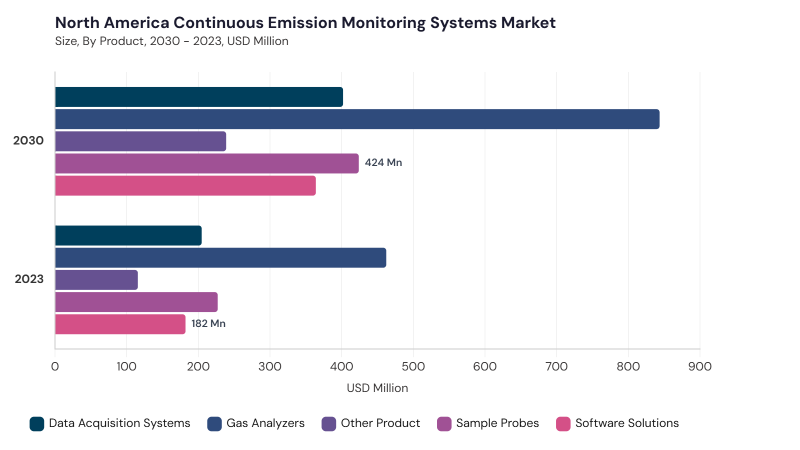
Based on Product, the market is segmented into Gas Analyzers, Sample Probes, Data Acquisition Systems, Software Solutions, and Other Product. The Gas Analyzers market dominated the North America Continuous Emission Monitoring Systems Market by Product in 2025, and would continue to be a dominant market till 2033; thereby, achieving a market value of USD 1018.3 million by 2032, growing at a CAGR of 9.6 % during the forecast period. The Sample Probes market is expected to witness a CAGR of 10% during (2026 - 2033). The Other Product market is expected to witness a CAGR of 11.5% during (2026 - 2033).
Gas Analyzers provide direct measurement of pollutants such as sulfur dioxide, nitrogen oxides, carbon monoxide, volatile organic compounds, and other regulated gases using technologies including infrared, chemiluminescence, FTIR, and advanced laser-based techniques. Sample Probes support representative extraction and conditioning of stack gases under high-temperature, corrosive, or particulate-intensive conditions. Data Acquisition Systems collect, validate, store, transmit, and report emissions information while integrating with plant control environments. Software Solutions support visualization, trend analysis, automated compliance reporting, diagnostics, and increasingly AI-enabled analytics. Other Product includes calibration gases, filters, conditioning systems, and ancillary equipment required to maintain monitoring accuracy and operational reliability.
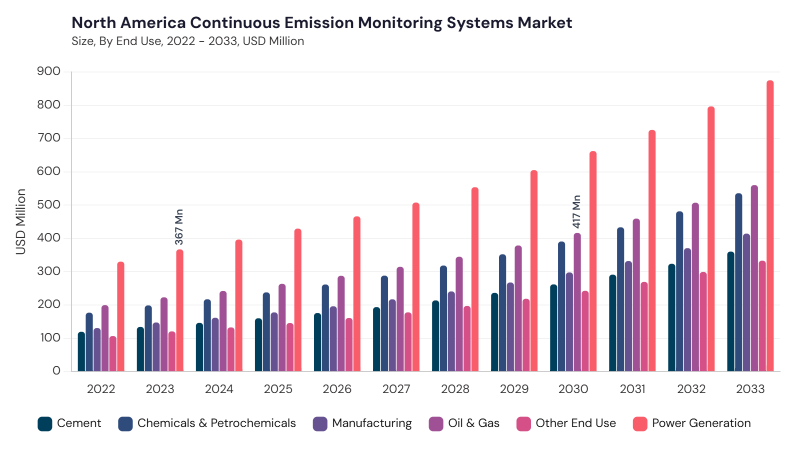
Based on End Use, the market is segmented into Power Generation, Oil & Gas, Chemicals & Petrochemicals, Manufacturing, Cement, and Other End Use. The Power Generation market dominated the North America Continuous Emission Monitoring Systems Market by End Use in 2025, and would continue to be a dominant market till 2033; thereby, achieving a market value of USD 796.6 million by 2032, growing at a CAGR of 9.4 % during the forecast period. The Oil & Gas market is expected to witness a CAGR of 10% during (2026 - 2033). Additionally, The Chemicals & Petrochemicals market is expected to witness highest CAGR of 10.8% during (2026 - 2033).
Power Generation facilities rely on CEMS for continuous tracking of sulfur oxides, nitrogen oxides, carbon dioxide, particulate matter, and other regulated emissions, while integration with plant control systems supports compliance and operational optimization. Oil & Gas applications include refineries, processing facilities, compressor operations, and other assets requiring monitoring of methane, VOCs, hydrogen sulfide, and combustion emissions. Chemicals & Petrochemicals require multi-pollutant monitoring across complex production processes, whereas Manufacturing uses adaptable monitoring systems across diverse industrial operations. Cement plants require rugged systems for kiln emissions and particulate-intensive environments, while Other End Use includes waste processing, mining, wastewater treatment, and other regulated emission sources.
Based on Technology, the market is segmented into Extractive CEMS, In-Situ CEMS, Dilution Extractive CEMS, and Other Technology. Extractive CEMS withdraw stack gases through sampling systems for remote analysis, providing flexibility across high-temperature, high-moisture, and multi-pollutant industrial environments. In-Situ CEMS measures pollutants directly within stacks or ducts, reducing sample-handling requirements and enabling rapid response through infrared, ultraviolet, and laser-based measurement technologies.
Dilution Extractive CEMS conditions samples through controlled dilution, improving measurement stability in applications involving high moisture, particulate matter, or corrosive gas compositions. Other Technology includes advanced spectroscopy, remote sensing, optical gas imaging, IoT-based sensor networks, and other specialized approaches increasingly used for distributed or fugitive-emission monitoring.
Based on Component, the market is segmented into Hardware, Services, and Software. Hardware forms the measurement foundation of CEMS and continues to benefit from improvements in sensor precision, multi-gas detection, durability, and automated calibration. Services encompass installation, system integration, calibration, maintenance, repairs, certification assistance, technical support, training, and lifecycle management required to sustain measurement accuracy and regulatory compliance.
Software supports data acquisition, validation, reporting, visualization, alarms, predictive analytics, and integration with environmental and plant-management systems. Increasing digitalization, remote diagnostics, cloud deployment, and predictive maintenance are strengthening interaction among hardware, services, and software as operators seek integrated monitoring ecosystems with lower downtime and improved compliance visibility.
Free Valuable Insights: The Global Continuous Emission Monitoring Systems Market will hit USD 8.9 Billion billion by 2033, at a CAGR of 10.9%
Based on Country, the market is segmented into US, Canada, Mexico, and Rest of North America. The US market dominated the North America Continuous Emission Monitoring Systems Market by Country in 2025, and would continue to be a dominant market till 2033; thereby, achieving a market value of USD 2184.2 million by 2032, growing at a CAGR of 9.6 % during the forecast period. The Canada market is expected to witness a CAGR of 13.2% during (2026 - 2033). Additionally, The Mexico market is expected to witness a CAGR of 12.5% during (2026 - 2033).
Across North America, CEMS adoption reflects differences in regulatory structures, industrial composition, emissions priorities, and digital maturity. The US emphasizes EPA-aligned continuous monitoring, multi-pollutant measurement, automated reporting, cloud analytics, advanced sensors, and increasingly integrated environmental-management platforms, while Canada focuses on greenhouse gas monitoring, methane reduction, laser-based sensing, remote analytics, durability across varied operating conditions, and integration with decarbonization initiatives. Mexico emphasizes multi-parameter monitoring, digital analytics, localized service infrastructure, compliance with evolving industrial emission requirements, and customized solutions for power generation, petrochemicals, automotive, steel, and chemical operations. Rest of North America continues to prioritize regulatory compliance, multi-pollutant sensing, IoT connectivity, cloud-based analytics, process optimization, predictive maintenance, and modernization of legacy emission-monitoring infrastructure.

By Product
By End Use
By Technology
By Component
By Country
Set to reach $2779.4 Million by 2032, growing at 10.3% CAGR during 2026-2033.
The US leads with $2184.2 million by 2032, growing at a CAGR of 9.6% during 2026-2033.
Power Generation sector dominates, reaching $796.6 million by 2032 at a 9.4% CAGR during 2026-2033.
Gas Analyzers segment reaches $1018.3 million by 2032, growing at a 9.6% CAGR during 2026-2033.
The Canada market is expected to witness a CAGR of 13.2% during 2026-2033.
The Mexico market is expected to witness a CAGR of 12.5% during 2026-2033.
Our team of dedicated experts can provide you with attractive expansion opportunities for your business.




 Unique Offerings
