The sample copy of this report is available for access.
The LAMEA Continuous Emission Monitoring Systems Market is expected to reach USD 504.1 million by 2029, growing at a CAGR of 13.1% during (2026 - 2033).
The LAMEA Continuous Emission Monitoring Systems Market evolved from manual sampling and periodic laboratory analysis toward automated systems capable of continuous, real-time emission measurement and reporting. Early adoption was influenced by environmental regulation and rising awareness of industrial air pollution, while advancements in sensors, digital communication, automated calibration, and multi-pollutant detection progressively improved system accuracy and reliability. Adoption expanded across power generation, oil and gas, petrochemicals, mining, manufacturing, cement, and other resource-intensive industries. Integration of remote monitoring, digital data acquisition, and scalable system architectures has further transformed CEMS from basic compliance equipment into broader environmental-management infrastructure supporting operational transparency and proactive emission control.
Stronger environmental enforcement, industrial expansion, digital transformation, and sustainability commitments are shaping current market development. Industrial operators increasingly require multi-pollutant detection, real-time reporting, remote diagnostics, automated compliance workflows, predictive maintenance, and integration with plant-control environments. IoT connectivity, cloud platforms, artificial intelligence, advanced analytics, digital twins, and improved sensor technologies are strengthening monitoring accuracy and enabling proactive management across geographically dispersed facilities. Expansion of energy, refining, mining, petrochemical, and heavy-industrial infrastructure continues to broaden deployment opportunities. However, high capital and operating costs, fragmented regulations, infrastructure limitations, harsh operating environments, limited technical expertise, interoperability issues, and inconsistent enforcement continue to influence market adoption.
Based on Product, the market is segmented into Gas Analyzers, Sample Probes, Data Acquisition Systems, Software Solutions, and Other Product. The Gas Analyzers market dominated the LAMEA Continuous Emission Monitoring Systems Market by Product in 2025, and would continue to be a dominant market till 2033; thereby, achieving a market value of USD 190.8 million by 2029, growing at a CAGR of 12.3 % during the forecast period. The Sample Probes market is expected to witness a CAGR of 12.7% during (2026 - 2033). The Other Product market is expected to witness a CAGR of 14.5% during (2026 - 2033).
Gas Analyzers provide continuous measurement of pollutants such as SO2, NOx, CO2, O2, and other industrial gases using technologies including NDIR, chemiluminescence, and other advanced sensing approaches. Sample Probes support representative extraction of flue gases while withstanding high temperatures, particulates, moisture, and corrosive environments. Data Acquisition Systems collect, process, store, and transmit emissions information for operational oversight and regulatory reporting, while Software Solutions support visualization, compliance tracking, automated reporting, predictive analytics, and cloud-based monitoring. Other Product includes calibration systems, flow monitors, particulate monitors, filters, communication equipment, and other ancillary components supporting measurement reliability and lifecycle maintenance.
Based on End Use, the market is segmented into Power Generation, Oil & Gas, Chemicals & Petrochemicals, Manufacturing, Cement, and Other End Use. The Power Generation market dominated the LAMEA Continuous Emission Monitoring Systems Market by End Use in 2025, and would continue to be a dominant market till 2033; thereby, achieving a market value of USD 150.1 million by 2029, growing at a CAGR of 12.1 % during the forecast period. The Oil & Gas market is expected to witness a CAGR of 12.7% during (2026 - 2033). Additionally, The Chemicals & Petrochemicals market is expected to witness highest CAGR of 13.6% during (2026 - 2033).
Power Generation facilities use CEMS to continuously track combustion-related emissions and support regulatory compliance, plant optimization, and environmental reporting. Oil & Gas applications span upstream production, pipelines, compressor stations, refineries, and processing facilities requiring monitoring of methane, VOCs, flaring, and other hazardous emissions. Chemicals & Petrochemicals require sensitive multi-component monitoring for complex process emissions, while Manufacturing uses CEMS across metals, mining-related processing, and other heavy industries. Cement plants require continuous monitoring of kiln-related particulate matter, NOx, SO2, and carbon monoxide, while Other End Use includes waste incineration, pulp and paper, agricultural processing, and other specialized applications.
Based on Technology, the market is segmented into Extractive CEMS, In-Situ CEMS, Dilution Extractive CEMS, and Other Technology. Extractive CEMS removes gas samples from emission sources for conditioned analysis and is suited to facilities requiring accurate multi-pollutant monitoring under demanding operating conditions. In-Situ CEMS measures pollutants directly within stacks or ducts, offering rapid response, smaller installation footprints, and reduced sample-handling requirements while benefiting from technologies such as TDLAS.
Dilution Extractive CEMS conditions difficult gas streams through controlled dilution, supporting environments characterized by high temperature, moisture, particulates, or corrosive compounds. Other Technology includes FTIR, photoacoustic analyzers, electrochemical sensing, and other specialized approaches used for multi-component, remote, or facility-specific monitoring requirements.
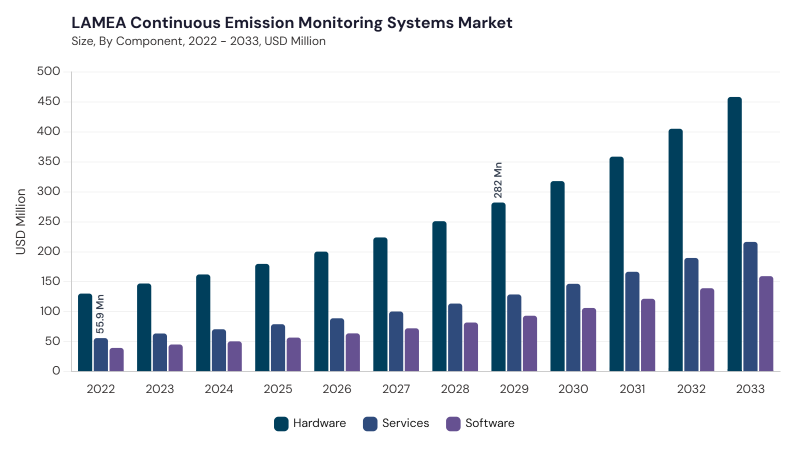
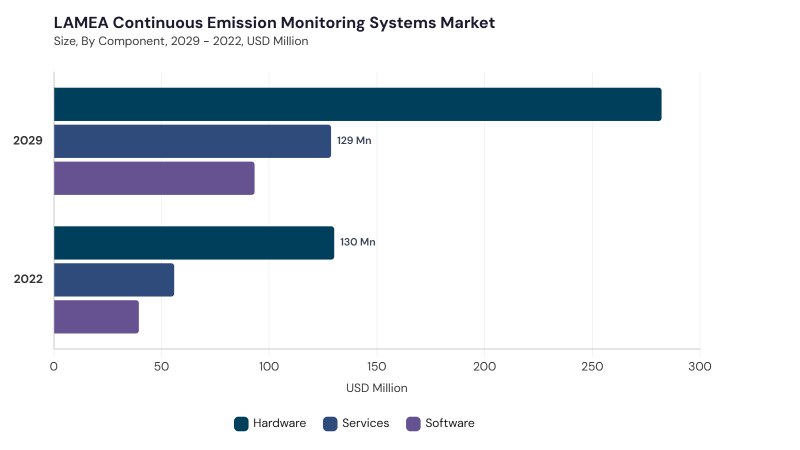
Based on Component, the market is segmented into Hardware, Services, and Software. Hardware provides the physical measurement infrastructure required for accurate and continuous pollutant detection and increasingly incorporates durable sensors, automated controls, and integration capabilities suited to harsh regional operating environments. Services include installation, commissioning, calibration, preventive maintenance, repairs, training, compliance assistance, and technical support required throughout the system lifecycle.
Software manages emissions data acquisition, visualization, trend analysis, alarms, compliance documentation, predictive maintenance, and centralized reporting. Growing use of cloud platforms, IoT connectivity, remote monitoring, and AI-based analytics is strengthening the integration of hardware, services, and software across LAMEA CEMS deployments.
Free Valuable Insights: Continuous Emission Monitoring Systems Market Size Worth USD 8.9 Billion billion by 2033
Based on Country, the market is segmented into Brazil, Argentina, UAE, Saudi Arabia, South Africa, Nigeria, and Rest of LAMEA. The Brazil market dominated the LAMEA Continuous Emission Monitoring Systems Market by Country in 2025, and would continue to be a dominant market till 2033; thereby, achieving a market value of USD 108.6 million by 2029, growing at a CAGR of 11.4 % during the forecast period. The Argentina market is expected to witness a CAGR of 13.8% during (2026 - 2033). Additionally, The UAE market is expected to witness a CAGR of 12% during (2026 - 2033).
Across LAMEA, CEMS adoption reflects differences in industrial structure, environmental regulation, infrastructure readiness, digital maturity, and localization requirements. Brazil emphasizes tighter compliance, IoT-enabled monitoring, cloud-based reporting, advanced sensor technologies, and integration with sustainability and carbon-management initiatives, while Argentina focuses on real-time monitoring, cloud analytics, interoperability, modular systems, and localized engineering support. The UAE prioritizes multi-pollutant monitoring, IoT connectivity, AI analytics, sustainability integration, and cloud-enabled environmental governance, whereas Saudi Arabia emphasizes real-time compliance, modular systems, data analytics, localization, and applications across oil and gas, petrochemicals, and power generation. South Africa focuses on automated monitoring, remote analytics, environmental transparency, modular platforms, and deployment across mining and power-intensive industries, while Nigeria emphasizes digital monitoring, localized services, predictive analytics, IoT connectivity, and reduced dependence on imported support infrastructure. Rest of LAMEA continues to advance IoT-enabled monitoring, predictive emissions management, modular systems, remote diagnostics, cloud platforms, and localized compliance solutions across industrial and energy applications.

By Product
By End Use
By Technology
By Component
By Country
Set to reach $504.1 Million by 2029, growing at 13.1% CAGR during 2026-2033.
Brazil leads with $108.6 million by 2029, growing at 11.4% CAGR during the forecast period.
The power generation segment achieves $150.1 million by 2029, growing at 12.1% CAGR during the forecast period.
Gas Analyzers reach $190.8 million by 2029, growing at 12.3% CAGR during 2026-2033.
The UAE market is expected to witness a CAGR of 12% during 2026-2033.
The Chemicals & Petrochemicals segment is expected to witness a 13.6% CAGR during 2026-2033.
Our team of dedicated experts can provide you with attractive expansion opportunities for your business.




 Unique Offerings
