The sample copy of this report is available for access.
The North America Container Security Market is expected to reach USD 5.3 billion by 2032, growing at a CAGR of 25% during (2026 - 2033).
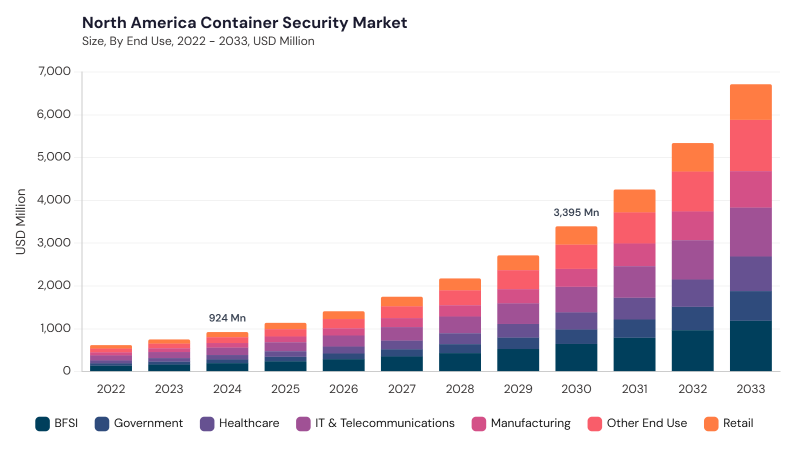
The North America Container Security Market evolved alongside the growing adoption of Docker, Kubernetes, microservices, and cloud-native application architectures, which created security requirements beyond conventional infrastructure protection. Early approaches concentrated on container isolation, image scanning, vulnerability assessment, and access controls, while growing orchestration complexity expanded requirements toward runtime defense, Kubernetes security, compliance enforcement, and software supply-chain protection. DevSecOps adoption subsequently embedded security within CI/CD pipelines, enabling earlier vulnerability identification and automated policy enforcement.
AI-driven threat detection, regulatory compliance, DevSecOps integration, and software supply-chain security are shaping current market development. Organizations increasingly deploy behavioral analytics, automated anomaly detection, vulnerability prioritization, image scanning, policy-as-code, and runtime protection to secure rapidly changing container environments. Growing use of Kubernetes and multi-cloud infrastructure is strengthening demand for unified visibility and centralized security controls, while compliance requirements encourage automated reporting, secure configurations, and continuous monitoring. Software provenance, cryptographic image verification, dependency security, zero-trust architectures, and protection against supply-chain attacks are also becoming increasingly important across enterprise container ecosystems.
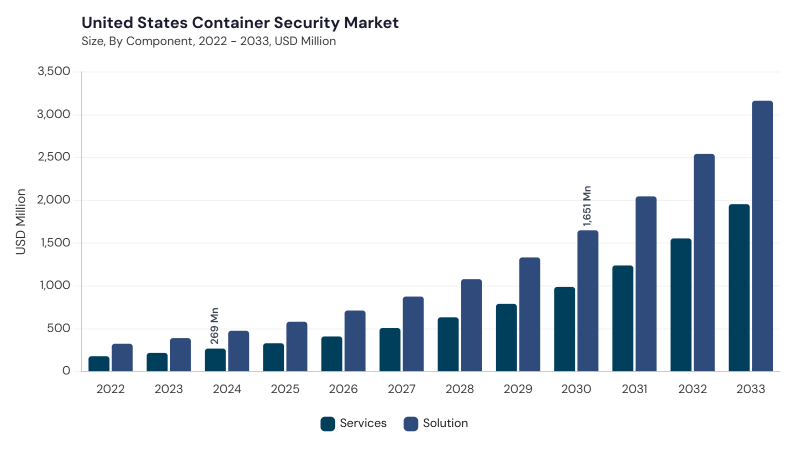
Based on Component, the market is segmented into Solution and Services. The Solution market dominated the North America Container Security Market by Component in 2025, and would continue to be a dominant market till 2033; thereby, achieving a market value of USD 3.3 billion by 2032, growing at a CAGR of 24.5 % during the forecast period. The Services market is expected to witness a CAGR of 25.8% during (2026 - 2033).
Solution includes vulnerability scanning, container image protection, runtime threat detection, Kubernetes security, network segmentation, secrets management, access control, policy enforcement, and compliance monitoring. Enterprises increasingly integrate these capabilities with CI/CD pipelines and consolidated cloud-native security platforms to strengthen application protection across distributed environments. Services include consulting, implementation, integration, managed security, incident response, training, compliance advisory, and technical support. Demand for Services is supported by expertise gaps, hybrid and multi-cloud complexity, continuous monitoring requirements, and the need for specialized assistance in configuring and operating container security architectures.
Based on Deployment, the market is segmented into Cloud and On-premise. The Cloud market dominated the North America Container Security Market by Deployment in 2025, and would continue to be a dominant market till 2033; thereby, achieving a market value of USD 3.3 billion by 2032, growing at a CAGR of 25.1 % during the forecast period. The On-premises market is expected to witness a CAGR of 24.8% during (2026 - 2033).
Cloud deployment supports scalable vulnerability scanning, runtime protection, policy enforcement, access management, infrastructure-as-code assessment, and continuous compliance across Kubernetes and cloud-native workloads. Integration with DevSecOps pipelines, AI-enabled threat detection, automated response, and cloud-native application protection platforms further strengthens adoption. On-premise deployment remains important for organizations requiring direct control over sensitive workloads, internal security infrastructure, network segmentation, and customized policies. Government, financial, healthcare, defense, and other regulated environments continue to use on-premise solutions, frequently alongside cloud tools within hybrid security architectures.
Based on Enterprise Size, the market is segmented into Large Enterprises and Small & Medium-Sized Enterprises (SMEs). Large Enterprises require comprehensive security capabilities including vulnerability management, workload protection, runtime detection, secrets management, network segmentation, software supply-chain security, automated compliance, and zero-trust controls across distributed container environments.
Their larger cybersecurity budgets and mature security teams support adoption of integrated platforms, AI-enabled analytics, and managed services. Small & Medium-Sized Enterprises (SMEs) increasingly adopt cloud-native applications but generally prioritize accessible cloud-based platforms, subscription models, automated image scanning, configuration monitoring, runtime protection, and managed services that reduce the requirement for large dedicated security teams.
Based on End Use, the market is segmented into BFSI, IT & Telecommunications, Retail, Healthcare, Manufacturing, Government, and Other End Use. BFSI emphasizes image scanning, runtime protection, secrets management, API security, identity controls, zero-trust architectures, and automated compliance. IT & Telecommunications relies on container security across cloud services, Kubernetes, 5G, network virtualization, microservices, and edge computing, while Retail applies protection to e-commerce, payments, omnichannel platforms, and customer data.
Healthcare prioritizes encryption, access controls, auditability, vulnerability management, and protection of digital health workloads. Manufacturing focuses on workload isolation, network segmentation, industrial applications, digital twins, and smart-factory environments, whereas Government emphasizes secure software development, continuous monitoring, data sovereignty, and zero-trust modernization. Other End Use includes energy, utilities, transportation, education, media, and related industries adopting containerized applications across cloud and edge infrastructure.
Free Valuable Insights: The Global Container Security Market will hit USD 18414.0 Million billion by 2033, at a CAGR of 25.6%
Based on Country, the market is segmented into US, Canada, Mexico, and Rest of North America. The US market dominated the North America Container Security Market by Country in 2025, and would continue to be a dominant market till 2033; thereby, achieving a market value of USD 4.0 billion by 2032, growing at a CAGR of 24.2 % during the forecast period. The Canada market is expected to witness a CAGR of 28% during (2026 - 2033). Additionally, The Mexico market is expected to witness a CAGR of 26.9% during (2026 - 2033).
Across North America, container security adoption is being shaped by Kubernetes expansion, AI-based threat detection, DevSecOps, software supply-chain protection, regulatory compliance, and hybrid cloud security. The US emphasizes automated Kubernetes security, SBOM generation, vulnerability management, behavioral analytics, runtime defense, and compliance automation, while Canada focuses on AI-enabled analytics, IoT-connected monitoring, blockchain-based transparency, interoperability, and regulatory alignment. Mexico is advancing AI-based risk analysis, cybersecurity integration, real-time monitoring, public-private collaboration, and localized security architectures, whereas Rest of North America continues to develop integrated security platforms, predictive analytics, encryption, modular security technologies, and scalable solutions suited to diverse regulatory and infrastructure environments.

By Component
By Deployment
By Enterprise Size
By End Use
By Country
Set to reach $5.3 Billion by 2032, growing at 25% CAGR during 2026-2033.
The US leads with $4.0 billion by 2032, growing at a 24.2% CAGR during 2026-2033.
Rising enterprise cloud adoption and AI-driven workloads are the main catalysts.
Solution segment hits $3.3 billion by 2032, growing at a 24.5% CAGR during 2026-2033.
Canada is expected to witness a 28% CAGR during 2026-2033.
Cloud segment hits $3.3 billion by 2032, growing at a 25.1% CAGR during 2026-2033.
Our team of dedicated experts can provide you with attractive expansion opportunities for your business.




 Unique Offerings
