The sample copy of this report is available for access.
The Asia Pacific Container Security Market is expected to reach USD 2779.0 million by 2030, growing at a CAGR of 26.2% during (2026 - 2033).
The Asia Pacific Container Security Market evolved alongside rapid adoption of containerized applications, Kubernetes orchestration, cloud-native development, and increasingly distributed digital infrastructure. Early protection concentrated on container images, runtime environments, vulnerability management, and access controls, while expanding multi-cloud and hybrid deployments increased the need for integrated security. Rising supply-chain attacks and stricter cybersecurity requirements further encouraged automated compliance, continuous monitoring, and zero-trust architectures. The market now increasingly emphasizes lifecycle security spanning development, deployment, and runtime through centralized protection, policy enforcement, analytics, and automated threat-response capabilities.
Zero-trust adoption, AI-driven threat detection, DevSecOps integration, software supply-chain security, and data-residency requirements are shaping current market development. Enterprises increasingly use continuous verification, segmented access, behavioral analytics, automated vulnerability scanning, SBOMs, cryptographic verification, and runtime monitoring to reduce exposure across dynamic container environments. Security controls are also being embedded directly into CI/CD pipelines to improve development-stage risk detection without compromising deployment speed. Expanding Kubernetes usage, hyperscale cloud infrastructure, 5G, edge computing, and hybrid-cloud adoption are further strengthening demand for scalable, interoperable, and compliance-oriented container security platforms.
Based on Component, the market is segmented into Solution and Services. The Solution market dominated the Asia Pacific Container Security Market by Component in 2025, and would continue to be a dominant market till 2033; thereby, achieving a market value of USD 1750.4 million by 2030, growing at a CAGR of 25.7 % during the forecast period. The Services market is expected to witness a CAGR of 27% during (2026 - 2033).
Solution includes vulnerability scanning, container image assurance, runtime protection, Kubernetes configuration security, secrets management, network controls, access management, and automated policy enforcement. Increasing DevSecOps adoption and multi-cloud complexity are encouraging enterprises to move toward integrated lifecycle protection and AI-enabled security analytics. Services include consulting, implementation, integration, managed detection, compliance support, training, and technical assistance. Their adoption is supported by shortages of cloud-security specialists, migration complexity, diverse regulatory requirements, and the need for continuous monitoring across heterogeneous enterprise environments.
Based on Deployment, the market is segmented into Cloud and On-premise. The Cloud market dominated the Asia Pacific Container Security Market by Deployment in 2025, and would continue to be a dominant market till 2033; thereby, achieving a market value of USD 1726.8 million by 2030, growing at a CAGR of 26.3 % during the forecast period. The On-premises market is expected to witness a CAGR of 26% during (2026 - 2033).
Cloud deployment enables centralized vulnerability management, Kubernetes protection, runtime monitoring, automated compliance, access control, and security visibility across distributed public, private, and hybrid environments. Growing use of cloud-native development, CI/CD automation, AI-driven security analytics, and managed container services is supporting adoption. On-premise deployment remains relevant among regulated industries, government organizations, financial institutions, telecommunications providers, manufacturers, and enterprises requiring tighter control over sensitive workloads. Hybrid models are increasingly used to combine localized governance and data control with cloud-based scalability and operational flexibility.
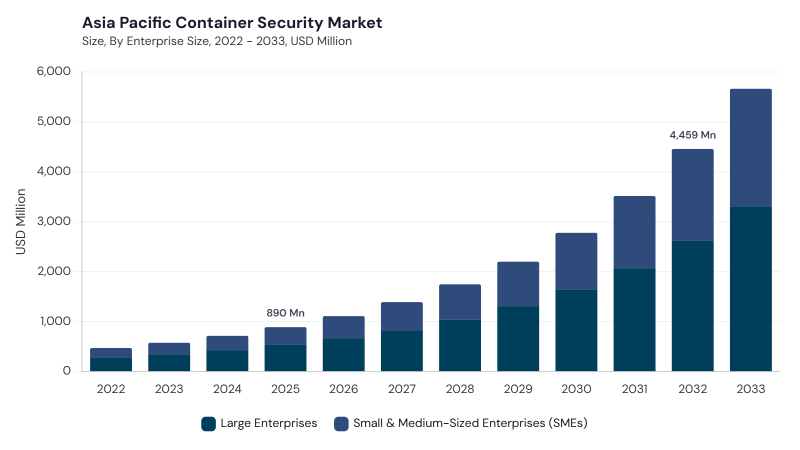
Based on Enterprise Size, the market is segmented into Large Enterprises and Small & Medium-Sized Enterprises (SMEs). Large Enterprises require advanced runtime protection, workload segmentation, software supply-chain security, compliance monitoring, centralized policy enforcement, AI-assisted anomaly detection, and zero-trust security across complex hybrid and multi-cloud deployments. Their larger cybersecurity budgets and technical resources support adoption of comprehensive platforms and specialized managed services.
Small & Medium-Sized Enterprises (SMEs) increasingly adopt containers through cloud-based development but generally prioritize simple deployment, flexible subscriptions, automated image scanning, access controls, managed security, and runtime monitoring that can deliver protection without substantial investment in dedicated cybersecurity infrastructure.
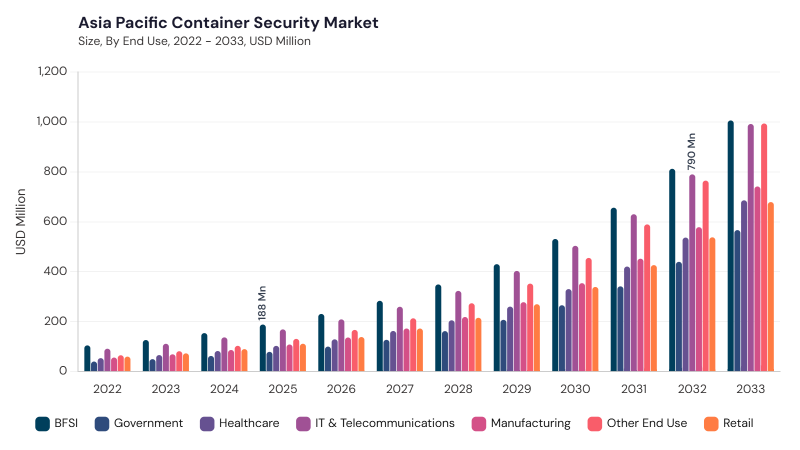
Based on End Use, the market is segmented into BFSI, IT & Telecommunications, Retail, Healthcare, Manufacturing, Government, and Other End Use. BFSI emphasizes runtime protection, identity controls, image scanning, secure DevSecOps, and automated compliance, while IT & Telecommunications uses container security across 5G, cloud infrastructure, edge services, network virtualization, and large-scale digital platforms. Retail requires scalable protection for e-commerce, payments, logistics, and customer-facing applications, whereas Healthcare prioritizes encryption, access control, vulnerability management, and continuous monitoring.
Manufacturing applies container security across smart factories, industrial IoT, edge computing, and IT/OT convergence, while Government focuses on zero-trust architectures, data-localization requirements, secure cloud modernization, and vulnerability management. Other End Use includes education, logistics, energy, travel, media, utilities, and professional services adopting cloud-native and containerized applications.
Free Valuable Insights: Container Security Market is Predicted to reach USD 18414.0 Million billion by 2033, at a CAGR of 25.6%
Based on Country, the market is segmented into China, Japan, India, South Korea, Singapore, Malaysia, and Rest of Asia Pacific. The China market dominated the Asia Pacific Container Security Market by Country in 2025, and would continue to be a dominant market till 2033; thereby, achieving a market value of USD 734.9 million by 2030, growing at a CAGR of 23.9 % during the forecast period. The Japan market is expected to witness a CAGR of 25.3% during (2026 - 2033). Additionally, The India market is expected to witness a CAGR of 27% during (2026 - 2033).
Across Asia Pacific, container security adoption is being shaped by AI-enabled threat detection, DevSecOps, zero-trust security, cloud transformation, regulatory compliance, and software supply-chain protection. China emphasizes AI analytics, blockchain-based verification, secure data management, localized compliance, and real-time monitoring, while Japan focuses on unified security platforms, Kubernetes protection, cloud-integrated controls, compliance reporting, and CNAPP adoption. India is advancing IoT-enabled monitoring, AI analytics, government-industry collaboration, localization, and integrated cyber-physical security, whereas South Korea emphasizes DevSecOps, AI-based threat detection, secure-by-design practices, managed security, and platform-agnostic protection. Singapore focuses on AI analytics, IoT integration, blockchain transparency, regulatory compliance, and integrated security ecosystems, while Malaysia emphasizes cloud-native security, AI-driven monitoring, encryption, blockchain tracking, and localized compliance. Rest of Asia Pacific continues to develop hybrid and multi-cloud security, automated compliance, AI-based anomaly detection, zero-trust architectures, and integrated lifecycle protection.

By Component
By Deployment
By Enterprise Size
By End Use
By Country
Set to reach $2779.0 Million by 2030, growing at 26.2% CAGR during 2026-2033.
China leads with $734.9 million by 2030, growing at a CAGR of 23.9% during the forecast period.
Rising enterprise cloud adoption is a key growth driver.
Solution segment hits $1750.4 million by 2030 at 25.7% CAGR during the forecast period.
India market is expected to witness a CAGR of 27% during 2026-2033.
Cloud segment reaches $1726.8 million by 2030 at a CAGR of 26.3% during the forecast period.
Our team of dedicated experts can provide you with attractive expansion opportunities for your business.




 Unique Offerings
