The sample copy of this report is available for access.
The North America Burn Ointment Market is expected to reach USD 586.0 million by 2032, growing at a CAGR of 5.3% during (2026 - 2033).
The North America Burn Ointment Market evolved from basic antiseptic and soothing topical remedies into scientifically validated formulations designed to control infection, support tissue regeneration, reduce inflammation, and improve scar outcomes. Progress in wound biology, antimicrobial science, biomaterials, and pharmaceutical formulation enabled the introduction of silver-based, antibiotic, natural, and advanced delivery systems. Growing clinical standardization and regulatory oversight further strengthened physician acceptance and product quality. Current development increasingly emphasizes regenerative compounds, nanotechnology, controlled-release formulations, natural ingredients, personalized burn care, and integration with broader wound-management protocols.
Advanced wound-healing technologies, natural and bioengineered ingredients, personalized treatment, and digital health integration are shaping current market development. Manufacturers are increasingly exploring nano-enabled delivery, stem-cell-supported approaches, sustained-release systems, advanced antimicrobials, and formulations designed to improve moisture balance and tissue repair. Consumer awareness of specialized burn care and interest in evidence-backed natural ingredients are also influencing product portfolios. At the same time, regulatory complexity, antimicrobial resistance concerns, high production costs, reimbursement limitations, formulation stability, and clinical validation requirements continue to influence product development and market adoption.
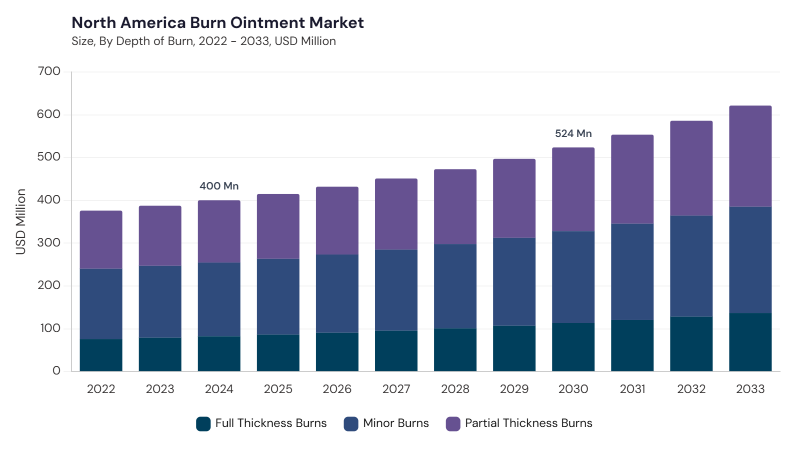
Based on Depth of Burn, the market is segmented into Minor Burns, Partial Thickness Burns, and Full Thickness Burns. The Minor Burns market dominated the North America Burn Ointment Market by Depth of Burn in 2025, and would continue to be a dominant market till 2033; thereby, achieving a market value of USD 236.1 million by 2032, growing at a CAGR of 4.5 % during the forecast period. The Partial Thickness Burns market is expected to witness a CAGR of 5.9% during (2026 - 2033). Additionally, The Full Thickness Burns market is expected to witness highest CAGR of 6.1% during (2026 - 2033).
Minor Burns typically require soothing, moisturizing, analgesic, and mild antimicrobial ointments suitable for self-care, pharmacies, and primary-care environments. Partial Thickness Burns require stronger antimicrobial protection, moisture management, and regeneration-supporting formulations because of greater tissue damage, blistering, infection risk, and scarring potential. Full Thickness Burns represent the most severe category and generally require hospital-based multidisciplinary treatment, surgical intervention, grafting, and intensive wound management, limiting ointments to supportive roles such as infection control, wound-bed preparation, and tissue protection.
Based on End-use, the market is segmented into Hospitals, Clinics, and Other End-use. The Hospitals market dominated the North America Burn Ointment Market by End-use in 2025, and would continue to be a dominant market till 2033; thereby, achieving a market value of USD 267.7 million by 2032, growing at a CAGR of 4.8 % during the forecast period. The Clinics market is expected to witness a CAGR of 5.8% during (2026 - 2033). Additionally, The Other End-use market is expected to witness highest CAGR of 5.8% during (2026 - 2033).
Hospitals require broad portfolios of antimicrobial, analgesic, regenerative, and barrier-protection ointments across emergency departments, burn units, trauma centers, and surgical settings. Clinics primarily address minor-to-moderate burns, outpatient wound management, follow-up care, scar prevention, and post-treatment monitoring through convenient non-invasive topical therapies. Other End-use includes home healthcare, rehabilitation centers, long-term care facilities, pharmacies, and related environments where ointments are used for extended healing, scar management, itching relief, moisturization, and uncomplicated first-aid treatment.
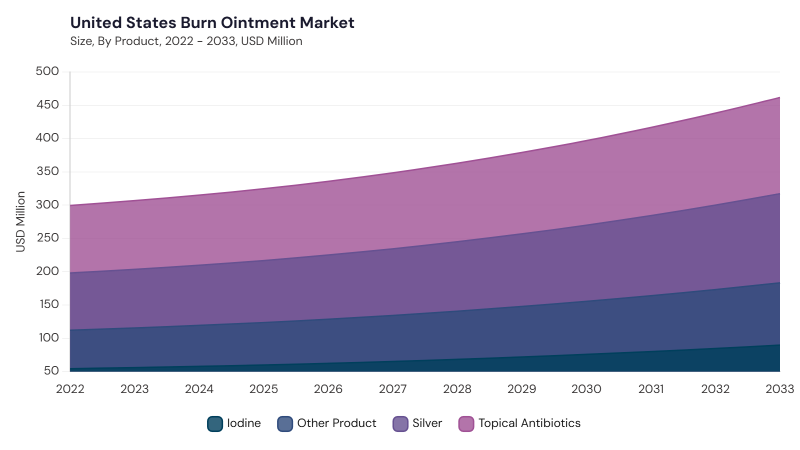
Based on Product, the market is segmented into Topical Antibiotics, Silver, Iodine, and Other Product. Topical Antibiotics are widely used for infection prevention in superficial and partial-thickness burns, supported by familiar clinical protocols and localized antimicrobial delivery. Silver-based products remain important due to broad-spectrum antimicrobial activity and continued use in more complex burn wounds, while advances in nanocrystalline silver are improving delivery and sustained action.
Iodine products serve selective antiseptic applications where broad microbial control is required but are influenced by safety and absorption considerations. Other Product includes natural extracts, growth factors, polymers, scar-management formulations, and regenerative or advanced delivery systems addressing specialized wound-healing requirements.
Free Valuable Insights: The Global Burn Ointment Market will hit USD 1804.6 Million billion by 2033, at a CAGR of 5.9%
Based on Country, the market is segmented into US, Canada, Mexico, and Rest of North America. The US market dominated the North America Burn Ointment Market by Country in 2025, and would continue to be a dominant market till 2033; thereby, achieving a market value of USD 438.2 million by 2032, growing at a CAGR of 4.7 % during the forecast period. The Canada market is expected to witness a CAGR of 7.9% during (2026 - 2033). Additionally, The Mexico market is expected to witness a CAGR of 6.6% during (2026 - 2033).
Across North America, burn ointment adoption is being shaped by advanced wound science, antimicrobial innovation, natural ingredients, regulatory standards, and personalized treatment. The US emphasizes bioactive compounds, tissue engineering, nanotechnology, antimicrobial stewardship, and patient-specific formulations, while Canada focuses on natural and organic ingredients, controlled-release technologies, regulatory compliance, and advanced biomaterials. Mexico is advancing plant-derived formulations, antimicrobial resistance management, bioadhesive delivery systems, nanoemulsions, and locally adapted manufacturing, whereas Rest of North America increasingly emphasizes precision burn care, bioactive polymers, nanocarriers, non-traditional antimicrobials, advanced diagnostics, and clinically validated wound-healing technologies.

By Depth of Burn
By End-use
By Product
By Country
Set to reach $586.0 Million by 2032, growing at 5.3% CAGR during 2026-2033.
The US leads with $438.2 million by 2032, growing at 4.7% CAGR during the forecast period.
The Minor Burns segment will achieve $236.1 million by 2032, growing at 4.5% CAGR during 2026-2033.
Hospitals segment reaches $267.7 million by 2032, growing at 4.8% CAGR during 2026-2033.
The Canada market is expected to witness a CAGR of 7.9% during 2026-2033.
Full Thickness Burns segment will witness the highest CAGR of 6.1% during 2026-2033.
Our team of dedicated experts can provide you with attractive expansion opportunities for your business.




 Unique Offerings