“Global Burn Ointment Market to reach a market value of USD 1,804.65 Million by 2033 growing at a CAGR of 5.9%”
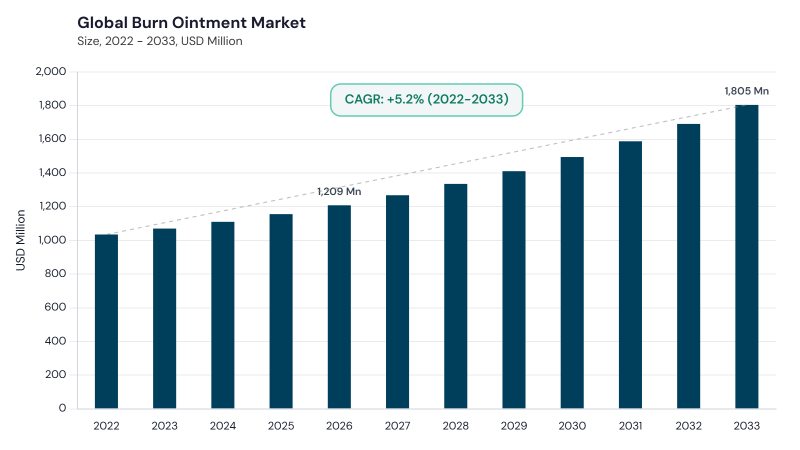
The Global Burn Ointment Market is expected to reach USD 1804.7 million by 2033, growing at a CAGR of 5.9% during (2026 - 2033).
Increasing incidence of burn injuries, growing awareness of effective wound care, and rising demand for topical treatments are driving the Burn Ointment Market across hospitals, clinics, pharmacies, and home healthcare settings. Adoption is further strengthened by the need for infection prevention, faster wound healing, pain relief, reduced scarring, convenient first-aid care, expanding healthcare access, over-the-counter wound care products, antimicrobial formulations, bioactive ingredients, moisturizing properties, and clinically validated topical solutions.
Growth in the Burn Ointment Market is driven by the increasing need for accessible, effective, and clinically reliable topical treatments across different burn severities and care settings. Burn ointments are becoming important first-line solutions for minor burns and supportive treatments for more complex wounds where infection control, moisture balance, pain relief, and tissue regeneration are essential. Manufacturers are focusing on multifunctional products that combine antimicrobial activity, soothing benefits, improved skin compatibility, and enhanced healing support. Rising use of first-aid kits, pharmacy-based wound care, hospital burn protocols, and outpatient wound-management practices is also expanding product utilization.
The competitive environment is moderately consolidated and innovation-driven, with pharmaceutical companies, consumer health brands, wound-care specialists, advanced dressing manufacturers, and medical technology firms competing across topical and adjacent burn-care formats. Smith+Nephew, Convatec, Mölnlycke, Coloplast, Cardinal Health, and Integra strengthen the advanced wound-care and burn-management ecosystem through hydrogels, silver dressings, antimicrobial barriers, regenerative matrices, and wound-bed preparation technologies. Kenvue, Sun Pharmaceutical, and Perrigo provide more direct topical or first-aid ointment relevance through NEOSPORIN, SILVEREX, triple-antibiotic products, and pain-relieving formulations.
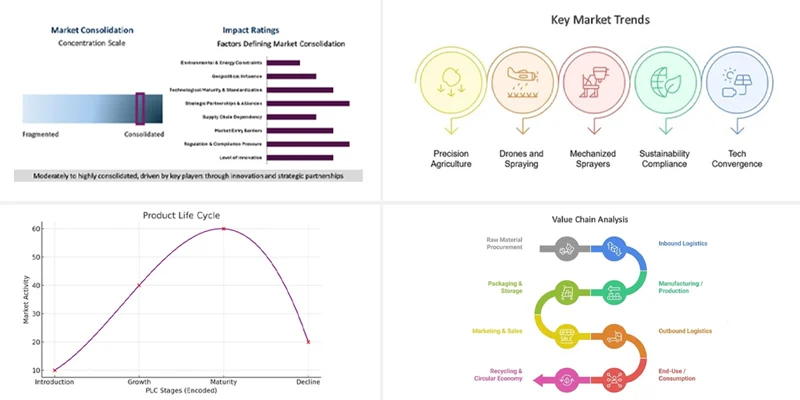
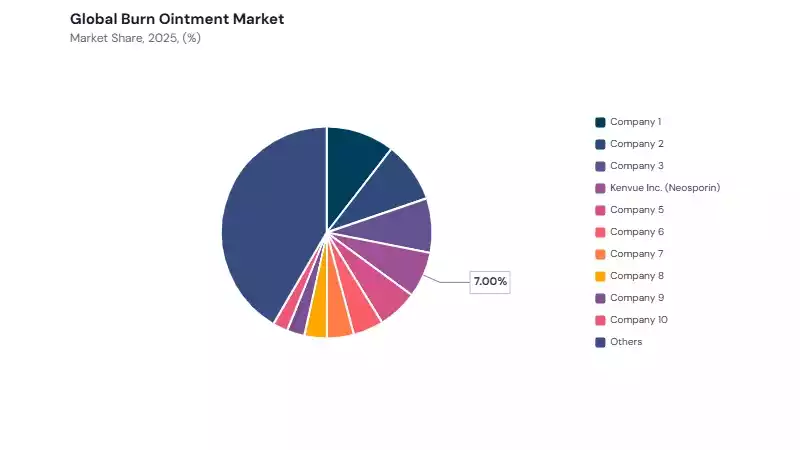
The global Burn Ointment Market reflects a moderately consolidated and clinically differentiated competitive landscape, with participation from direct topical first-aid brands, pharmaceutical dermatology companies, advanced wound-care manufacturers, and regenerative tissue-repair specialists. Kenvue and Perrigo maintain strong relevance in consumer first-aid ointments through antibiotic and pain-relieving formulations for minor burns, while Sun Pharmaceutical participates through its SILVEREX topical cream portfolio. Smith+Nephew, Convatec, Mölnlycke, Coloplast, Cardinal Health, and Integra compete more broadly through adjacent burn and wound-care technologies such as hydrogels, silver antimicrobial dressings, Hydrofiber platforms, soft silicone dressings, gelling-fiber products, and dermal regeneration matrices.
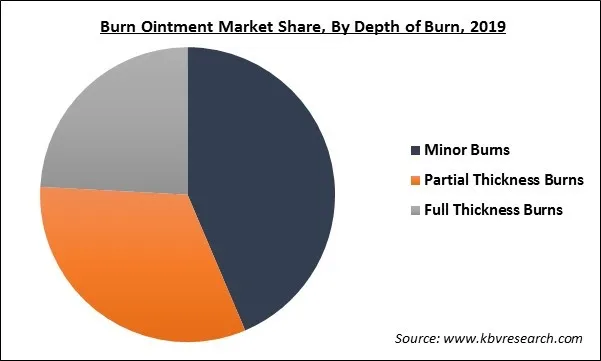
Based on Depth of Burn, the market is segmented into Minor Burns, Partial Thickness Burns, and Full Thickness Burns. The Minor Burns market dominated the Global Burn Ointment Market by Depth of Burn in 2025, and would continue to be a dominant market till 2033; thereby, achieving a market value of USD 724.1 million by 2033, growing at a CAGR of 5 % during the forecast period. The Partial Thickness Burns market is expected to witness a CAGR of 6.5% during (2026 - 2033). Additionally, The Full Thickness Burns market is expected to witness highest CAGR of 6.6% during (2026 - 2033).
Minor Burns represent the leading segment as superficial burns are frequent in household, kitchen, workplace, and recreational settings and are commonly treated with OTC topical products. These products focus on soothing discomfort, hydration, pain relief, and infection prevention. Partial Thickness Burns require more advanced topical care because they involve deeper skin injury, blistering, pain, and higher infection risk, creating demand for antimicrobial, regenerative, and moisture-retentive formulations. Full Thickness Burns require specialized hospital-centered wound care, where ointments and adjacent topical technologies support infection control, wound-bed preparation, tissue regeneration, and surgical treatment pathways.
Based on End-use, the market is segmented into Hospitals, Clinics, and Other End-use. The Hospitals market dominated the Global Burn Ointment Market by End-use in 2025, and would continue to be a dominant market till 2033; thereby, achieving a market value of USD 823.5 million by 2033, growing at a CAGR of 5.3 % during the forecast period. The Clinics market is expected to witness a CAGR of 6.4% during (2026 - 2033). Additionally, The Other End-use market is expected to witness highest CAGR of 6.4% during (2026 - 2033).
Hospitals remain the leading end-use segment because they manage moderate-to-severe burns, acute trauma cases, complex wound infections, and specialized burn-care protocols. Hospital demand is supported by burn units, emergency departments, surgical wards, and multidisciplinary wound-care teams. Clinics address mild-to-moderate burns, outpatient wound care, dressing changes, follow-up treatment, and scar-management support. Other End-use includes home care settings, pharmacies, wellness centers, community healthcare, and first-aid use, where accessibility, affordability, ease of application, and consumer trust remain key purchase factors.
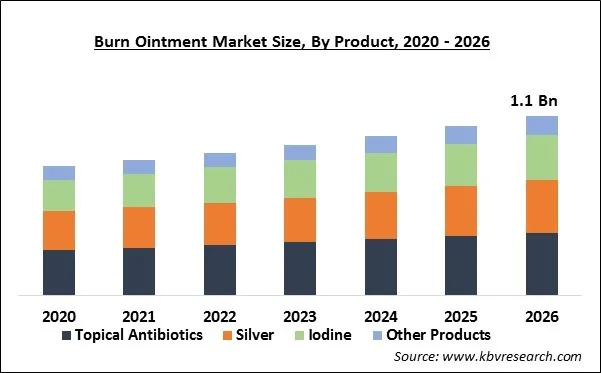
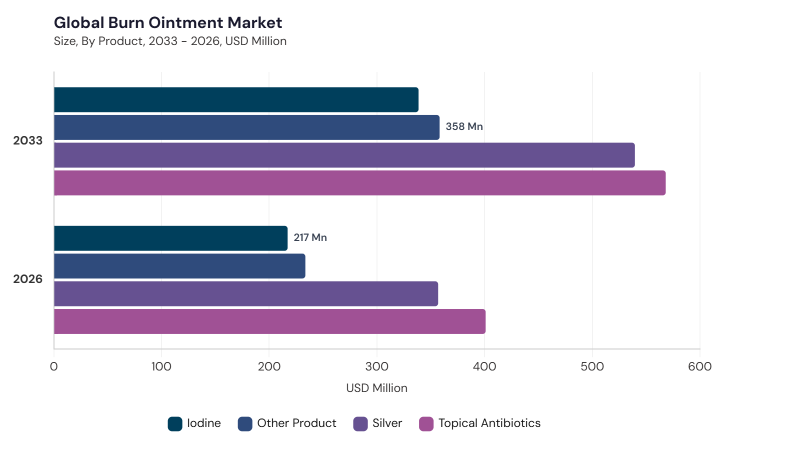
Based on Product, the market is segmented into Topical Antibiotics, Silver, Iodine, and Other Product. The Topical Antibiotics market dominated the Global Burn Ointment Market by Product in 2025, and would continue to be a dominant market till 2033; thereby, achieving a market value of USD 568.2 million by 2033, growing at a CAGR of 5.1 % during the forecast period. The Silver market is expected to witness a CAGR of 6.1% during (2026 - 2033). Additionally, The Iodine market is expected to witness highest CAGR of 6.6% during (2026 - 2033).
Topical Antibiotics remain the leading product category due to their role in preventing bacterial contamination and supporting first-aid treatment for superficial and partial-thickness burns. Silver-based products are widely used for their broad antimicrobial effectiveness, especially in more complex burn and wound-care settings. Iodine-based products serve selective antiseptic applications where rapid microbial control is required. Other Product includes herbal-based formulations, honey-based gels, growth-factor products, collagen creams, bioengineered formulations, and advanced topical technologies that support scar reduction, tissue regeneration, and personalized burn recovery.
Free Valuable Insights: Burn Ointment Market Size to reach $1804.6 Million by 2033
Region-wise, the Burn Ointment Market is analyzed across North America, Europe, Asia Pacific, and LAMEA. The North America market dominated the Global Burn Ointment Market by Region in 2025, and would continue to be a dominant market till 2033; thereby, achieving a market value of USD 621.5 million by 2033, growing at a CAGR of 5.3 % during the forecast period. The Asia Pacific market is expected to witness a CAGR of 6.4% during (2026 - 2033). Additionally, The Europe market is expected to witness a CAGR of 5.7% during (2026 - 2033).
North America remains the leading regional market, supported by strong awareness of burn management, established emergency and wound-care services, advanced healthcare infrastructure, and availability of branded OTC and clinical burn-care products. Europe benefits from regulated wound-care standards, developed healthcare systems, demand for natural and advanced formulations, and established use of antimicrobial topical therapies. Asia Pacific is expanding through improving healthcare infrastructure, rising burn injury incidence, growing consumer healthcare spending, increasing OTC adoption, and demand for herbal and advanced formulations. LAMEA is developing steadily as healthcare access, pharmacy distribution, burn-care awareness, and demand for affordable topical treatments improve across emerging markets.
| Report Attribute | Details |
|---|---|
| Market size value in 2026 | USD 1208.5 million |
| Market size forecast in 2033 | USD 1804.6 million |
| Base Year | 2025 |
| Historical Period | 2022 to 2024 |
| Forecast Period | 2026 to 2033 |
| Revenue Growth Rate | CAGR of 5.9% from 2026 to 2033 |
| Number of Pages | 552 |
| Tables | 630 |
| Report Coverage | Market Trends, Revenue Estimation and Forecast, Segmentation Analysis, Regional and Country Breakdown, Competitive Landscape, Market Share Analysis, Company Profiling, Companies Strategic Developments, SWOT Analysis, Product Life Cycle Analysis, Value Chain Analysis, Market Consolidation Analysis, Key Customer Criteria, Pandemic Impact Analysis, and Winning Imperatives |
| Segments Covered | Depth of Burn, End-use, Product, and Geography |
| Country Scope |
|
| Companies Included | Smith+Nephew plc; Convatec Group Plc; Mölnlycke Health Care AB; Kenvue Inc.; Coloplast A/S; Sun Pharmaceutical Industries Ltd.; Cardinal Health, Inc.; Perrigo Company plc; Integra LifeSciences Holdings Corporation |
By Depth of Burn
By End-use
By Product
By Geography
The market is expected to reach USD 1804.7 million by 2033, growing at 5.9% CAGR during 2026-2033.
The market grows at 5.9% CAGR during the forecast period (2026-2033).
Smith+Nephew, Convatec, Mölnlycke Health Care, Kenvue, Coloplast, Sun Pharma, Cardinal Health, Perrigo, Integra LifeSciences.
Advancements in integrated burn care pathways and rising burn injuries drive demand for effective treatments.
The market is expected to reach USD 1804.7 million by 2033, indicating strong growth in burn ointments.
Technological innovations in ointment formulations are enhancing therapeutic efficacy in burn treatments.
Our team of dedicated experts can provide you with attractive expansion opportunities for your business.







 Unique Offerings