The sample copy of this report is available for access.
The Europe Burn Ointment Market is expected to reach USD 412.8 million by 2031, growing at a CAGR of 5.7% during (2026 - 2033).
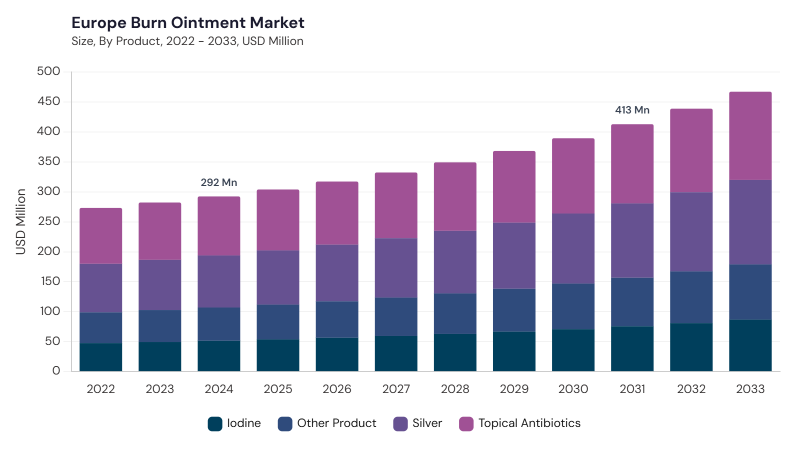
The Europe Burn Ointment Market evolved from traditional soothing and antiseptic remedies into specialized, clinically validated topical treatments designed to manage infection, support tissue repair, maintain wound hydration, and reduce scarring. Advances in dermatological research, antimicrobial science, sustained-release formulations, biocompatible polymers, and bioactive compounds progressively improved therapeutic performance. Harmonized regulatory standards across Europe further strengthened product quality, safety, and clinical acceptance. Current development increasingly emphasizes advanced drug delivery systems, natural and biocompatible ingredients, nanotechnology, personalized burn care, digital treatment monitoring, and multifunctional formulations suited to different burn severities and patient groups.
Natural and organic formulations, advanced biomaterials, digital health integration, and stronger regulatory validation are shaping current market development. Manufacturers are increasingly exploring nanoemulsions, liposomal encapsulation, hydrogels, controlled-release systems, plant-derived actives, antimicrobial peptides, and bioengineered compounds to improve healing and patient comfort. AI-assisted burn assessment, telemedicine, smart packaging, and remote monitoring are also supporting more personalized treatment pathways. At the same time, stringent regulatory requirements, high production costs, reimbursement differences, antimicrobial stewardship concerns, supply chain vulnerabilities, and competition from advanced wound dressings continue to influence commercialization and product adoption across Europe.
Based on Depth of Burn, the market is segmented into Minor Burns, Partial Thickness Burns, and Full Thickness Burns. The Minor Burns market dominated the Europe Burn Ointment Market by Depth of Burn in 2025, and would continue to be a dominant market till 2033; thereby, achieving a market value of USD 168.7 million by 2031, growing at a CAGR of 4.8 % during the forecast period. The Partial Thickness Burns market is expected to witness a CAGR of 6.3% during (2026 - 2033). Additionally, The Full Thickness Burns market is expected to witness highest CAGR of 6.4% during (2026 - 2033).
Minor Burns typically require soothing, moisturizing, analgesic, and gentle antimicrobial formulations intended for rapid symptom relief and uncomplicated wound recovery. Partial Thickness Burns require stronger antimicrobial protection, moisture retention, regenerative support, and scar-minimizing properties because of deeper tissue damage and greater infection risk. Full Thickness Burns represent the most severe category and generally require specialized hospital care, surgical intervention, grafting, and multidisciplinary management, with ointments serving complementary roles in wound-bed preparation, infection prevention, tissue protection, and postoperative recovery.
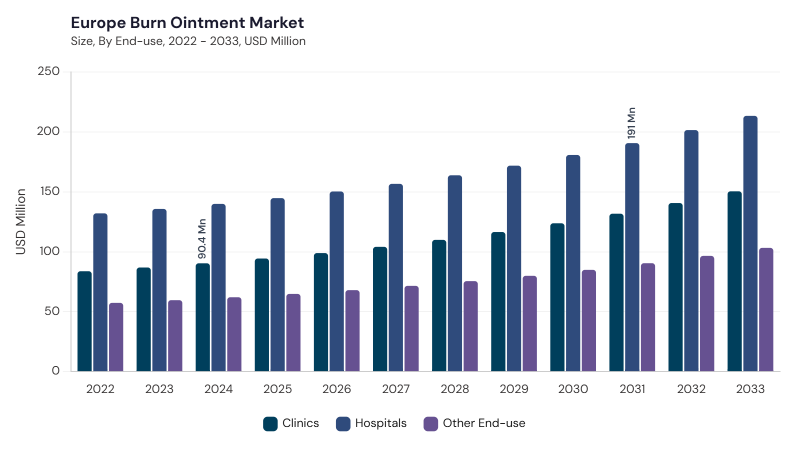
Based on End-use, the market is segmented into Hospitals, Clinics, and Other End-use. The Hospitals market dominated the Europe Burn Ointment Market by End-use in 2025, and would continue to be a dominant market till 2033; thereby, achieving a market value of USD 190.6 million by 2031, growing at a CAGR of 5.1 % during the forecast period. The Clinics market is expected to witness a CAGR of 6.2% during (2026 - 2033). Additionally, The Other End-use market is expected to witness highest CAGR of 6.2% during (2026 - 2033).
Hospitals use burn ointments across emergency departments, burn units, surgical wards, and postoperative care for antimicrobial protection, pain management, tissue regeneration, and graft-related wound support. Clinics primarily manage minor-to-moderate burns, dressing changes, follow-up treatment, scar prevention, and outpatient recovery using easy-to-apply topical products. Other End-use includes rehabilitation centers, community pharmacies, outpatient burn facilities, and home-care environments where ointments support long-term healing, moisturization, scar management, itching relief, and continued skin protection after acute treatment.
Based on Product, the market is segmented into Topical Antibiotics, Silver, Iodine, and Other Product. Topical Antibiotics provide localized antimicrobial activity for superficial and partial-thickness burns where bacterial infection risk requires targeted treatment. Silver-based ointments remain important because of broad-spectrum antimicrobial activity and their use in burns requiring enhanced infection control, while advances in nano-silver and controlled delivery are improving performance.
Iodine products are used selectively for rapid antiseptic action and contaminated wounds but remain influenced by cytotoxicity and clinical-use considerations. Other Product includes natural extracts, enzymatic formulations, regenerative compounds, scar-management products, growth factors, and combination therapies designed to address hydration, pain, tissue repair, and specialized wound-healing needs.
Free Valuable Insights: The Worldwide Burn Ointment Market is projected to reach USD 1804.6 Million billion by 2033, at a CAGR of 5.9%
Based on Country, the market is segmented into Germany, UK, France, Russia, Spain, Italy, and Rest of Europe. The Germany market dominated the Europe Burn Ointment Market by Country in 2025, and would continue to be a dominant market till 2033; thereby, achieving a market value of USD 67.7 million by 2031, growing at a CAGR of 3.9 % during the forecast period. The UK market is expected to witness a CAGR of 4.6% during (2026 - 2033). Additionally, The France market is expected to witness a CAGR of 6.5% during (2026 - 2033).
Across Europe, burn ointment adoption is being shaped by antimicrobial innovation, natural ingredients, advanced delivery technologies, regulatory alignment, and personalized wound care. Germany emphasizes antimicrobial efficacy, bio-derived compounds, nanotechnology, sustained-release systems, and patient-specific formulations, while the UK focuses on antimicrobial resistance management, natural and hypoallergenic ingredients, nanotechnology, and clinically validated treatments. France is advancing plant-derived bioactives, nanoencapsulation, bioadhesive technologies, ingredient transparency, and multifunctional wound-healing formulations, whereas Russia emphasizes botanical ingredients, nanoemulsions, targeted delivery, regulatory compliance, and domestic pharmaceutical development. Spain focuses on natural formulations, nanotechnology, digital access, bioactive peptides, and localized product development, while Italy emphasizes plant-derived ingredients, liposomal delivery, formulation safety, quality control, and personalized treatment. Rest of Europe continues to develop natural compounds, nanocarriers, controlled-release systems, multifunctional formulations, and evidence-based wound-healing products aligned with diverse healthcare and regulatory requirements.

By Depth of Burn
By End-use
By Product
By Country
Set to reach $412.8 Million by 2031, growing at 5.7% CAGR during 2026-2033.
Germany leads with $67.7 million by 2031, growing at 3.9% CAGR during the forecast period.
Rising demand for minor burn treatments, reaching $168.7 million by 2031 at 4.8% CAGR.
Hospitals segment will reach $190.6 million by 2031, growing at 5.1% CAGR during the forecast period.
The UK market is expected to witness a CAGR of 4.6% during 2026-2033.
Full Thickness Burns segment is expected to witness highest CAGR of 6.4% during 2026-2033.
Our team of dedicated experts can provide you with attractive expansion opportunities for your business.




 Unique Offerings