The sample copy of this report is available for access.
The North America Automotive Over-The-Air Updates Market is expected to reach USD 5.3 billion by 2032, growing at a CAGR of 17.8% during (2026 – 2033).
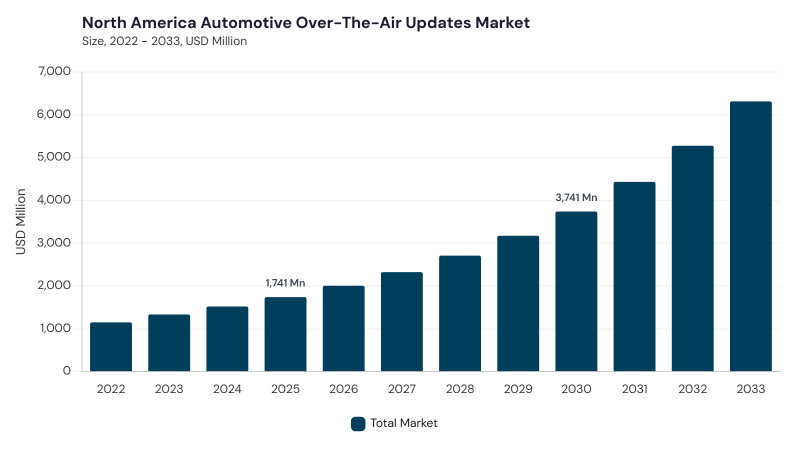
The North America Automotive Over-The-Air Market originated from the early use of telematics, remote diagnostics, and connected vehicle systems. Initially, vehicle software updates were handled through dealerships, physical service visits, or limited remote patches. As vehicles became more software-dependent, wireless communication, cloud platforms, embedded connectivity, and software-defined architectures changed how automakers managed vehicle functions. OTA updates gradually became important for improving infotainment, safety, firmware, and performance without physical intervention. Today, the market is closely linked with connected vehicles, cybersecurity, electric mobility, autonomous features, and digital vehicle lifecycle management.
The current North America Automotive Over-The-Air Market is shaped by software-defined vehicles, cybersecurity needs, 5G connectivity, ADAS upgrades, subscription-based vehicle features, and consumer demand for continuous digital improvement. Automakers are using OTA platforms to reduce service visits, manage recalls, improve vehicle performance, and activate new software-based features after purchase. Cloud providers, software firms, cybersecurity companies, semiconductor suppliers, and OEMs are collaborating to improve update reliability and scalability. The market is also moving toward AI-enabled diagnostics, fail-safe update systems, and secure software delivery. These trends are making OTA updates a core part of modern vehicle ownership and connected mobility.
Based on Technology, the market is segmented into Software OTA (SOTA), Firmware OTA (FOTA), and Full-System OTA (FSOTA). The Software OTA (SOTA) market dominated the North America Automotive Over-The-Air Updates Market by Technology in 2025, and would continue to be a dominant market till 2033; thereby, achieving a market value of USD 2.3 billion by 2032, growing at a CAGR of 17.3 % during the forecast period. The Firmware OTA (FOTA) market is expected to witness a CAGR of 18.2% during (2026 - 2033). The Full-System OTA (FSOTA) market is expected to witness a CAGR of 18.3% during (2026 - 2033).
Software OTA leads due to rising demand for remote infotainment upgrades, navigation updates, cybersecurity patches, connected services, and digital feature enhancements. It is easier to deploy compared to deeper system-level updates and supports frequent improvements across consumer-facing vehicle functions. Firmware OTA is gaining traction as automakers update ECUs, embedded systems, powertrain controls, and safety-related firmware remotely. Full-System OTA remains at an earlier stage but is expected to grow as centralized computing and software-defined vehicle platforms expand.
Based on Vehicle Type, the market is segmented into Hatchback & Sedan, SUV, LCV, and HCV. The Hatchback & Sedan market dominated the North America Automotive Over-The-Air Updates Market by Vehicle Type in 2025, and would continue to be a dominant market till 2033; thereby, achieving a market value of USD 1.9 billion by 2032, growing at a CAGR of 17 % during the forecast period. The SUV market is expected to witness a CAGR of 18% during (2026 - 2033). The HCV market is expected to witness a CAGR of 18.6% during (2026 - 2033).
The Hatchback & Sedan market dominated the North America Automotive Over-The-Air Market by Vehicle Type in 2025, and would continue to be a dominant market till 2033; thereby, achieving a market value of Not Available by 2033. The SUV segment recorded a significant revenue share in the North America Automotive Over-The-Air Market in 2025.
Hatchbacks and sedans lead due to large production volumes, broad consumer adoption, connected infotainment integration, and regular software updates for navigation, safety, and convenience features. SUVs are gaining strong momentum as manufacturers integrate premium connectivity, ADAS, hybrid systems, and remote software management capabilities. LCVs are supported by fleet digitalization, predictive maintenance, telematics, and connected logistics platforms. HCVs remain comparatively smaller but are gradually adopting OTA solutions for emissions compliance, safety updates, fleet monitoring, and uptime improvement.
Based on Vehicle Architecture Layer, the market is segmented into ECU-Level OTA, Domain Controller OTA, and Centralized/Zonal Architecture OTA. The ECU-Level OTA market dominated the North America Automotive Over-The-Air Updates Market by Vehicle Architecture Layer in 2025, and would continue to be a dominant market till 2033; thereby, achieving a market value of USD 2.1 billion by 2032, growing at a CAGR of 17.1 % during the forecast period. The Domain Controller OTA market is expected to witness a CAGR of 18.2% during (2026 - 2033). The Centralized/Zonal Architecture OTA market is expected to witness a CAGR of 18.4% during (2026 - 2033).
ECU-Level OTA leads because most connected and conventional vehicles still use multiple electronic control units that require targeted software patches, diagnostics, and calibration updates. This architecture supports legacy vehicles and early connected models where localized module updates are more practical. Domain Controller OTA is expanding as automakers consolidate vehicle functions into larger computing domains for powertrain, infotainment, chassis, and ADAS. Centralized and zonal OTA remains early but is gaining relevance with electric vehicles, autonomous platforms, and software-defined vehicle architectures.
Based on Connectivity Technology, the market is segmented into Cellular (3G/4G/5G), Wi-Fi OTA, V2X/Edge-assisted OTA, and Satellite OTA. Cellular connectivity dominates due to broad network availability, expanding 5G infrastructure, reliable remote software delivery, and suitability for vehicles operating across wide geographic areas.
Wi-Fi OTA remains important for large downloads at homes, dealerships, service centers, and controlled high-bandwidth locations. V2X and edge-assisted OTA are growing with intelligent transport systems, edge computing, connected infrastructure, and low-latency update requirements. Satellite OTA serves niche use cases for remote regions, long-haul vehicles, off-road fleets, and locations with limited terrestrial network coverage.
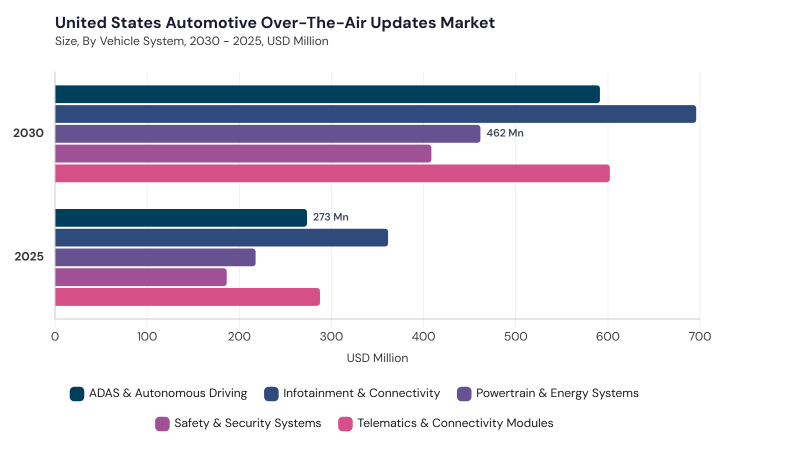
Based on Vehicle System, the market is segmented into Infotainment & Connectivity, Telematics & Connectivity Modules, ADAS & Autonomous Driving, Powertrain & Energy Systems, and Safety & Security Systems. Infotainment and connectivity lead as consumers expect updated navigation, multimedia platforms, smartphone integration, connected apps, and personalized digital experiences.
Telematics and connectivity modules are gaining importance as remote diagnostics, fleet management, vehicle tracking, and emergency services depend on secure software maintenance. ADAS and autonomous driving systems require regular updates to improve sensor algorithms, perception accuracy, and safety performance. Powertrain and energy systems benefit from EV and hybrid updates, while safety and security systems require frequent patches for cybersecurity and functional safety protection.
Free Valuable Insights: The Global Automotive Over-The-Air Updates Market will hit USD 18.3 Billion billion by 2033, at a CAGR of 18.4%
Based on Country, the market is segmented into US, Canada, Mexico, and Rest of North America. The US market dominated the North America Automotive Over-The-Air Updates Market by Country in 2025, and would continue to be a dominant market till 2033; thereby, achieving a market value of USD 3.8 billion by 2032, growing at a CAGR of 17 % during the forecast period. The Canada market is expected to witness a CAGR of 20.4% during (2026 - 2033). Additionally, The Mexico market is expected to witness a CAGR of 19.2% during (2026 - 2033).
The US leads due to strong OEM investments, software-defined vehicle adoption, connected EV platforms, cloud infrastructure, cybersecurity focus, and subscription-based vehicle services. Canada supports regional growth through connected vehicle adoption, data privacy requirements, cloud-based diagnostics, and rising demand for personalized vehicle experiences. Mexico is gaining importance through automotive manufacturing clusters, regional software development, EV production, and partnerships with telecom and technology providers. Rest of North America contributes through connected mobility adoption, OTA-enabled fleet operations, and demand for secure remote software management.

By Technology
By Vehicle Type
By Vehicle Architecture Layer
By Connectivity Technology
By Vehicle System
By Country
Set to reach USD 5.3 billion by 2033, growing at 17.8% CAGR during 2026-2033.
The US leads with USD 3.8 billion by 2032, growing at 17% CAGR during the forecast period.
Software OTA (SOTA) segment dominates, reaching USD 2.3 billion by 2032 at 17.3% CAGR during the forecast period.
Hatchback & Sedan segment will reach USD 1.9 billion by 2032, growing at 17% CAGR during the forecast period.
Canada is expected to witness a CAGR of 20.4% during 2026-2033.
ECU-Level OTA segment will reach USD 2.1 billion by 2032, growing at 17.1% CAGR during the forecast period.
Our team of dedicated experts can provide you with attractive expansion opportunities for your business.




 Unique Offerings