The sample copy of this report is available for access.
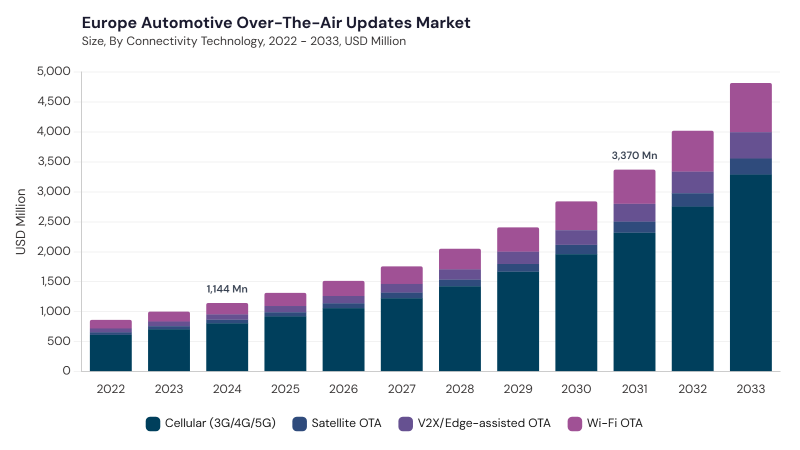
The Europe Automotive Over-The-Air Updates Market is expected to reach USD 3.4 billion by 2031, growing at a CAGR of 18% during (2026 – 2033).
The Europe Automotive Over-The-Air Market originated from the growing digitalization of vehicles and the need to reduce physical service visits for software maintenance. Early OTA use was limited to basic firmware patches, diagnostics, and minor infotainment updates. As vehicles adopted more electronic control units, connected systems, cloud platforms, and secure communication technologies, OTA evolved into a structured remote software delivery model. The rise of software-defined vehicles further transformed OTA from a convenience feature into a core lifecycle management tool. Today, the market is strongly shaped by vehicle connectivity, regulatory compliance, data privacy, electrification, and cybersecurity needs.
The current Europe Automotive Over-The-Air Market is driven by software-defined vehicle architectures, connected mobility, electric vehicle growth, ADAS adoption, and strict cybersecurity regulations. Automakers are using OTA updates to improve vehicle performance, deliver security patches, support emissions compliance, and enhance digital cockpit experiences. Cloud platforms, edge computing, eSIM connectivity, and AI-based diagnostics are strengthening update reliability and personalization. Demand is also rising as OEMs look to reduce recall costs and create continuous post-sale software services. These trends are making OTA updates a central part of Europe’s connected and software-led automotive ecosystem.
Based on Technology, the market is segmented into Software OTA (SOTA), Firmware OTA (FOTA), and Full-System OTA (FSOTA). The Software OTA (SOTA) market dominated the Europe Automotive Over-The-Air Updates Market by Technology in 2025, and would continue to be a dominant market till 2033; thereby, achieving a market value of USD 1.5 billion by 2031, growing at a CAGR of 17.5 % during the forecast period. The Firmware OTA (FOTA) market is expected to witness a CAGR of 18.4% during (2026 - 2033). The Full-System OTA (FSOTA) market is expected to witness a CAGR of 18.4% during (2026 - 2033).
Software OTA leads due to growing use of connected infotainment, navigation, telematics, digital cockpit features, and non-safety-critical software improvements. It supports frequent updates, feature enhancements, bug fixes, and customer experience upgrades without dealership visits. Firmware OTA is gaining adoption as manufacturers remotely manage ECU firmware, embedded control systems, safety functions, and compliance-related updates. Full-System OTA remains at an earlier stage but is gaining importance as premium electric vehicles and software-defined platforms require synchronized updates across multiple vehicle domains.
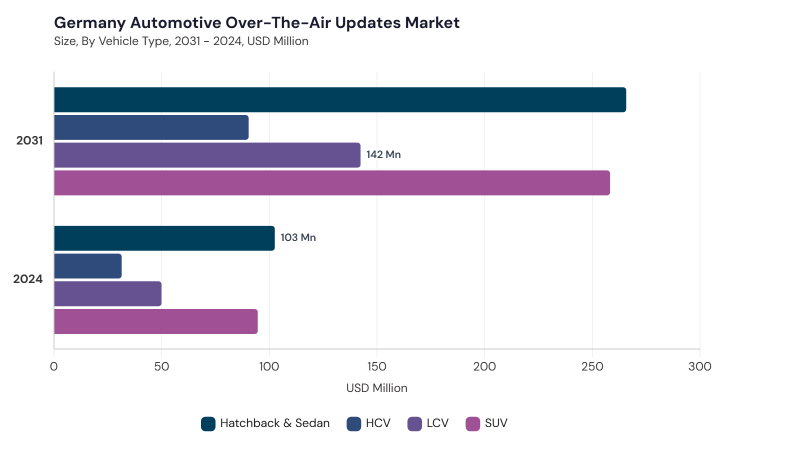
Based on Vehicle Type, the market is segmented into Hatchback & Sedan, SUV, LCV, and HCV. The Hatchback & Sedan market dominated the Europe Automotive Over-The-Air Updates Market by Vehicle Type in 2025, and would continue to be a dominant market till 2033; thereby, achieving a market value of USD 1.2 billion by 2031, growing at a CAGR of 17.2 % during the forecast period. The SUV market is expected to witness a CAGR of 18.2% during (2026 - 2033). The HCV market is expected to witness a CAGR of 18.8% during (2026 - 2033).
Hatchbacks and sedans lead due to their strong presence across European urban and suburban mobility, along with broad integration of infotainment, navigation, telematics, and driver assistance features. SUVs are gaining momentum as consumers increasingly prefer technologically advanced models with ADAS, connectivity, hybrid systems, and premium digital services. LCVs benefit from fleet digitalization, e-commerce logistics, remote diagnostics, route management, and software-based maintenance. HCVs remain smaller but are steadily adopting OTA for emissions compliance, powertrain optimization, predictive maintenance, and connected fleet operations.
Based on Vehicle Architecture Layer, the market is segmented into ECU-Level OTA, Domain Controller OTA, and Centralized/Zonal Architecture OTA. The ECU-Level OTA market dominated the Europe Automotive Over-The-Air Updates Market by Vehicle Architecture Layer in 2025, and would continue to be a dominant market till 2033; thereby, achieving a market value of USD 1.3 billion by 2031, growing at a CAGR of 17.3 % during the forecast period. The Domain Controller OTA market is expected to witness a CAGR of 18.4% during (2026 - 2033). The Centralized/Zonal Architecture OTA market is expected to witness a CAGR of 18.6% during (2026 - 2033).
ECU-Level OTA leads because a large installed base of European vehicles still relies on multiple electronic control units requiring individual patches, calibrations, security updates, and diagnostics. It remains important for legacy vehicles, entry-level models, and early connected vehicle platforms. Domain Controller OTA is expanding as automakers consolidate functions such as powertrain, chassis, infotainment, and ADAS into centralized domain units. Centralized and zonal architecture OTA is still emerging but is gaining relevance with electric vehicles, autonomous features, software-defined vehicles, and high-bandwidth in-vehicle networks.
Based on Connectivity Technology, the market is segmented into Cellular (3G/4G/5G), Wi-Fi OTA, V2X/Edge-assisted OTA, and Satellite OTA. Cellular connectivity dominates due to Europe’s broad mobile network coverage, expanding 5G infrastructure, cross-border connectivity, and strong suitability for remote update delivery. Wi-Fi OTA complements cellular networks by supporting large downloads at homes, dealerships, service centers, and stable high-bandwidth locations.
V2X and edge-assisted OTA are gaining traction with connected transport programs, smart mobility infrastructure, and low-latency update requirements. Satellite OTA serves specialized use cases for commercial fleets, long-haul vehicles, remote operations, and areas where terrestrial connectivity is limited.
Based on Vehicle System, the market is segmented into Infotainment & Connectivity, Telematics & Connectivity Modules, ADAS & Autonomous Driving, Powertrain & Energy Systems, and Safety & Security Systems. Infotainment and connectivity lead due to rising consumer demand for digital cockpit experiences, cloud navigation, multimedia services, smartphone integration, voice features, and connected applications. Telematics and connectivity modules are expanding through fleet monitoring, emergency assistance, remote diagnostics, and connected mobility services.
ADAS and autonomous driving systems require continuous software refinements for sensor performance, safety algorithms, and automated driving functions. Powertrain and energy systems benefit from EV and hybrid battery management updates, while safety and security systems require secure patches and vulnerability management.
Free Valuable Insights: The Global Automotive Over-The-Air Updates Market will hit USD 18.3 Billion billion by 2033, at a CAGR of 18.4%
Based on Country, the market is segmented into Germany, UK, France, Russia, Spain, Italy, and Rest of Europe. The Germany market dominated the Europe Automotive Over-The-Air Updates Market by Country in 2025, and would continue to be a dominant market till 2033; thereby, achieving a market value of USD 756.8 million by 2031, growing at a CAGR of 16.5 % during the forecast period. The UK market is expected to witness a CAGR of 16.8% during (2026 - 2033). Additionally, The France market is expected to witness a CAGR of 18.8% during (2026 - 2033).
Germany leads due to its strong automotive manufacturing base, advanced connected vehicle ecosystem, software-defined vehicle development, and strict cybersecurity compliance focus. The UK supports growth through cloud-based platforms, EV adoption, connected fleet services, and regulatory emphasis on safety and data protection. France benefits from eSIM adoption, AI-powered diagnostics, cybersecurity-focused OTA platforms, and growing electric vehicle integration. Russia, Spain, and Italy contribute through connected vehicle adoption, localization strategies, telecom partnerships, and digital vehicle lifecycle management, while Rest of Europe adds demand from smart mobility and fleet modernization.

By Technology
By Vehicle Type
By Vehicle Architecture Layer
By Connectivity Technology
By Vehicle System
By Country
Set to reach USD 3.4 billion by 2031, growing at 18% CAGR during 2026-2033.
Germany leads with USD 756.8 million by 2031, growing at 16.5% CAGR during the forecast period.
High growth in the Full-System OTA segment with an 18.4% CAGR during 2026-2033.
Software OTA segment to reach USD 1.5 billion by 2031, growing at 17.5% CAGR during the forecast period.
France market is expected to witness a CAGR of 18.8% during 2026-2033.
Hatchback & Sedan segment to reach USD 1.2 billion by 2031, growing at 17.2% CAGR during the forecast period.
Our team of dedicated experts can provide you with attractive expansion opportunities for your business.




 Unique Offerings