The sample copy of this report is available for access.
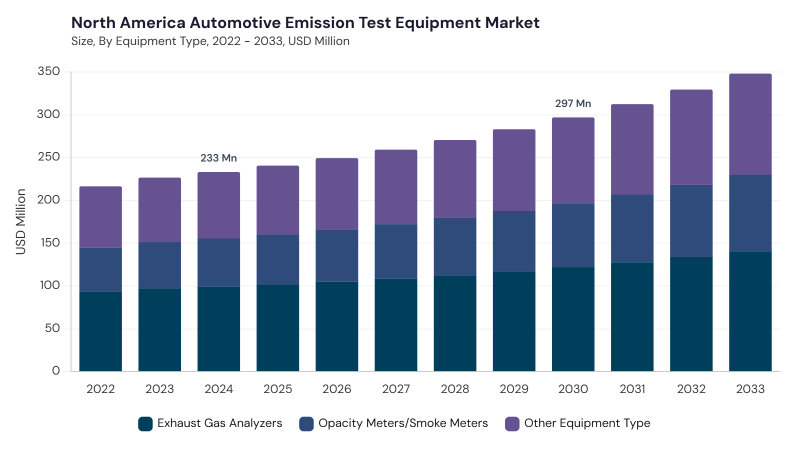
The North America Automotive Emission Test Equipment Market is expected to reach USD 329.4 million by 2032, growing at a CAGR of 4.9% during (2026 - 2033).
The North America Automotive Emission Test Equipment Market evolved from basic exhaust testing instruments measuring carbon monoxide and hydrocarbons into sophisticated systems capable of assessing nitrogen oxides, particulate matter, and complex vehicle emission profiles. Regulatory developments, including tighter vehicle emission standards and updates to the Clean Air Act, accelerated adoption of advanced analyzers, dynamometers, on-board diagnostic validation, and real-time monitoring technologies. The market has progressively expanded from conventional laboratory testing toward portable and on-road measurement. Current systems increasingly support hybrid vehicles, alternative powertrains, advanced diagnostics, and digitally integrated compliance workflows.
Stricter emission regulations, electrification, real-world testing, and digital transformation are shaping current market development. Manufacturers are integrating high-sensitivity sensors, portable emission measurement systems, remote sensing technologies, cloud-based analytics, artificial intelligence, automated calibration, and real-time data acquisition to improve accuracy and compliance efficiency. Growing hybrid and electric vehicle adoption is also encouraging modular testing platforms capable of addressing changing powertrain architectures and energy-related assessments. At the same time, high equipment costs, frequent calibration requirements, regulatory complexity, legacy-system limitations, and technical challenges associated with emerging vehicle technologies continue to influence adoption.
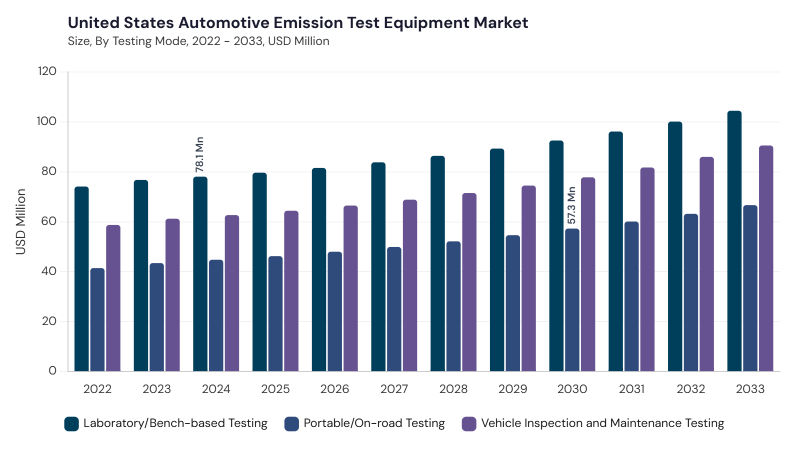
Based on Testing Mode, the market is segmented into Laboratory/Bench-based Testing, Vehicle Inspection and Maintenance Testing, and Portable/On-road Testing. The Laboratory/Bench-based Testing market dominated the North America Automotive Emission Test Equipment Market by Testing Mode in 2025, and would continue to be a dominant market till 2033; thereby, achieving a market value of USD 132.5 million by 2032, growing at a CAGR of 4.3 % during the forecast period. The Vehicle Inspection and Maintenance Testing market is expected to witness a CAGR of 5.2% during (2026 - 2033). Additionally, The Portable/On-road Testing market is expected to witness highest CAGR of 5.5% during (2026 - 2033).
Laboratory/Bench-based Testing uses dynamometers, chassis test cells, advanced analyzers, and standardized driving cycles to provide repeatable emission measurements for development and certification. Vehicle Inspection and Maintenance Testing evaluates in-use vehicles to identify deterioration, malfunctioning emission controls, or excessive pollutants throughout the vehicle lifecycle. Portable/On-road Testing uses PEMS and related technologies to measure emissions during real-world driving conditions, strengthening compliance assessment beyond controlled environments. Increasing regulatory scrutiny, digital data collection, and real-world verification are expanding the role of all three testing modes.
Based on Equipment Type, the market is segmented into Exhaust Gas Analyzers, Opacity Meters/Smoke Meters, and Other Equipment Type. The Exhaust Gas Analyzers market dominated the North America Automotive Emission Test Equipment Market by Equipment Type in 2025, and would continue to be a dominant market till 2033; thereby, achieving a market value of USD 133.9 million by 2032, growing at a CAGR of 4.3 % during the forecast period. The Opacity Meters/Smoke Meters market is expected to witness a CAGR of 5.7% during (2026 - 2033). Additionally, The Other Equipment Type market is expected to witness highest CAGR of 5% during (2026 - 2033).
Exhaust Gas Analyzers measure pollutants including carbon monoxide, carbon dioxide, hydrocarbons, oxygen, and nitrogen oxides across laboratory, engine, and portable testing environments. Opacity Meters/Smoke Meters primarily support diesel emission assessment by measuring visible smoke and particulate-related opacity from commercial and heavy-duty vehicles. Other Equipment Type includes particulate measurement devices, sampling systems, dilution tunnels, transient measurement tools, and complementary diagnostic instruments required for increasingly comprehensive emission assessment. Advances in sensor sensitivity, data logging, remote monitoring, and multi-pollutant measurement are improving equipment accuracy and flexibility.
Based on Vehicle Type, the market is segmented into Passenger Cars, Heavy Commercial Vehicles, Light Commercial Vehicles, and Two-wheelers and Three-wheelers. Passenger Cars require emission testing across internal combustion, hybrid, and increasingly electrified architectures using laboratory, diagnostic, and real-world testing systems. Heavy Commercial Vehicles require specialized equipment for diesel emissions, NOx, particulate matter, durability testing, and real-world fleet compliance.
Light Commercial Vehicles increasingly require adaptable testing solutions as delivery and business fleets transition toward hybrid, alternative-fuel, and electric platforms. Two-wheelers and Three-wheelers represent a smaller regional application but require compact analyzers and specialized test systems as regulatory attention and alternative mobility applications gradually develop.
Free Valuable Insights: The Global Automotive Emission Test Equipment Market will hit USD 1367.4 Million billion by 2033, at a CAGR of 5.6%
Based on Country, the market is segmented into US, Canada, Mexico, and Rest of North America. The US market dominated the North America Automotive Emission Test Equipment Market by Country in 2025, and would continue to be a dominant market till 2033; thereby, achieving a market value of USD 249.3 million by 2032, growing at a CAGR of 4.2 % during the forecast period. The Canada market is expected to witness a CAGR of 7.3% during (2026 - 2033). Additionally, The Mexico market is expected to witness a CAGR of 6.2% during (2026 - 2033).
Across North America, automotive emission testing is being shaped by regulatory tightening, electrification, portable measurement, digital analytics, and evolving vehicle architectures. The US emphasizes EPA and CARB-aligned testing, low-NOx compliance, real-world emissions measurement, digital reporting, and systems adapted to hybrid and electric vehicles, while Canada focuses on increasingly sensitive emission detection, connected testing platforms, remote monitoring, real-driving emissions, and adaptable equipment for changing powertrains. Mexico is advancing particulate and NOx measurement, automated testing, cloud-based analytics, localization of service capabilities, and multi-parameter systems suited to its expanding automotive manufacturing base, whereas Rest of North America increasingly emphasizes PEMS, modular test platforms, alternative-fuel compatibility, real-time analytics, and compliance-oriented digital integration.

By Testing Mode
By Equipment Type
By Vehicle Type
By Country
Set to reach $329.4 Million by 2032, growing at 4.9% CAGR during 2026-2033.
The US leads with $249.3 million by 2032, growing at 4.2% CAGR during 2026-2033.
Rising demand for laboratory/bench-based testing, reaching $132.5 million by 2032 at 4.3% CAGR.
Expected to witness a CAGR of 5.2% during 2026-2033.
Canada is expected to witness a CAGR of 7.3% during 2026-2033.
Expected to witness a CAGR of 5.7% during 2026-2033.
Our team of dedicated experts can provide you with attractive expansion opportunities for your business.




 Unique Offerings