The sample copy of this report is available for access.
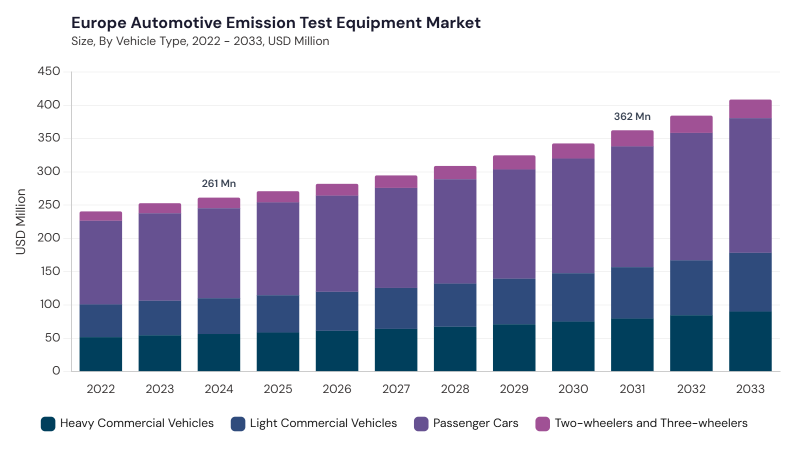
The Europe Automotive Emission Test Equipment Market is expected to reach USD 362.4 million by 2031, growing at a CAGR of 5.4% during (2026 - 2033).
The Europe Automotive Emission Test Equipment Market evolved from basic exhaust gas analyzers and opacity meters into sophisticated platforms capable of measuring multiple pollutants under laboratory and real-world driving conditions. Progressive tightening of Euro emission standards accelerated the adoption of advanced analyzers, dynamometers, portable measurement systems, durability testing, and digitally integrated platforms. Euro 5 and Euro 6 represented important milestones in shifting testing beyond stationary environments toward more precise and comprehensive assessment. Current development increasingly emphasizes lower detection thresholds, real-time analytics, portable testing, non-exhaust measurement, and systems capable of supporting hybrid and electric vehicle architectures.
Euro 7 readiness, real-driving emissions testing, electrification, digitalization, and non-exhaust pollutant measurement are shaping current market development. Testing providers are advancing PEMS, multi-pollutant analyzers, IoT-enabled systems, cloud-based analytics, AI-assisted diagnostics, and automated testing platforms to improve accuracy and regulatory compliance. Increasing hybrid and electric vehicle adoption is also broadening testing requirements toward brake and tire particles, battery-related assessments, and energy-performance evaluation. At the same time, high capital expenditure, calibration costs, regulatory complexity, data-integration barriers, interoperability challenges, and continuous equipment-upgrade requirements continue to influence adoption.
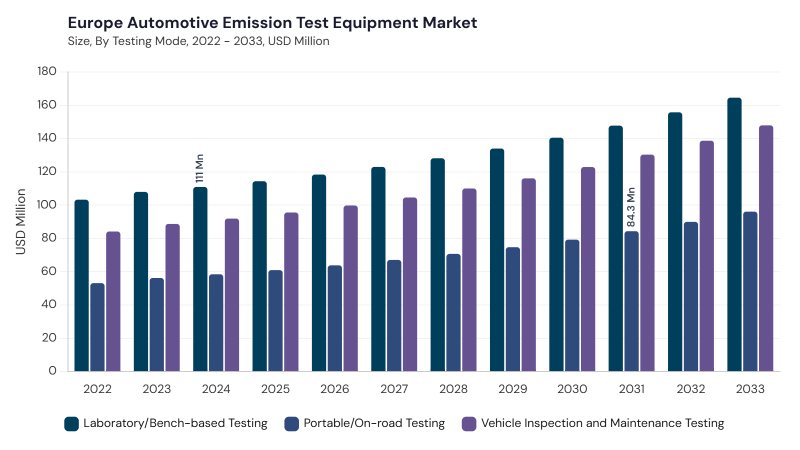
Based on Testing Mode, the market is segmented into Laboratory/Bench-based Testing, Vehicle Inspection and Maintenance Testing, and Portable/On-road Testing. The Laboratory/Bench-based Testing market dominated the Europe Automotive Emission Test Equipment Market by Testing Mode in 2025, and would continue to be a dominant market till 2033; thereby, achieving a market value of USD 147.7 million by 2031, growing at a CAGR of 4.8 % during the forecast period. The Vehicle Inspection and Maintenance Testing market is expected to witness a CAGR of 5.8% during (2026 - 2033). Additionally, The Portable/On-road Testing market is expected to witness highest CAGR of 6% during (2026 - 2033).
Laboratory/Bench-based Testing uses chassis dynamometers, engine test stands, gas analyzers, and standardized driving cycles to provide repeatable and controlled emission assessment. Vehicle Inspection and Maintenance Testing supports periodic roadworthiness and in-use compliance programs by identifying malfunctioning or deteriorated emission-control systems. Portable/On-road Testing uses PEMS, compact sensors, and GPS-enabled systems to evaluate pollutant output under actual traffic, terrain, and environmental conditions. Increasing RDE requirements, digital monitoring, and regulatory focus on real-world emissions are strengthening the role of portable testing alongside laboratory and inspection methods.
Based on Equipment Type, the market is segmented into Exhaust Gas Analyzers, Opacity Meters/Smoke Meters, and Other Equipment Type. The Exhaust Gas Analyzers market dominated the Europe Automotive Emission Test Equipment Market by Equipment Type in 2025, and would continue to be a dominant market till 2033; thereby, achieving a market value of USD 149.2 million by 2031, growing at a CAGR of 4.8 % during the forecast period. The Opacity Meters/Smoke Meters market is expected to witness a CAGR of 6.3% during (2026 - 2033). Additionally, The Other Equipment Type market is expected to witness highest CAGR of 5.6% during (2026 - 2033).
Exhaust Gas Analyzers measure pollutants such as carbon monoxide, carbon dioxide, nitrogen oxides, and hydrocarbons across laboratory and field environments. Opacity Meters/Smoke Meters primarily evaluate smoke density and particulate-related emissions from diesel vehicles, supporting roadside inspections and periodic technical testing. Other Equipment Type includes dynamometers, particle counters, brake emission analyzers, exhaust flow meters, sampling systems, and complementary instruments used for comprehensive emission assessment. Advances in multi-gas sensing, particulate measurement, wireless connectivity, digital reporting, and automated data management are increasing the functionality of these systems.
Based on Vehicle Type, the market is segmented into Passenger Cars, Heavy Commercial Vehicles, Light Commercial Vehicles, and Two-wheelers and Three-wheelers. Passenger Cars require laboratory, portable, diagnostic, and real-driving emission testing across gasoline, diesel, hybrid, and increasingly electric vehicle platforms. Heavy Commercial Vehicles need specialized dynamometers, gas analyzers, soot measurement systems, durability equipment, and PEMS for diesel-related NOx and particulate compliance.
Light Commercial Vehicles require adaptable testing solutions suited to urban delivery, service operations, hybridization, and changing duty cycles. Two-wheelers and Three-wheelers use specialized analyzers, compact dynamometers, and portable measurement technologies as regulatory requirements and urban air-quality priorities continue to evolve.
Free Valuable Insights: The Worldwide Automotive Emission Test Equipment Market is projected to reach USD 1367.4 Million billion by 2033, at a CAGR of 5.6%
Based on Country, the market is segmented into Germany, UK, France, Russia, Spain, Italy, and Rest of Europe. The Germany market dominated the Europe Automotive Emission Test Equipment Market by Country in 2025, and would continue to be a dominant market till 2033; thereby, achieving a market value of USD 78.4 million by 2031, growing at a CAGR of 4.1 % during the forecast period. The UK market is expected to witness a CAGR of 4.2% during (2026 - 2033). Additionally, The France market is expected to witness a CAGR of 6.3% during (2026 - 2033).
Across Europe, automotive emission testing is being shaped by stricter regulations, real-driving measurement, electrification, digital integration, and broader pollutant assessment. Germany emphasizes high-precision sensors, digital testing platforms, real-time monitoring, hybrid and electric vehicle testing, and modular systems, while the UK focuses on PEMS, brake-emission measurement, hybrid powertrain simulation, and advanced pollutant sensing. France is advancing real-world testing, OBD-compatible systems, portable equipment, cloud analytics, and non-exhaust assessment, whereas Russia emphasizes automated analyzers, localization, real-time monitoring, AI-enabled diagnostics, and hybrid and electric vehicle testing. Spain focuses on RDE, portable systems, telematics integration, electric powertrain diagnostics, and cloud-based analytics, while Italy emphasizes IoT-enabled testing, modular portable systems, greenhouse gas measurement, and advanced sensor integration. Rest of Europe continues to develop PEMS, multi-pollutant platforms, connected analytics, modular systems, and testing solutions compatible with hybrid and electric powertrains.

By Testing Mode
By Equipment Type
By Vehicle Type
By Country
Set to reach $362.4 Million by 2031, growing at 5.4% CAGR during 2026-2033.
Germany leads with $78.4 million by 2031, growing at 4.1% CAGR during the forecast period.
Rising demand for portable/on-road testing with a 6% CAGR during 2026-2033.
Laboratory/Bench-based Testing hits $147.7 million by 2031, growing at 4.8% CAGR during the forecast period.
France market is expected to witness a CAGR of 6.3% during 2026-2033.
Exhaust Gas Analyzers reach $149.2 million by 2031, growing at 4.8% CAGR during the forecast period.
Our team of dedicated experts can provide you with attractive expansion opportunities for your business.




 Unique Offerings