The sample copy of this report is available for access.
The North America AI-Powered Marketing Services Market is expected to reach USD 37.9 billion by 2032, growing at a CAGR of 20.8% during (2026 - 2033).
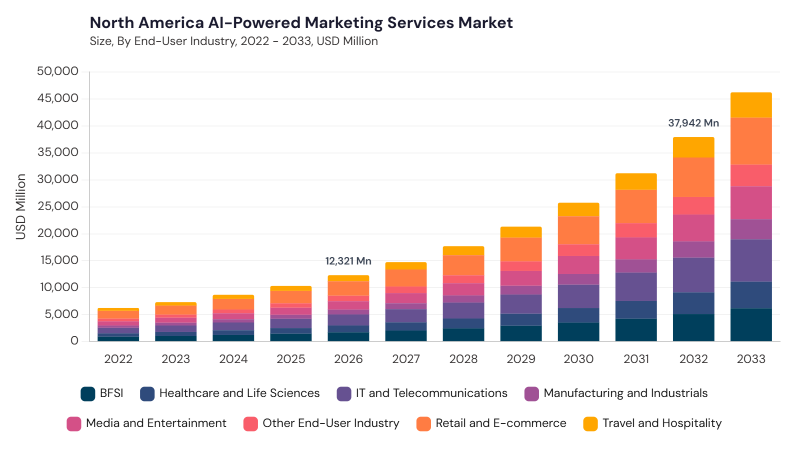
North America AI-Powered Marketing Services Market originated from the intersection of artificial intelligence advancement and rising demand for data-driven marketing solutions. Early adoption focused on basic automation, campaign management, audience segmentation, and analytics tools, before machine learning, natural language processing, predictive analytics, and computer vision expanded marketing intelligence. Cloud computing enabled scalable AI deployment, while deep learning strengthened sentiment analysis and customer behavior prediction. The market has now moved from niche use cases into integrated AI-driven marketing ecosystems focused on measurable and optimized outcomes.
Hyper-personalization, omnichannel orchestration, generative AI, predictive analytics, and AIaaS are shaping current market development. Marketing teams increasingly use AI to tailor content, automate campaign decisions, optimize spend, generate creative assets, and unify customer insights across digital and physical channels. However, data privacy, regulatory compliance, implementation cost, legacy-system integration, data quality, talent availability, and ROI uncertainty continue to influence adoption. Vendors compete through algorithmic accuracy, platform integration, compliance strength, scalable cloud delivery, customization, and measurable campaign uplift.
Based on Organization Size, the market is segmented into Large Enterprises and Small and Medium-sized Enterprises. The Large Enterprises market dominated the North America AI-Powered Marketing Services Market by Organization Size in 2025, and would continue to be a dominant market till 2033; thereby, achieving a market value of USD 24.0 billion by 2032, growing at a CAGR of 20.5 % during the forecast period. Additionally, The Small and Medium-sized Enterprises market is expected to witness highest CAGR of 21.4% during (2026 - 2033).
Large enterprises use AI for personalization, predictive analytics, customer journey orchestration, campaign optimization, segmentation, content generation, sentiment analysis, and real-time decision-making across complex B2B and B2C environments. Their scale supports customized AI models, enterprise data integration, security governance, and advanced compliance controls. Small and Medium-sized Enterprises maintained a promising presence as cloud platforms, subscription models, AIaaS, chatbots, automated content tools, and user-friendly marketing automation reduce adoption barriers. SMEs prioritize affordability, quick deployment, social media automation, lead generation, customer segmentation, and measurable marketing ROI.
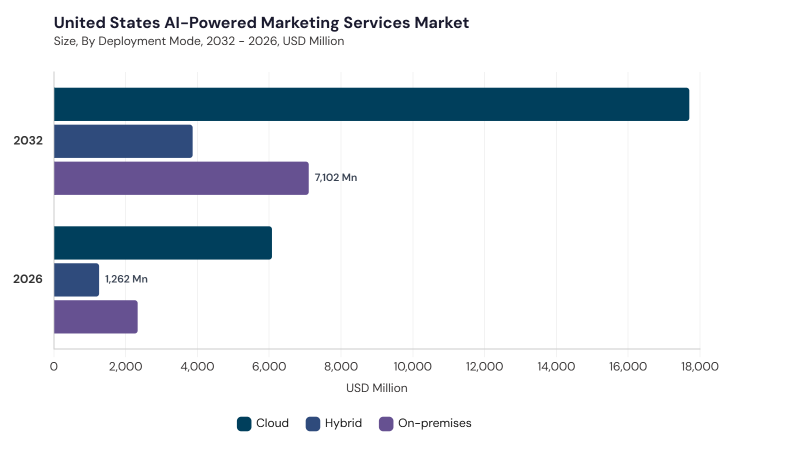
Based on Deployment Mode, the market is segmented into Cloud, On-premises, and Hybrid. Cloud deployment supports rapid implementation, flexible scaling, AIaaS adoption, API-based integration, SaaS marketing tools, campaign automation, programmatic advertising, and real-time customer engagement without heavy internal infrastructure.
On-premises retained a considerable presence among enterprises requiring tighter data governance, proprietary AI models, customized systems, and controlled integration with legacy infrastructure. Hybrid remained a promising segment as organizations combine cloud-based AI power with internally controlled data and applications. This approach balances scalability, privacy, compliance, operating flexibility, and gradual AI modernization.
Based on End-User Industry, the market is segmented into Retail and E-commerce, IT and Telecommunications, BFSI, Healthcare and Life Sciences, Media and Entertainment, Travel and Hospitality, Manufacturing and Industrials, and Other End-User Industry. Retail and E-commerce uses AI for product recommendations, pricing, sentiment analysis, promotional automation, chatbots, customer journey analytics, and conversion improvement.
IT and Telecommunications secured a substantial share through churn analysis, lead generation, subscriber engagement, and account targeting, while BFSI used AI for personalized financial communication, customer acquisition, compliance messaging, and cross-selling. Healthcare and Life Sciences adopted AI for patient and professional engagement, while Media and Entertainment relied on audience analytics, content discovery, and ad optimization. Travel and Hospitality used personalized offers and demand-oriented campaigns, whereas Manufacturing and Industrials developed opportunities in B2B lead intelligence, account-based marketing, distributor engagement, and AI-assisted sales enablement.
Free Valuable Insights: The Global AI-Powered Marketing Services Market will hit USD 111.6 Billion billion by 2033, at a CAGR of 21.3%
Based on Country, the market is segmented into US, Canada, Mexico, and Rest of North America. The US market dominated the North America AI-Powered Marketing Services Market by Country in 2025, and would continue to be a dominant market till 2033; thereby, achieving a market value of USD 28.6 billion by 2032, growing at a CAGR of 20 % during the forecast period. The Canada market is expected to witness a CAGR of 23.5% during (2026 - 2033). Additionally, The Mexico market is expected to witness a CAGR of 22.7% during (2026 - 2033).
Across North America, AI-powered marketing service adoption varies with digital advertising maturity, enterprise AI readiness, cloud adoption, privacy regulation, localization needs, and marketing technology ecosystems. The US emphasizes hyper-personalization, omnichannel AI, programmatic advertising, generative AI, data privacy, ethical AI, and large-scale platform innovation, while Canada focuses on conversational AI, bilingual and multicultural localization, privacy-preserving analytics, omnichannel engagement, and compliance-driven trust. Mexico is advancing through cloud adoption, internet penetration, real-time analytics, omnichannel marketing, local-language intelligence, and SME adoption. Rest of North America reflects continued demand for hyper-personalization, scalable AI services, privacy-focused tools, regional customization, and integrated digital marketing ecosystems.

By Organization Size
By Deployment Mode
By End-User Industry
By Country
Set to reach $37.9 Billion by 2032, growing at 20.8% CAGR during 2026-2033.
The US leads with $28.6 billion by 2032, growing at a 20% CAGR during 2026-2033.
Rising enterprise cloud adoption and AI-driven workloads are the main catalysts.
Large Enterprises segment will reach $24.0 billion by 2032, growing at a 20.5% CAGR during 2026-2033.
The Canada market is expected to witness a 23.5% CAGR during 2026-2033.
SMEs are expected to witness the highest CAGR of 21.4% during 2026-2033.
Our team of dedicated experts can provide you with attractive expansion opportunities for your business.




 Unique Offerings
