Global AI-Powered Marketing Services Market Size, Share & Industry Analysis Report By Organization Size (Large Enterprises, and Small and Medium-sized Enterprises), By Deployment Mode (Cloud, and On-premises), By End-User Industry (Retail and E-commerce, and IT and Telecommunications), By Regional Outlook and Forecast, 2026 - 2033
Report Id: KBV-31901Publication Date: October-2026Number of Pages: 620Report Format: PDF + Excel + Interactive Dashboard
Special Offering:
Industry Insights | Market Trends Highest number of Tables | 24/7 Analyst Support
Sample Report Available
The sample copy of this report is available for access.
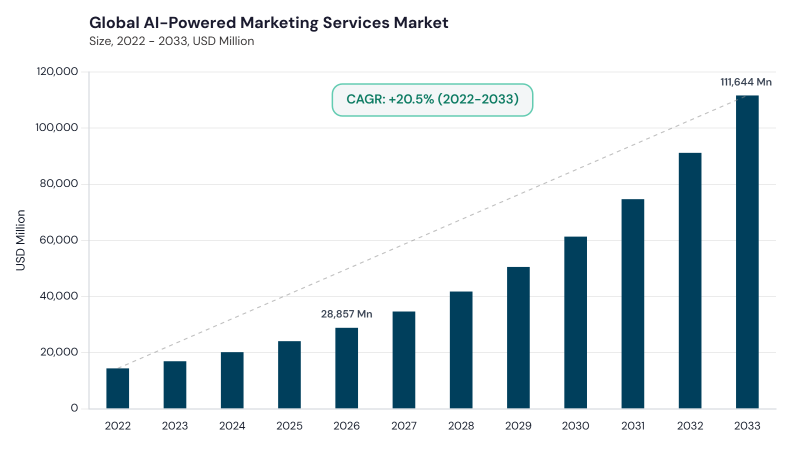
Growing demand for personalized customer engagement, automated campaign management, predictive analytics, and data-driven marketing decision-making is driving the AI-Powered Marketing Services Market across retail, BFSI, media, healthcare, travel, technology, and other industries. Organizations are using AI-powered services to improve customer targeting, content creation, conversion rates, campaign productivity, and return on marketing investment. Growth is further strengthened by generative AI expansion, larger customer-data volumes, digital advertising growth, and integration with marketing automation platforms.
Key Market Trends & Insights
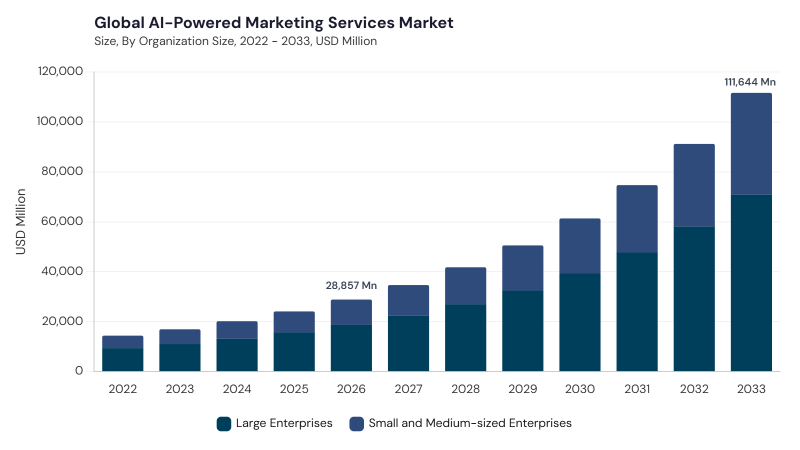
By organization size, Large Enterprises dominated with a revenue share of 64.90% in 2025 and are projected to reach USD 70.8 billion by 2033, growing at a CAGR of 21.0% during (2026 - 2033).
Small and Medium-sized Enterprises accounted for 35.10% of revenue in 2025 and are projected to reach USD 40.7 billion by 2033, registering the higher organization-size CAGR of 21.9% during (2026 - 2033).
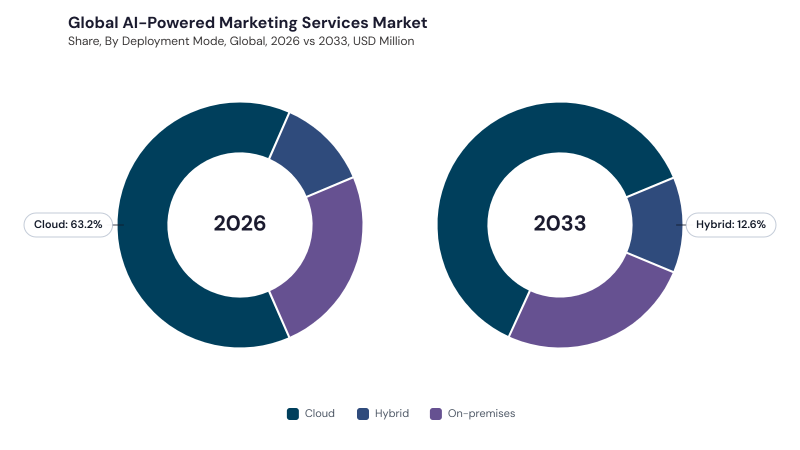
By deployment mode, Cloud led with a revenue share of 63.33% in 2025 and is projected to reach USD 69.0 billion by 2033, growing at a CAGR of 21.0% during (2026 - 2033).
Hybrid is projected to register the fastest deployment-mode CAGR of 22.0% during (2026 - 2033), reaching USD 14.0 billion by 2033, while On-premises is projected to reach USD 28.5 billion.
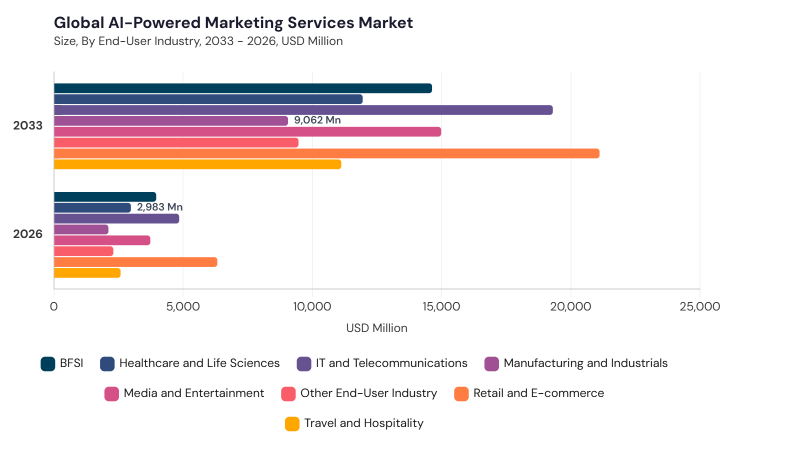
By end-user industry, Retail and E-commerce dominated with a revenue share of 22.31% in 2025 and is projected to reach USD 21.1 billion by 2033, growing at a CAGR of 18.8% during (2026 - 2033).
IT and Telecommunications accounted for 16.75% of revenue in 2025 and is projected to reach USD 19.3 billion by 2033, growing at a CAGR of 21.8% during (2026 - 2033).
Travel and Hospitality is projected to register the fastest end-user CAGR of 23.2% during (2026 - 2033), reaching USD 11.1 billion by 2033, followed closely by Manufacturing and Industrials at 23.1%.
Regionally, North America dominated with a revenue share of 42.85% in 2025 and is projected to reach USD 46.2 billion by 2033, growing at a CAGR of 20.8% during (2026 - 2033).
LAMEA is projected to register the fastest regional CAGR of 23.1% during (2026 - 2033), reaching USD 11.3 billion by 2033, while Asia Pacific is projected to reach USD 27.3 billion at a CAGR of 22.1%.
Rising demand for hyper-personalized engagement, real-time customer intelligence, automated campaign execution, and measurable marketing ROI is strengthening investment in AI-powered marketing services. Marketers are increasingly using machine learning, generative AI, predictive analytics, natural language processing, and customer-data platforms to improve audience segmentation, content relevance, lead scoring, campaign optimization, and omnichannel orchestration. Growth is also supported by the need to reduce manual marketing workloads and scale content production across websites, mobile apps, email, social media, digital advertising, and conversational channels. At the same time, privacy rules, consent management, and responsible AI requirements are pushing providers to combine personalization with governance, transparency, and secure data handling.
Competition is shaped by rapid innovation, platform integration, service customization, data quality, and the ability to connect AI outputs with measurable campaign performance. Large technology providers compete through CRM, advertising, cloud, analytics, and customer-experience ecosystems, while agencies and consulting firms differentiate through implementation capabilities, data strategy, content operations, and managed marketing services. Specialist vendors compete through focused strengths in e-commerce automation, programmatic media, AI-generated content, customer-data platforms, and personalization engines. Strategic partnerships with cloud platforms, data providers, marketing technology vendors, and creative systems are important because customers increasingly want integrated solutions rather than isolated AI tools.
Automation of Complex Marketing Operations Driving Efficiency and Scalability
Integration of Advanced Predictive Analytics Enhancing Strategic Decision-Making
Growing Adoption of AI-Enabled Omnichannel Marketing Strategies Broadening Market Reach
Restraints
Data Privacy and Security Concerns in AI-Powered Marketing Services Market
High Implementation Costs and Integration Complexities as Market Constraints
Lack of Standardized Frameworks and Interoperability Issues in AI Marketing Technologies
Opportunities
Hyper-Personalization Enabled by Advanced AI Algorithms
Integration of AI with Omnichannel Marketing Ecosystems
Adoption of Explainable AI to Build Trust and Transparency
Challenges
Market Share Analysis
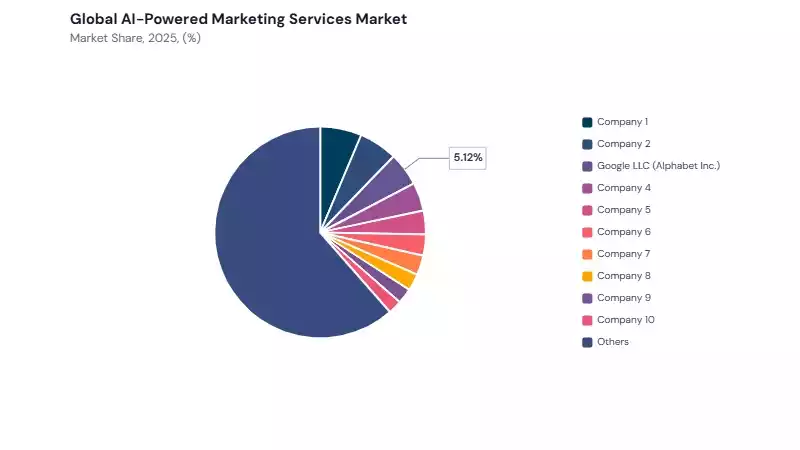
The market is highly fragmented, with CRM platforms, marketing automation vendors, advertising technology companies, hyperscale technology providers, global agencies, consulting firms, and specialized AI marketing platforms competing across overlapping use cases. Salesforce leads the provided distribution, followed by Adobe and Google, while Microsoft and HubSpot form another important technology tier. Publicis Groupe and Accenture represent agency and transformation-service strength, while Oracle, Klaviyo, and The Trade Desk maintain positions in enterprise data, e-commerce automation, and programmatic advertising. Competitive positioning is increasingly shaped by first-party data access, generative AI content operations, privacy-compliant personalization, omnichannel integration, predictive analytics, and the ability to convert customer intelligence into measurable campaign outcomes.
Organization Size Outlook
Based on organization size, the market is segmented into Large Enterprises and Small and Medium-sized Enterprises. The Large Enterprises market dominated the Global AI-Powered Marketing Services Market by Organization Size in 2025, and would continue to be a dominant market till 2033; thereby, achieving a market value of USD 70.8 billion by 2033, growing at a CAGR of 21 % during the forecast period. Additionally, The Small and Medium-sized Enterprises market is expected to witness highest CAGR of 21.9% during (2026 - 2033).
Large enterprises rely on AI-powered marketing services to manage complex customer datasets, global campaigns, advanced personalization, predictive analytics, customer journey orchestration, and cross-functional integration with sales, service, commerce, and enterprise data systems. These organizations often prioritize governance, scalability, interoperability, and enterprise-grade customization. SMEs use AI to automate social media management, content creation, email personalization, customer engagement, advertising optimization, and lead identification. Cloud platforms, subscription pricing, managed services, and simplified interfaces are helping smaller organizations access AI capabilities without large internal technology teams.
Deployment Mode Outlook
Based on deployment mode, the market is segmented into Cloud, On-premises, and Hybrid. The Cloud market dominated the Global AI-Powered Marketing Services Market by Deployment Mode in 2025, and would continue to be a dominant market till 2033; thereby, achieving a market value of USD 69.0 billion by 2033, growing at a CAGR of 21 % during the forecast period. The On-premises market is expected to witness a CAGR of 21.9% during (2026 - 2033).
Cloud deployment supports scalable computing, faster implementation, collaborative access, continuous software updates, and integration with evolving AI models and marketing applications. On-premises deployment remains relevant for organizations that require direct control over customer information, proprietary models, data storage, governance policies, and internal enterprise systems. Hybrid deployment combines cloud innovation with controlled infrastructure for sensitive datasets or customized workloads. Across deployment choices, decisions are influenced by data governance, cybersecurity, AI model management, integration requirements, cost structures, and organizational control preferences.
End-User Industry Outlook
Based on end-user industry, the market is segmented into Retail and E-commerce, IT and Telecommunications, BFSI, Healthcare and Life Sciences, Media and Entertainment, Travel and Hospitality, Manufacturing and Industrials, and Other End-User Industry. The Retail and E-commerce market dominated the Global AI-Powered Marketing Services Market by End-User Industry in 2025, and would continue to be a dominant market till 2033; thereby, achieving a market value of USD 21.1 billion by 2033, growing at a CAGR of 18.8 % during the forecast period. The IT and Telecommunications market is expected to witness a CAGR of 21.8% during (2026 - 2033). Additionally, The BFSI market is expected to witness highest CAGR of 20.5% during (2026 - 2033).
Retail and e-commerce companies use AI for product recommendations, promotional targeting, customer journeys, pricing communication, and generative content. IT and telecommunications providers apply AI for acquisition, retention, cross-selling, and subscriber engagement. BFSI uses AI for customer segmentation, lifecycle communication, and lead identification under strict governance. Healthcare, media, travel, manufacturing, and other industries use AI for personalized outreach, content recommendations, account-based marketing, customer analytics, and campaign automation.
Regional Outlook
Region-wise, the AI-Powered Marketing Services Market is analyzed across North America, Europe, Asia Pacific, and LAMEA. The North America market dominated the Global AI-Powered Marketing Services Market by Region in 2025, and would continue to be a dominant market till 2033; thereby, achieving a market value of USD 46.2 billion by 2033, growing at a CAGR of 20.8 % during the forecast period. The Europe market is expected to witness a CAGR of 20.8% during (2026 - 2033). Additionally, The Asia Pacific market is expected to witness a CAGR of 22.1% during (2026 - 2033).
North America leads due to strong AI adoption, mature digital advertising ecosystems, enterprise technology spending, and widespread use of cloud-based marketing platforms. Europe is supported by enterprise digitalization, AI-powered customer analytics, multichannel marketing needs, and strong attention to privacy, transparency, consent, and responsible AI. Asia Pacific benefits from e-commerce, mobile commerce, digital payments, social platforms, large online customer populations, and expanding cloud infrastructure. LAMEA demand is supported by digital commerce, social media marketing, cloud utilization, managed services, and growing pressure to improve customer targeting and marketing efficiency.
AI-Powered Marketing Services Market - Get online access to the report
The market is highly fragmented, with CRM platforms, marketing automation vendors, advertising technology companies, hyperscale technology providers, global agencies, consulting firms, and specialized AI marketing platforms competing across overlapping use cases. Salesforce leads the provided distribution, followed by Adobe and Google, while Microsoft and HubSpot form another important technology tier. Publicis Groupe and Accenture represent agency and transformation-service strength, while Oracle, Klaviyo, and The Trade Desk maintain positions in enterprise data, e-commerce automation, and programmatic advertising. Competitive positioning is increasingly shaped by first-party data access, generative AI content operations, privacy-compliant personalization, omnichannel integration, predictive analytics, and the ability to convert customer intelligence into measurable campaign outcomes.
Based on organization size, the market is segmented into Large Enterprises and Small and Medium-sized Enterprises. The Large Enterprises market dominated the Global AI-Powered Marketing Services Market by Organization Size in 2025, and would continue to be a dominant market till 2033; thereby, achieving a market value of USD 70.8 billion by 2033, growing at a CAGR of 21 % during the forecast period. Additionally, The Small and Medium-sized Enterprises market is expected to witness highest CAGR of 21.9% during (2026 - 2033).
Large enterprises rely on AI-powered marketing services to manage complex customer datasets, global campaigns, advanced personalization, predictive analytics, customer journey orchestration, and cross-functional integration with sales, service, commerce, and enterprise data systems. These organizations often prioritize governance, scalability, interoperability, and enterprise-grade customization. SMEs use AI to automate social media management, content creation, email personalization, customer engagement, advertising optimization, and lead identification. Cloud platforms, subscription pricing, managed services, and simplified interfaces are helping smaller organizations access AI capabilities without large internal technology teams.
Deployment Mode Outlook
Based on deployment mode, the market is segmented into Cloud, On-premises, and Hybrid. The Cloud market dominated the Global AI-Powered Marketing Services Market by Deployment Mode in 2025, and would continue to be a dominant market till 2033; thereby, achieving a market value of USD 69.0 billion by 2033, growing at a CAGR of 21 % during the forecast period. The On-premises market is expected to witness a CAGR of 21.9% during (2026 - 2033).
Cloud deployment supports scalable computing, faster implementation, collaborative access, continuous software updates, and integration with evolving AI models and marketing applications. On-premises deployment remains relevant for organizations that require direct control over customer information, proprietary models, data storage, governance policies, and internal enterprise systems. Hybrid deployment combines cloud innovation with controlled infrastructure for sensitive datasets or customized workloads. Across deployment choices, decisions are influenced by data governance, cybersecurity, AI model management, integration requirements, cost structures, and organizational control preferences.
End-User Industry Outlook
Based on end-user industry, the market is segmented into Retail and E-commerce, IT and Telecommunications, BFSI, Healthcare and Life Sciences, Media and Entertainment, Travel and Hospitality, Manufacturing and Industrials, and Other End-User Industry. The Retail and E-commerce market dominated the Global AI-Powered Marketing Services Market by End-User Industry in 2025, and would continue to be a dominant market till 2033; thereby, achieving a market value of USD 21.1 billion by 2033, growing at a CAGR of 18.8 % during the forecast period. The IT and Telecommunications market is expected to witness a CAGR of 21.8% during (2026 - 2033). Additionally, The BFSI market is expected to witness highest CAGR of 20.5% during (2026 - 2033).
Retail and e-commerce companies use AI for product recommendations, promotional targeting, customer journeys, pricing communication, and generative content. IT and telecommunications providers apply AI for acquisition, retention, cross-selling, and subscriber engagement. BFSI uses AI for customer segmentation, lifecycle communication, and lead identification under strict governance. Healthcare, media, travel, manufacturing, and other industries use AI for personalized outreach, content recommendations, account-based marketing, customer analytics, and campaign automation.
Region-wise, the AI-Powered Marketing Services Market is analyzed across North America, Europe, Asia Pacific, and LAMEA. The North America market dominated the Global AI-Powered Marketing Services Market by Region in 2025, and would continue to be a dominant market till 2033; thereby, achieving a market value of USD 46.2 billion by 2033, growing at a CAGR of 20.8 % during the forecast period. The Europe market is expected to witness a CAGR of 20.8% during (2026 - 2033). Additionally, The Asia Pacific market is expected to witness a CAGR of 22.1% during (2026 - 2033).
North America leads due to strong AI adoption, mature digital advertising ecosystems, enterprise technology spending, and widespread use of cloud-based marketing platforms. Europe is supported by enterprise digitalization, AI-powered customer analytics, multichannel marketing needs, and strong attention to privacy, transparency, consent, and responsible AI. Asia Pacific benefits from e-commerce, mobile commerce, digital payments, social platforms, large online customer populations, and expanding cloud infrastructure. LAMEA demand is supported by digital commerce, social media marketing, cloud utilization, managed services, and growing pressure to improve customer targeting and marketing efficiency.
Market Trends, Revenue Estimation and Forecast, Segmentation Analysis, Regional and Country Breakdown, Competitive Landscape, Market Share Analysis, Company Profiling, Companies Strategic Developments, SWOT Analysis, Product Life Cycle Analysis, Value Chain Analysis, Market Consolidation Analysis, Key Customer Criteria, Pandemic Impact Analysis, and Winning Imperatives
Segments Covered
Organization Size, Deployment Mode, End-User Industry, and Geography
Country Scope
North America: US, Canada, Mexico, Rest of North America
Europe: Germany, UK, France, Russia, Spain, Italy, Rest of Europe
Asia Pacific: China, Japan, India, South Korea, Singapore, Malaysia, Rest of Asia Pacific
LAMEA: Brazil, Argentina, UAE, Saudi Arabia, South Africa, Nigeria, Rest of LAMEA
Companies Included
Salesforce; Adobe; Google; Microsoft; HubSpot; Publicis Groupe; Accenture; Oracle; Klaviyo; The Trade Desk
Need a report that reflects how COVID-19 has impacted this market and its growth? Download Free Sample Now
Recent Strategies Deployed in the Market
2026-April: Salesforce completed its acquisition of Qualified, strengthening agentic AI marketing capabilities for conversational demand generation, visitor engagement, lead qualification, prospect nurturing, and coordination with Agentforce Sales and Agentforce Marketing.
2026-February: Oracle launched role-based AI agents for marketing workflows within Oracle Fusion Cloud Applications, including agents that support campaign planning, cross-sell and upsell initiatives, program briefs, and marketing-process automation.
2025-September: Klaviyo launched Marketing Agent for autonomous B2C campaign execution, enabling campaign strategy development, content generation, flows, forms, and customer-engagement recommendations using brand and customer data.
2025-September: Adobe expanded GenStudio for Performance Marketing through Microsoft Marketplace, broadening enterprise access to AI-powered campaign content creation, creative variation generation, and performance insights.
2025-July: Google expanded AI-powered advertising capabilities in India by bringing ads into AI Overviews and rolling out agentic Google Ads and Google Analytics capabilities for campaign setup, optimization, reporting, and troubleshooting.
2025-June: Adobe expanded GenStudio for Performance Marketing with AI-powered video and display advertising capabilities, linking generative creative production with campaign activation and brand-compliant content workflows.
2025-June: The Trade Desk launched Deal Desk within Kokai, applying AI to direct programmatic deals, upfront commitments, deal quality, pacing, performance visibility, and alternative premium inventory recommendations.
2025-May: Google launched AI Max for Search campaigns and broader agentic marketing capabilities across Google Ads and Google Analytics to support targeting, creative enhancement, campaign management, optimization, reporting, and troubleshooting.
2025-April: HubSpot moved to acquire Dashworks to strengthen AI assistants for marketing, sales, and service teams by adding contextual search and knowledge-retrieval capabilities to Breeze.
2025-March: Publicis Groupe and Adobe expanded their global AI marketing partnership to integrate Adobe Firefly generative AI with Publicis CoreAI for scaled personalized content operations.
2025-March: Accenture invested in and collaborated with Aaru to use agentic AI for consumer behavior prediction, marketing strategy testing, product development, and customer-experience decision support.
Publicis Groupe agreed to acquire Lotame to strengthen AI-powered data and identity marketing through audience identity, data activation, and CoreAI integration.







 Unique Offerings
