The sample copy of this report is available for access.
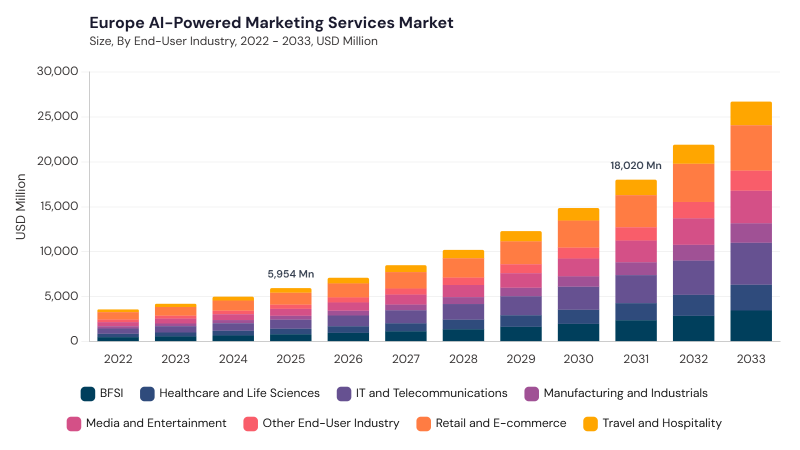
The Europe AI-Powered Marketing Services Market is expected to reach USD 18.0 billion by 2031, growing at a CAGR of 20.8% during (2026 - 2033).
Europe AI-Powered Marketing Services Market originated alongside digital transformation in marketing, beginning with automation tools for email marketing, campaign management, and customer segmentation. Machine learning, natural language processing, computer vision, predictive analytics, and generative AI expanded the scope of AI-powered marketing from basic analytics to personalized and dynamic engagement. European regulatory frameworks also shaped adoption by pushing vendors toward compliant, transparent, and accountable AI solutions. The market has now evolved into a strategic AI marketing ecosystem focused on customer experience optimization, data-driven decisions, and competitive differentiation.
Hyper-personalization, predictive marketing, AI governance, multilingual content adaptation, and SME-focused automation are shaping current market development. Companies increasingly use AI to analyze behavioral data, forecast customer actions, automate campaigns, generate localized content, and improve marketing ROI. However, GDPR, EU AI Act alignment, data privacy concerns, fragmented data ecosystems, integration complexity, high implementation cost, and AI talent requirements continue to influence adoption. Vendors compete through model accuracy, regulatory compliance, localization, platform integration, pricing flexibility, and scalable AI-enabled marketing services.
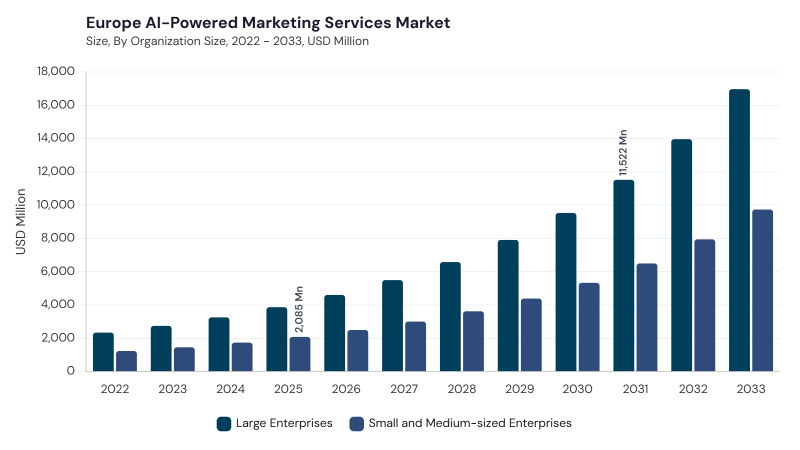
Based on Organization Size, the market is segmented into Large Enterprises and Small and Medium-sized Enterprises. The Large Enterprises market dominated the Europe AI-Powered Marketing Services Market by Organization Size in 2025, and would continue to be a dominant market till 2033; thereby, achieving a market value of USD 11.5 billion by 2031, growing at a CAGR of 20.5 % during the forecast period. Additionally, The Small and Medium-sized Enterprises market is expected to witness highest CAGR of 21.4% during (2026 - 2033).
Large enterprises use AI for multilingual content adaptation, audience intelligence, marketing attribution, customer journey analytics, automated engagement, predictive campaign management, and real-time personalization. Their larger budgets and data infrastructure support custom AI models, CRM integration, GDPR governance, and omnichannel marketing across multiple European markets. Small and Medium-sized Enterprises represented a promising presence as self-service AI tools, affordable automation platforms, SaaS models, and agency-led solutions improve access. SMEs prioritize campaign targeting, lead generation, social media automation, email marketing, quick deployment, and cost-efficient AI adoption.
Based on Deployment Mode, the market is segmented into Cloud, On-premises, and Hybrid. Cloud deployment supports real-time analytics, customer segmentation, campaign automation, predictive insights, multichannel engagement, and faster updates without heavy internal infrastructure. It is especially useful for SMEs, digital agencies, and enterprises requiring flexible coordination across European markets.
On-premises maintained a considerable share among organizations prioritizing direct control over sensitive customer datasets, proprietary models, and legacy enterprise systems. Hybrid remained a promising segment as companies combine scalable cloud AI with internally governed information, compliance-sensitive workloads, data residency needs, and gradual cloud migration.
Based on End-User Industry, the market is segmented into Retail and E-commerce, IT and Telecommunications, BFSI, Healthcare and Life Sciences, Media and Entertainment, Travel and Hospitality, Manufacturing and Industrials, and Other End-User Industry. Retail and E-commerce uses AI for demand forecasting, product recommendations, customer segmentation, chatbots, visual search, dynamic pricing, sentiment analysis, and omnichannel marketing. IT and Telecommunications secured a substantial share through churn prediction, subscriber segmentation, service personalization, and automated campaigns, while BFSI used AI for regulated customer acquisition, lifecycle communication, and personalized financial offers.
Healthcare and Life Sciences adopted AI for patient and professional engagement, while Media and Entertainment used audience profiling, content promotion, and subscription engagement. Travel and Hospitality relied on personalized offers and demand-linked campaigns, whereas Manufacturing and Industrials developed opportunities in B2B targeting, distributor analytics, multilingual campaigns, and automated prospect qualification.
Free Valuable Insights: The Worldwide AI-Powered Marketing Services Market is projected to reach USD 111.6 Billion billion by 2033, at a CAGR of 21.3%
Based on Country, the market is segmented into Germany, UK, France, Russia, Spain, Italy, and Rest of Europe. The UK market dominated the Europe AI-Powered Marketing Services Market by Country in 2025, and would continue to be a dominant market till 2033; thereby, achieving a market value of USD 3.6 billion by 2031, growing at a CAGR of 19.2 % during the forecast period. The Germany market is expected to witness a CAGR of 19.8% during (2026 - 2033). Additionally, The France market is expected to witness a CAGR of 21.7% during (2026 - 2033).
Across Europe, AI-powered marketing service adoption varies with digital maturity, regulatory pressure, language complexity, data governance, cloud adoption, and SME readiness. Germany emphasizes AI automation, hyper-personalization, ethical AI, data privacy, research-backed innovation, and secure infrastructure, while the UK focuses on omnichannel AI, customer segmentation, real-time personalization, explainable AI, and compliance-led marketing. France prioritizes French-language AI, conversational tools, predictive analytics, cultural localization, and sector-specific campaigns. Russia focuses on Russian-language NLP, omnichannel automation, localized AI models, and responsible deployment. Spain emphasizes hyper-personalization, conversational AI, immersive engagement, tourism, retail, and cultural adaptation, while Italy focuses on localized content, omnichannel automation, transparent governance, regional consumer behavior, and AI-led creative tools. Rest of Europe remains diverse, with growth supported by cloud-enabled AI, SME adoption, predictive marketing, localized content, and compliance-driven service models.

By Organization Size
By Deployment Mode
By End-User Industry
By Country
Set to reach $18.0 Billion by 2031, growing at 20.8% CAGR during 2026-2033.
The UK market leads, achieving $3.6 billion by 2031, growing at 19.2% CAGR during the forecast period.
Rising adoption by Large Enterprises, reaching $11.5 billion by 2031, at 20.5% CAGR during 2026-2033.
Expected to witness the highest growth at 21.4% CAGR during 2026-2033.
Germany is expected to grow at 19.8% CAGR during 2026-2033.
The France market is expected to grow at 21.7% CAGR during 2026-2033.
Our team of dedicated experts can provide you with attractive expansion opportunities for your business.




 Unique Offerings
