The sample copy of this report is available for access.
The North America AI In Chemicals Market is expected to reach USD 3.1 billion by 2032, growing at a CAGR of 26.4% during (2026 - 2033).
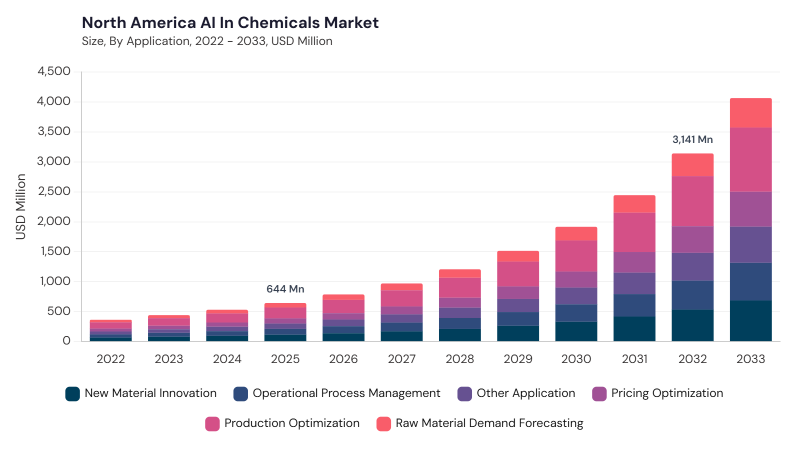
The North America AI In Chemicals Market originated from early use of computational techniques for chemical process optimization and research. Initial development was gradual due to limited computing power and fragmented chemical data, but advances in machine learning, computational capacity, digitized chemical datasets, AI-driven molecular modeling, predictive analytics, automated workflows, and intelligent process control shifted AI from limited experimentation toward broader industrial integration. The market now reflects a mature phase where AI supports research, process optimization, quality control, supply chain management, sustainability, and regulatory compliance across chemical operations.
Current market growth is shaped by sustainability-centric AI applications, generative AI, advanced automation, predictive maintenance, real-time monitoring, adaptive process control, and digital chemistry platforms. Chemical producers are increasingly using AI to reduce hazardous waste, design greener chemical processes, accelerate molecular discovery, simulate chemical interactions, improve plant reliability, and optimize production efficiency. Demand is also rising for AI systems that combine cloud analytics, edge computing, industrial IoT, digital twins, smart manufacturing, and enterprise data integration to improve innovation speed and operational resilience.
Based on Type, the market is segmented into Software, Services, and Hardware. The Software market dominated the North America AI In Chemicals Market by Type in 2025, and would continue to be a dominant market till 2033; thereby, achieving a market value of USD 1.5 billion by 2032, growing at a CAGR of 25.8 % during the forecast period. The Services market is expected to witness a CAGR of 26.8% during (2026 - 2033). Additionally, The Hardware market is expected to witness highest CAGR of 27.3% during (2026 - 2033).
Software remains central as chemical companies use predictive analytics, machine learning platforms, process optimization tools, digital twins, computer vision, AI-enabled research software, cloud infrastructure, generative AI, and simulation models to improve plant efficiency and accelerate formulation development. Services hold a substantial standing through consulting, AI implementation, system integration, model customization, data engineering, cybersecurity, workforce training, and ongoing technical support required to scale AI beyond pilot projects. Hardware maintains the smallest but promising presence through industrial IoT sensors, AI-enabled cameras, robotics, edge computing, high-performance computing infrastructure, industrial processors, connected equipment, and automated process-control systems used for real-time plant-level data capture and decision-making.
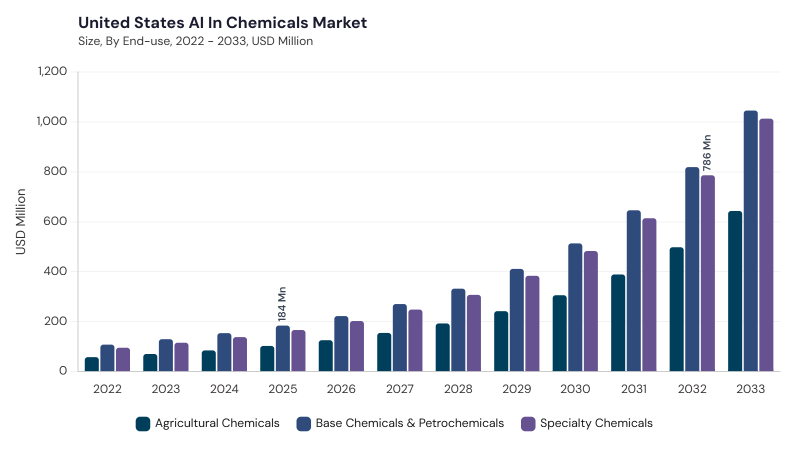
Based on End-use, the market is segmented into Base Chemicals & Petrochemicals, Specialty Chemicals, and Agricultural Chemicals. Base Chemicals & Petrochemicals remain the core end-use segment as AI supports large-volume commodity production, continuous process monitoring, predictive maintenance, feedstock utilization, energy efficiency, emissions reduction, digital twins, edge computing, and operational resilience in petrochemical facilities.
Specialty Chemicals hold a significant position through AI-enabled formulation development, quality control, customized production, material discovery, molecular property prediction, product differentiation, and sustainable alternative development. Agricultural Chemicals represent the smallest but promising segment through AI use in formulation research, demand planning, production scheduling, supply-chain management, pest-outbreak prediction, dosage optimization, biologically based agrochemicals, and product lifecycle management.
Based on Application, the market is segmented into Production Optimization, New Material Innovation, Operational Process Management, Pricing Optimization, Raw Material Demand Forecasting, and Other Application. Production Optimization remains the leading application as AI supports process monitoring, predictive maintenance, anomaly detection, real-time control adjustments, resource utilization, energy efficiency, waste reduction, and manufacturing consistency. New Material Innovation holds a substantial presence through machine-learning-assisted molecular screening, formulation modeling, chemical database analysis, simulation tools, biodegradable polymer design, and advanced material discovery. Operational Process Management maintains a considerable standing through AI-based scheduling, inventory management, quality control, safety monitoring, compliance reporting, workflow automation, and supply-chain visibility.
Pricing Optimization shows a steady foothold as producers use machine learning to assess demand, raw material costs, customer behavior, competitor activity, price elasticity, and product-level profitability. Raw Material Demand Forecasting remains the smallest application with an emerging presence through predictive models for feedstock planning, inventory exposure, supplier performance, seasonality, and supply-chain volatility. Other Application includes quality assurance, safety management, regulatory compliance, automated reporting, customer insights, sustainability management, and AI-powered engagement tools tailored to chemical industry needs.
Free Valuable Insights: The Global AI In Chemicals Market will hit USD 10.5 Billion billion by 2033, at a CAGR of 27.2%
Based on Country, the market is segmented into US, Canada, Mexico, and Rest of North America. The US market dominated the North America AI In Chemicals Market by Country in 2025, and would continue to be a dominant market till 2033; thereby, achieving a market value of USD 2.1 billion by 2032, growing at a CAGR of 25.5 % during the forecast period. The Canada market is expected to witness a CAGR of 28.3% during (2026 - 2033). Additionally, The Mexico market is expected to witness a CAGR of 27.6% during (2026 - 2033).
The US is shaped by AI-enabled molecular discovery, predictive maintenance, process optimization, regulatory compliance tools, edge computing, IoT integration, and cloud-based chemical enterprise solutions, while Canada reflects green chemistry, AI-assisted lifecycle analysis, sensor and IoT-based plant monitoring, smart manufacturing, AI-cloud collaboration, and sustainable formulation optimization. Mexico is supported by Industry 4.0 modernization, AI-enabled smart factories, sustainability-focused process tools, supply-chain resilience, predictive analytics, real-time quality control, and localized AI innovation hubs, whereas Rest of North America is influenced by green chemistry solutions, IoT-based monitoring, predictive maintenance, AI-enabled supply-chain optimization, digital twins, cloud platforms, and regional AI infrastructure investments.

By Type
By End-use
By Application
By Country
Set to reach $3.1 Billion by 2032, growing at 26.4% CAGR during 2026-2033.
The US leads with $2.1 billion by 2032, growing at 25.5% CAGR during the forecast period.
Rising enterprise cloud adoption and AI-driven workloads are the main catalysts.
Software segment will reach $1.5 billion by 2032, growing at 25.8% CAGR during the forecast period.
Canada is expected to witness a CAGR of 28.3% during 2026-2033.
The Hardware segment is expected to witness the highest CAGR of 27.3% during 2026-2033.
Our team of dedicated experts can provide you with attractive expansion opportunities for your business.




 Unique Offerings
