The sample copy of this report is available for access.
The LAMEA AI In Chemicals Market is expected to reach USD 369.3 million by 2029, growing at a CAGR of 29.1% during (2026 - 2033).
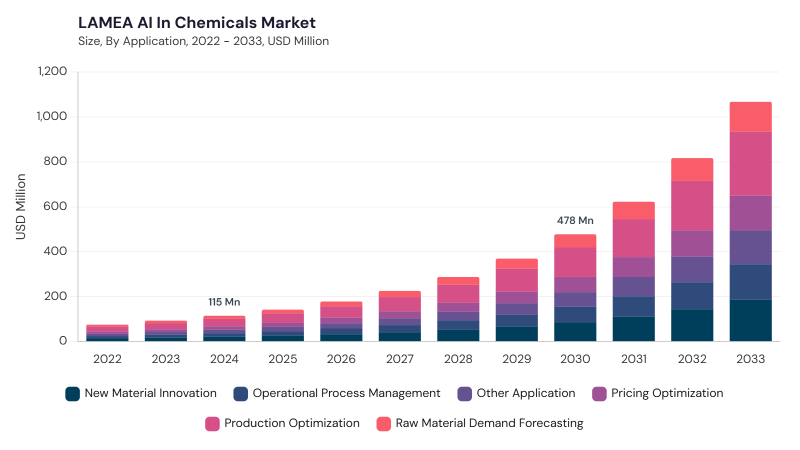
The LAMEA AI In Chemicals Market originated from early integration of computational methods and data processing technologies across the chemical industry in Latin America, the Middle East, and Africa. Initial adoption was limited to predictive maintenance and process automation, mainly to improve operational efficiency and reduce resource waste in traditionally managed chemical operations. Over time, advancements in machine learning, natural language processing, computer vision, cloud computing, and AI capabilities tailored to local industrial challenges shifted the market from basic automation toward integrated AI platforms supporting real-time decision-making, product innovation, safety improvement, and circular economy optimization.
Current market growth is shaped by sustainable chemical production, AI-driven predictive analytics, localized AI partnerships, industrial digitization, and greater use of IoT and enterprise data systems. Chemical companies are increasingly using AI to optimize energy use, minimize emissions, improve waste management, anticipate equipment failures, forecast demand, streamline inventory, and improve supply-chain resilience. Demand is also rising for AI solutions that address variable raw material quality, diverse regulatory environments, localized compliance needs, chemical formulation, asset reliability, and sustainability-driven process transformation across LAMEA.
Based on Type, the market is segmented into Software, Services, and Hardware. The Software market dominated the LAMEA AI In Chemicals Market by Type in 2025, and would continue to be a dominant market till 2033; thereby, achieving a market value of USD 183.1 million by 2029, growing at a CAGR of 28.5 % during the forecast period. The Services market is expected to witness a CAGR of 29.5% during (2026 - 2033). Additionally, The Hardware market is expected to witness highest CAGR of 30.1% during (2026 - 2033).
Software remains central as chemical companies use AI algorithms, machine learning models, predictive analytics platforms, simulation tools, data visualization, formulation optimization, process monitoring, quality control, R&D acceleration, and supply-chain management systems. Services hold a substantial share through consulting, AI model development, systems integration, cloud deployment, technical support, data management, training, and customized deployment across uneven digital capability environments. Hardware maintains the smallest but promising presence through connected sensors, intelligent control equipment, industrial computing systems, edge computing platforms, robotics, automated data-acquisition infrastructure, and AI-optimized devices used for real-time monitoring and safer chemical operations.
Based on End-use, the market is segmented into Base Chemicals & Petrochemicals, Specialty Chemicals, and Agricultural Chemicals. Base Chemicals & Petrochemicals remain the core end-use segment as AI supports refinery optimization, feedstock flexibility, predictive maintenance, process stability, energy management, safety compliance, anomaly detection, and real-time monitoring across capital-intensive facilities.
Specialty Chemicals hold a significant share through AI-enabled formulation optimization, quality management, molecular design, predictive modeling, customized product development, sustainability-linked reformulation, coatings, additives, personal-care ingredients, and industrial formulations. Agricultural Chemicals represent the smallest but emerging segment through AI use in fertilizers, pesticides, herbicides, crop protection agents, production scheduling, inventory planning, formulation analysis, smart application systems, pest detection, and demand estimation.
Based on Application, the market is segmented into Production Optimization, New Material Innovation, Operational Process Management, Pricing Optimization, Raw Material Demand Forecasting, and Other Application. Production Optimization remains the leading application as AI supports real-time process monitoring, predictive maintenance, adaptive control, yield improvement, energy reduction, reaction-condition optimization, equipment utilization, and process transparency. New Material Innovation holds a substantial share through AI-driven molecular modeling, generative models, virtual screening, advanced polymers, industrial compounds, localized formulations, catalysts, specialty materials, and product development suited to demanding climatic and infrastructure conditions.
Operational Process Management maintains a considerable presence through intelligent workflow coordination, condition monitoring, automated diagnostics, supply-chain logistics, plant scheduling, inventory management, and decision systems. Pricing Optimization shows a steady foothold as suppliers use analytical models to assess feedstock cost movements, currency fluctuations, customer demand, export markets, competitor activity, and margin optimization. Raw Material Demand Forecasting remains the smallest but promising application through predictive tools for procurement planning, inventory management, raw material needs, supply constraints, and market volatility. Other Application includes safety management, environmental surveillance, logistics planning, product inspection, emissions compliance, customer experience tools, waste management, and supply-chain coordination.
Free Valuable Insights: AI In Chemicals Market Size Worth USD 10.5 Billion billion by 2033
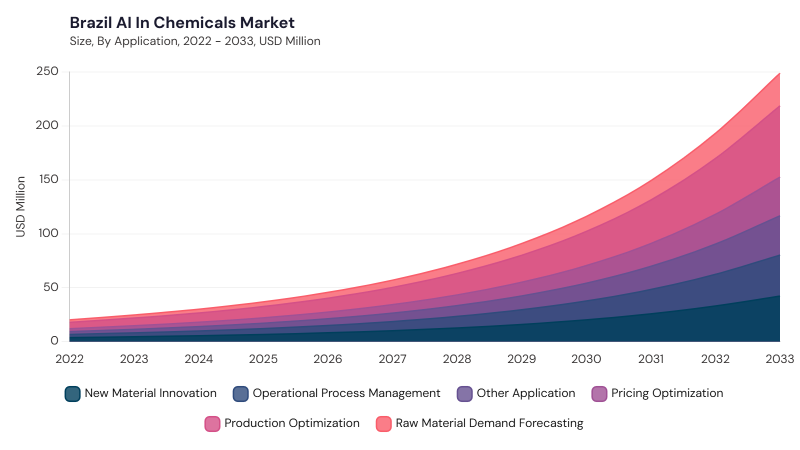
Based on Country, the market is segmented into Brazil, Argentina, UAE, Saudi Arabia, South Africa, Nigeria, and Rest of LAMEA. The Brazil market dominated the LAMEA AI In Chemicals Market by Country in 2025, and would continue to be a dominant market till 2033; thereby, achieving a market value of USD 90.8 million by 2029, growing at a CAGR of 27.4 % during the forecast period. The Argentina market is expected to witness a CAGR of 30.3% during (2026 - 2033). Additionally, The UAE market is expected to witness a CAGR of 27.5% during (2026 - 2033).
Brazil is shaped by AI-driven green chemistry, supply-chain digitalization, virtual screening, predictive synthesis, localized AI models, and R&D partnerships, while Argentina reflects agentic AI, regulatory compliance optimization, collaborative innovation, adaptive reasoning, and sustainability-focused AI deployment. The UAE is supported by digital transformation, smart industry strategies, digital twins, AI-driven supply-chain tools, sustainability-focused simulation, and AI-optimized continuous manufacturing, whereas Saudi Arabia is driven by Vision 2030, predictive maintenance, sustainable production, AI-powered chemical discovery, cloud platforms, and localized AI applications. South Africa is advancing through predictive analytics, sustainability integration, digital collaboration platforms, cloud computing, IIoT, and localized process automation; Nigeria is influenced by data-driven decision-making, government digital innovation incentives, cross-industry collaboration, predictive analytics, and chemical formulation optimization; and Rest of LAMEA is shaped by green chemistry, predictive supply-chain analytics, cloud-based AI platforms, regional AI hubs, edge computing, and localized compliance adaptation.

By Type
By End-use
By Application
By Country
Set to reach $369.3 Million by 2029, growing at 29.1% CAGR during 2026-2033.
Brazil leads with $90.8 million by 2029, growing at 27.4% CAGR during the forecast period.
Software segment dominates, reaching $183.1 million by 2029 with a 28.5% CAGR during the forecast period.
Hardware segment expected to witness highest CAGR of 30.1% during 2026-2033.
UAE market expected to witness a CAGR of 27.5% during 2026-2033.
Our team of dedicated experts can provide you with attractive expansion opportunities for your business.




 Unique Offerings
