The sample copy of this report is available for access.
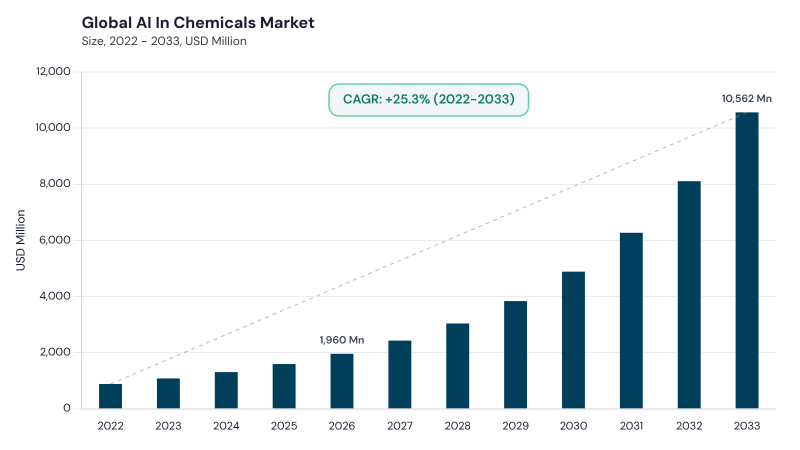
“Global AI In Chemicals Market to reach a market value of USD 10562.05 Million by 2033 growing at a CAGR of %”
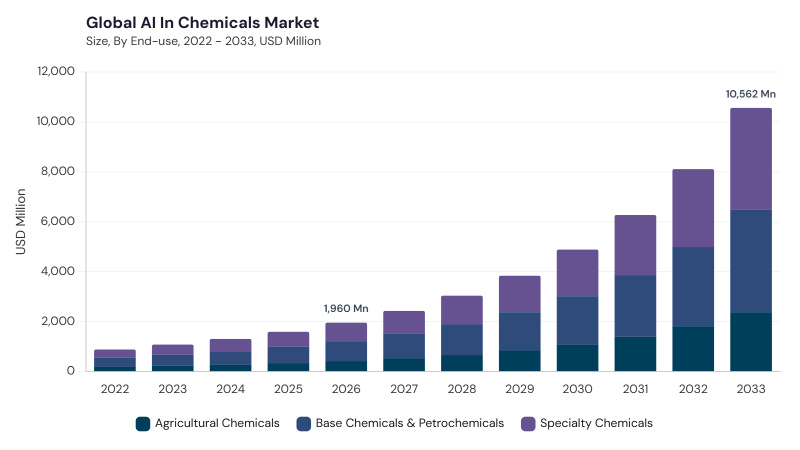
The Global AI In Chemicals Market is expected to reach USD 10.5 billion by 2033, growing at a CAGR of 27.2% during (2026 - 2033).
AI is becoming a strategic technology in the chemicals industry as manufacturers seek better process control, faster material innovation, predictive maintenance, and data-led operational decisions. Chemical producers are using AI to improve production efficiency, lower energy use, enhance product consistency, strengthen safety, and shorten R&D timelines across specialty chemicals, petrochemicals, polymers, advanced materials, and broader manufacturing operations. Adoption is expanding through digital twins, machine learning, advanced analytics, automation, and connected plant systems applied to formulation development, process optimization, quality inspection, demand forecasting, and supply chain planning.
Rising pressure to improve production efficiency, reduce waste, optimize energy consumption, and accelerate innovation is driving AI adoption across chemical operations. Chemical manufacturers are using AI to evaluate complex process data, predict equipment failures, improve reaction outcomes, reduce downtime, and support safer plant operations. In R&D, AI-assisted molecular design, generative modeling, and computational chemistry are shortening experimentation cycles and improving material discovery. Supply-chain volatility and raw-material price movement are also encouraging AI-enabled forecasting, procurement planning, and pricing analytics.
Competition in the AI In Chemicals Market is shaped by the convergence of enterprise AI, hyperscale cloud platforms, industrial automation, process optimization software, digital twins, and consulting services. Large technology providers compete through cloud infrastructure, generative AI, data analytics, and enterprise integration, while industrial specialists differentiate through process engineering, plant automation, asset performance, and manufacturing intelligence. Chemical-industry customers prioritize domain-specific accuracy, integration with legacy systems, data security, regulatory compliance, and measurable operational value. Partnerships between cloud providers, chemical companies, automation vendors, and research organizations are accelerating AI deployment across R&D, production, product stewardship, and sustainability workflows.
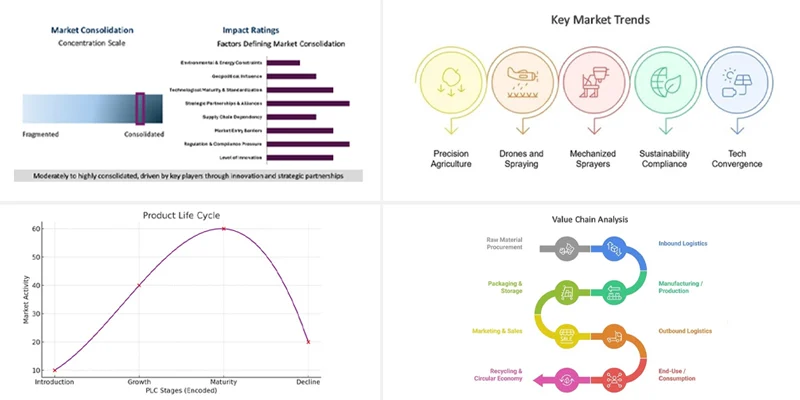

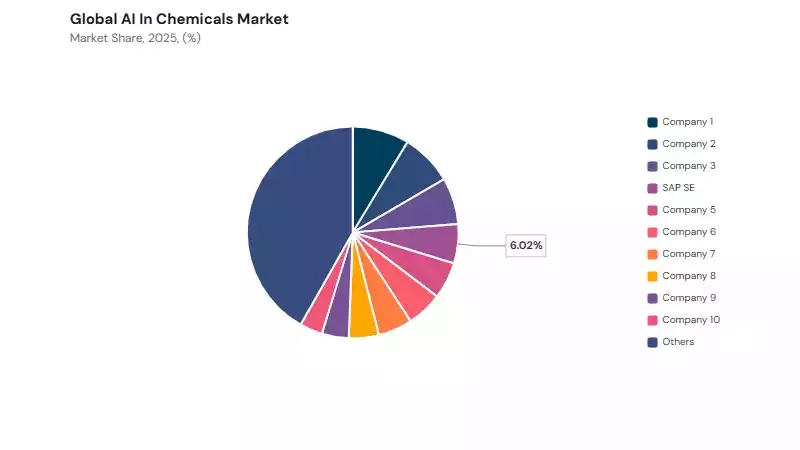
The AI In Chemicals Market is moderately fragmented, with enterprise AI providers, cloud companies, industrial automation specialists, process optimization software vendors, and consulting firms competing across the value chain. IBM Corporation, Microsoft Corporation, Google, SAP SE, Amazon Web Services, AspenTech, Siemens AG, Honeywell, AVEVA, and Accenture represent the key company snapshot group. Competition is increasingly shaped by the ability to integrate AI securely with chemical manufacturing systems, laboratory workflows, enterprise data, and industrial automation platforms. Vendors with strong domain expertise, scalable cloud infrastructure, digital twin capabilities, process optimization tools, and implementation services are better positioned to support chemical companies moving from pilot projects toward enterprise-wide AI deployment.
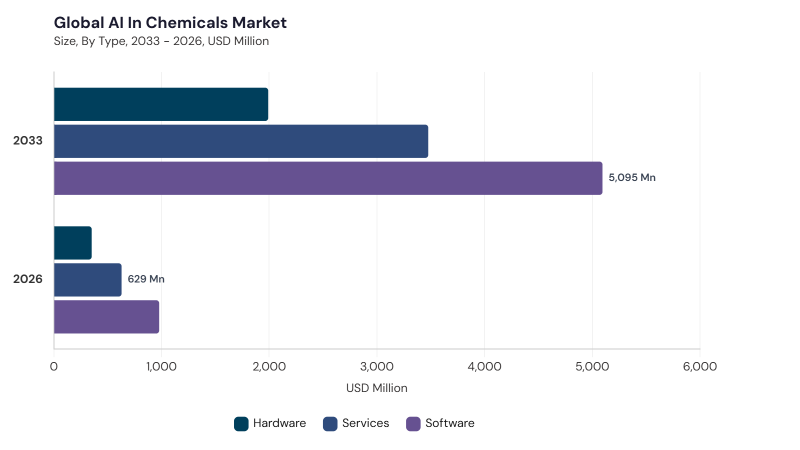
Based on type, the market is segmented into Software, Services, and Hardware. The Software market dominated the Global AI In Chemicals Market by Type in 2025, and would continue to be a dominant market till 2033; thereby, achieving a market value of USD 5.0 billion by 2033, growing at a CAGR of 26.6 % during the forecast period. The Services market is expected to witness a CAGR of 27.7% during (2026 - 2033). Additionally, The Hardware market is expected to witness highest CAGR of 28.1% during (2026 - 2033).
Software forms the core of AI deployment in chemicals as companies use analytics platforms, digital twins, process modeling tools, predictive maintenance systems, generative AI models, and decision-support applications across R&D, production, and supply-chain functions. Services support adoption by helping chemical companies define use cases, prepare data, integrate AI with legacy systems, deploy models, strengthen cybersecurity, and train internal teams. Hardware remains important because AI-enabled chemical operations require sensors, edge devices, industrial computing systems, specialized processors, and high-performance infrastructure to capture, process, and act on plant-level and laboratory data. Together, these type segments support the transition from isolated AI pilots toward scalable, integrated, and production-ready chemical intelligence systems.
Based on end-use, the market is segmented into Base Chemicals & Petrochemicals, Specialty Chemicals, and Agricultural Chemicals. The Base Chemicals & Petrochemicals market dominated the Global AI In Chemicals Market by End-use in 2025, and would continue to be a dominant market till 2033; thereby, achieving a market value of USD 4.1 billion by 2033, growing at a CAGR of 26.4 % during the forecast period. The Specialty Chemicals market is expected to witness a CAGR of 27.6% during (2026 - 2033). Additionally, The Agricultural Chemicals market is expected to witness highest CAGR of 27.9% during (2026 - 2033).
Base Chemicals & Petrochemicals use AI to improve high-volume production, continuous process control, predictive maintenance, energy efficiency, feedstock planning, and operational reliability across capital-intensive facilities. Specialty Chemicals rely on AI for formulation development, product customization, quality control, molecular modeling, automated experimentation, and faster innovation cycles for high-value products. Agricultural Chemicals apply AI in formulation research, crop-protection product development, production planning, seasonal demand forecasting, inventory management, and sustainability-focused product optimization. Each end-use area reflects a different AI adoption pattern, with large-scale operators emphasizing process efficiency and specialty producers focusing more strongly on innovation, customization, and regulatory responsiveness.
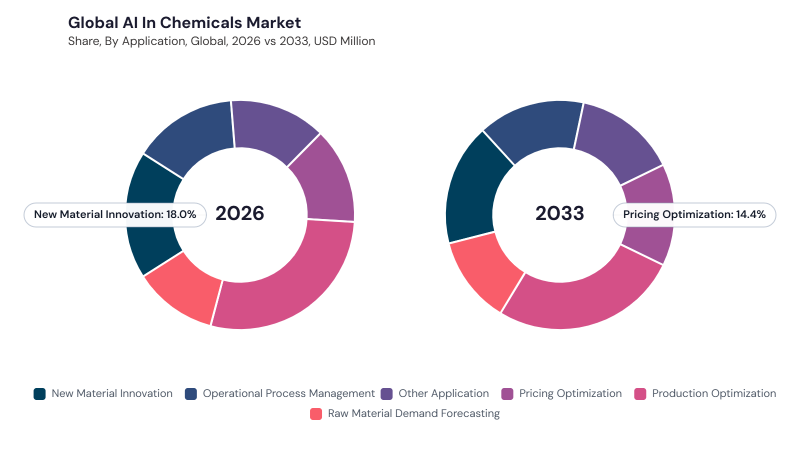
Based on application, the market is segmented into Production Optimization, New Material Innovation, Operational Process Management, Pricing Optimization, Raw Material Demand Forecasting, and Other Application. The Production Optimization market dominated the Global AI In Chemicals Market by Application in 2025, and would continue to be a dominant market till 2033; thereby, achieving a market value of USD 2.7 billion by 2033, growing at a CAGR of 26.1 % during the forecast period. The New Material Innovation market is expected to witness a CAGR of 26.4% during (2026 - 2033). Additionally, The Operational Process Management market is expected to witness highest CAGR of 27.7% during (2026 - 2033).
Production Optimization covers AI-enabled yield improvement, energy reduction, process stability, predictive maintenance, and real-time operating-parameter adjustment in chemical plants. New Material Innovation uses machine learning, generative AI, simulation, and high-throughput screening to accelerate molecular discovery, formulation design, and development of advanced materials. Operational Process Management includes intelligent scheduling, workflow automation, asset monitoring, quality management, safety oversight, and coordination between plant systems and enterprise platforms. Pricing Optimization and Raw Material Demand Forecasting help chemical companies manage input-cost volatility, customer demand, procurement planning, inventory exposure, and margin decisions. Other Application includes safety monitoring, emissions management, supply-chain analytics, customer intelligence, compliance documentation, and broader decision-support functions.
Free Valuable Insights: AI In Chemicals Market Size to reach $10.5 Billion by 2033
Region-wise, the AI In Chemicals Market is analyzed across North America, Europe, Asia Pacific, and LAMEA. The North America market dominated the Global AI In Chemicals Market by Region in 2025, and would continue to be a dominant market till 2033; thereby, achieving a market value of USD 4.0 billion by 2033, growing at a CAGR of 26.4 % during the forecast period. The Europe market is expected to witness a CAGR of 26.7% during (2026 - 2033). Additionally, The Asia Pacific market is expected to witness a CAGR of 28.3% during (2026 - 2033).
North America reflects mature AI adoption across research, process optimization, quality control, predictive maintenance, and supply-chain management, supported by strong technology infrastructure and chemical-industry modernization. Europe is shaped by regulatory compliance, sustainability goals, digital lab adoption, AI governance, and process optimization aligned with environmental and traceability requirements. Asia Pacific benefits from expanding chemical manufacturing clusters, smart factory development, digital infrastructure growth, and rising use of AI in petrochemicals, specialty chemicals, agricultural chemicals, and materials innovation. LAMEA adoption is supported by petrochemical activity, cloud infrastructure expansion, process-efficiency needs, sustainability initiatives, and localized AI partnerships addressing regional production and regulatory requirements.
| Report Attribute | Details |
|---|---|
| Market size value in 2026 | USD 1.9 billion |
| Market size forecast in 2033 | USD 10.5 billion |
| Base Year | 2025 |
| Historical Period | 2022 to 2024 |
| Forecast Period | 2026 to 2033 |
| Revenue Growth Rate | CAGR of 27.2% from 2026 to 2033 |
| Number of Pages | 575 |
| Tables | 480 |
| Report Coverage | Market Trends, Revenue Estimation and Forecast, Segmentation Analysis, Regional and Country Breakdown, Competitive Landscape, Market Share Analysis, Company Profiling, Companies Strategic Developments, SWOT Analysis, Product Life Cycle Analysis, Value Chain Analysis, Market Consolidation Analysis, Key Customer Criteria, Pandemic Impact Analysis, and Winning Imperatives |
| Segments Covered | Type, End-use, Application, and Geography |
| Country Scope |
|
| Companies Included | IBM Corporation; Microsoft Corporation; Google; SAP SE; Amazon Web Services; AspenTech; Siemens AG; Honeywell; AVEVA; Accenture |
By Type
By End-use
By Application
By Geography
The AI In Chemicals Market is valued at USD 1.9 billion in 2026.
The Software segment leads, expected to reach USD 5.0 billion by 2033.
IBM, Microsoft, Google, SAP SE, Amazon Web Services, AspenTech, Siemens AG, Honeywell, AVEVA, Accenture.
North America leads, projected to reach USD 4.0 billion by 2033.
Digital transformation and AI integration in drug discovery drive growth.
Production Optimization leads, expected to reach USD 2.7 billion by 2033.
Our team of dedicated experts can provide you with attractive expansion opportunities for your business.






 Unique Offerings
