The sample copy of this report is available for access.
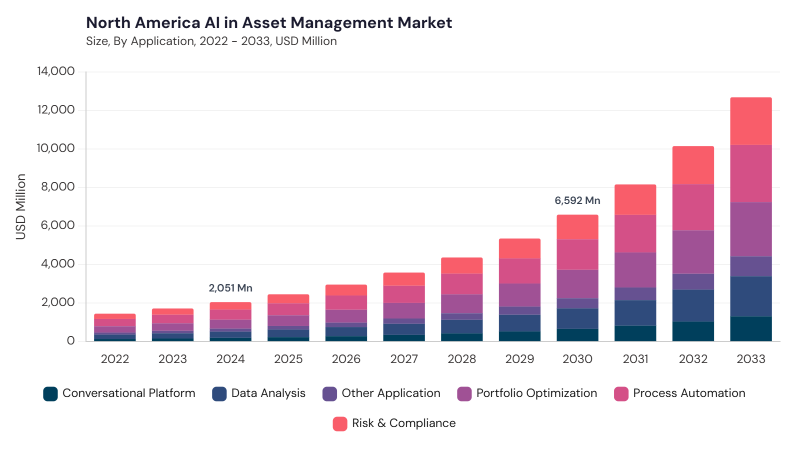
The North America AI In Asset Management Market is expected to reach USD 10.1 billion by 2032, growing at a CAGR of 23.1% during (2026 – 2033).
AI adoption in North American asset management evolved from early algorithmic trading and rule-based quantitative systems toward increasingly sophisticated machine learning, natural language processing, predictive analytics, and generative AI applications. Initial deployments focused on automating selected investment and data-processing tasks, but improvements in big data infrastructure and cloud computing enabled firms to process larger structured and unstructured datasets at greater speed. Advances in AI models gradually expanded their role across portfolio construction, risk assessment, compliance, customer engagement, and operational workflows.
Automation, generative AI, data governance, and responsible AI adoption are increasingly shaping the regional market. Asset managers are deploying AI to streamline trade execution, asset allocation, compliance monitoring, reporting, and other workflows while reducing manual intervention and operating costs. Generative AI and advanced predictive models are improving scenario analysis, market simulation, research, and personalized investment strategies. At the same time, greater regulatory emphasis on transparency, explainability, data privacy, and model accountability is encouraging investment in standardized data architectures and explainable AI frameworks.
Based on Deployment Mode, the market is segmented into On-Premises and Cloud. The On-Premises market dominated the North America AI In Asset Management Market by Deployment Mode in 2025, and would continue to be a dominant market till 2033; thereby, achieving a market value of USD 5.1 billion by 2032, growing at a CAGR of 22.8 % during the forecast period. Additionally, The Cloud market is expected to witness highest CAGR of 23.5% during (2026 - 2033).
On-Premises deployment remains important among large asset managers, institutional investors, and firms requiring direct control over AI infrastructure, sensitive financial data, trading algorithms, and governance processes. This approach supports customized systems, lower dependence on third-party infrastructure, and tighter oversight of mission-critical analytics, although higher capital and maintenance requirements can constrain adoption among smaller firms. Cloud deployment continues to expand as asset managers seek scalable computing resources, faster model deployment, lower infrastructure burdens, and integration with digital investment platforms. Secure cloud environments, AI-as-a-service offerings, and hybrid architectures are further improving flexibility while addressing data protection and regulatory considerations.
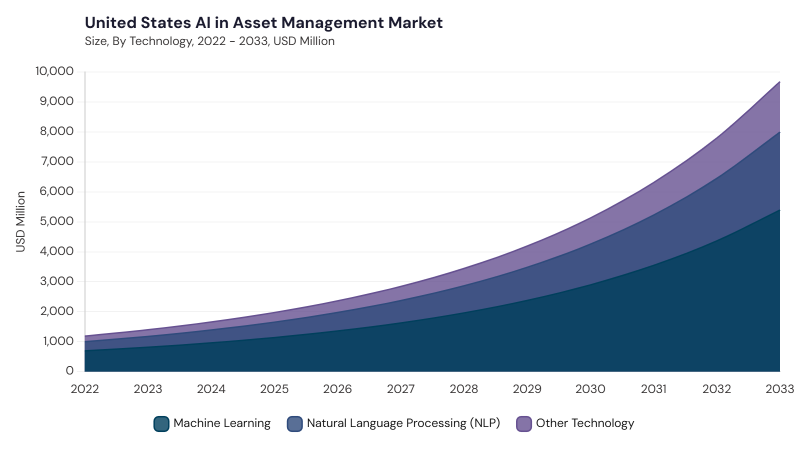
Based on Technology, the market is segmented into Machine Learning, Natural Language Processing (NLP), and Other Technology. The Machine Learning market dominated the North America AI In Asset Management Market by Technology in 2025, and would continue to be a dominant market till 2033; thereby, achieving a market value of USD 5.6 billion by 2032, growing at a CAGR of 22.6 % during the forecast period. The Natural Language Processing (NLP) market is expected to witness a CAGR of 23.6% during (2026 - 2033). Additionally, The Other Technology market is expected to witness highest CAGR of 24.1% during (2026 - 2033).
Machine Learning supports portfolio optimization, algorithmic trading, predictive analytics, fraud detection, risk assessment, and adaptive investment strategies by continuously analyzing historical and real-time financial data. Natural Language Processing followed as asset managers increasingly used unstructured information from earnings calls, financial reports, regulatory filings, news, and sentiment sources to support investment research and compliance. Other Technology includes computer vision, deep learning, reinforcement learning, expert systems, anomaly detection, and AI-driven automation tools used for specialized functions such as document verification, strategy optimization, fraud monitoring, and operational process improvement.
Based on Application, the market is segmented into Process Automation, Portfolio Optimization, Risk & Compliance, Data Analysis, Conversational Platform, and Other Application. Process Automation supports trade processing, reporting, fund administration, compliance checks, onboarding, workflow management, and intelligent document handling, helping firms improve scalability and reduce errors. Portfolio Optimization followed as asset managers increasingly used predictive analytics, alternative data, algorithmic strategies, and real-time intelligence to improve asset allocation and investment performance.
Risk & Compliance continues to expand through fraud detection, anomaly monitoring, regulatory surveillance, and explainable AI, while Data Analysis supports investment research, sentiment assessment, predictive modeling, and large-scale financial data processing. Conversational Platform applications include virtual assistants, chatbots, and interactive client-service tools, while Other Application covers financial forecasting, reporting automation, customized wealth management, ESG analysis, trade surveillance, and specialized operational analytics.
Free Valuable Insights: The Global AI In Asset Management Market will hit USD 30.4 Billion billion by 2033, at a CAGR of 23.8%
Based on Country, the market is segmented into US, Canada, Mexico, and Rest of North America. The US market dominated the North America AI In Asset Management Market by Country in 2025, and would continue to be a dominant market till 2033; thereby, achieving a market value of USD 7.7 billion by 2032, growing at a CAGR of 22.3 % during the forecast period. The Canada market is expected to witness a CAGR of 26.1% during (2026 - 2033). Additionally, The Mexico market is expected to witness a CAGR of 24.9% during (2026 - 2033).
Across North America, AI adoption in asset management is increasingly influenced by data modernization, automation, regulatory governance, cloud infrastructure, and demand for more advanced investment analytics. The US is advancing unified data architectures, explainable AI, proprietary machine learning models, and strategic technology partnerships to support investment research and portfolio management. Canada is emphasizing data quality, transparent AI frameworks, regulatory alignment, and collaborative technology ecosystems, while Mexico is expanding generative AI, workflow automation, cloud infrastructure, and locally adapted investment solutions. Rest of North America is progressing through ethical AI frameworks, collaborative innovation, data-driven automation, cybersecurity, and scalable AI platforms.

By Deployment Mode
By Technology
By Application
By Country
Set to reach $10.1 Billion by 2032, growing at 23.1% CAGR during 2026-2033.
The US leads with $7.7 billion by 2032, growing at 22.3% CAGR during 2026-2033.
Rising enterprise cloud adoption and AI-driven workloads are the main catalysts.
Cloud market to witness highest CAGR of 23.5% during 2026-2033.
The Canada market is expected to witness a CAGR of 26.1% during 2026-2033.
Machine Learning segment to reach $5.6 billion by 2032, growing at 22.6% CAGR during 2026-2033.
Our team of dedicated experts can provide you with attractive expansion opportunities for your business.




 Unique Offerings