The sample copy of this report is available for access.
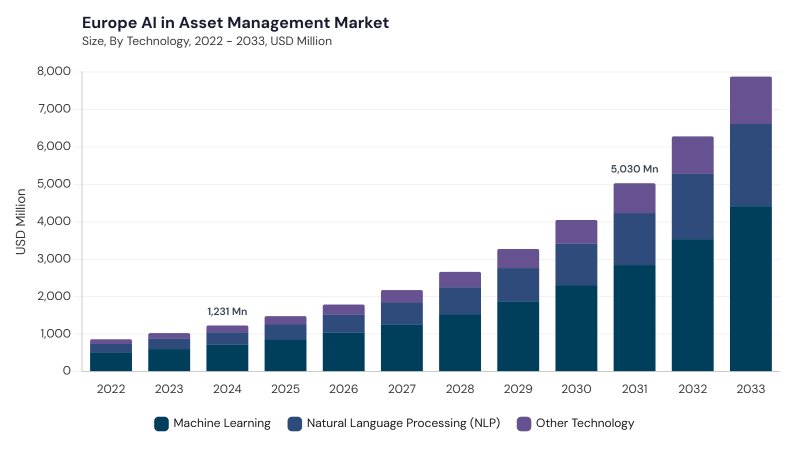
The Europe AI In Asset Management Market is expected to reach USD 5.0 billion by 2031, growing at a CAGR of 23.6% during (2026 – 2033).
AI adoption across Europe’s asset management industry evolved from early machine learning, quantitative analytics, and algorithmic trading applications toward broader use across portfolio construction, research, risk management, compliance, and client reporting. Initial adoption remained gradual because of legacy systems, fragmented data, and regulatory concerns, but advances in cloud computing, big data platforms, natural language processing, and predictive analytics accelerated deployment. The emergence of explainable AI and stronger governance frameworks further improved institutional confidence.
Regulatory governance, alternative data analytics, operational automation, and AI-augmented investment strategies are increasingly shaping the European market. Asset managers are applying AI to process financial news, social media, satellite imagery, corporate disclosures, and other structured and unstructured datasets to strengthen research and predictive accuracy. Automation is also improving trade processing, reporting, compliance monitoring, data validation, and client servicing while reducing manual workloads. At the same time, explainability, auditability, data privacy, and ethical model design are becoming central to AI deployment, encouraging firms to combine technological innovation with robust governance and human oversight.
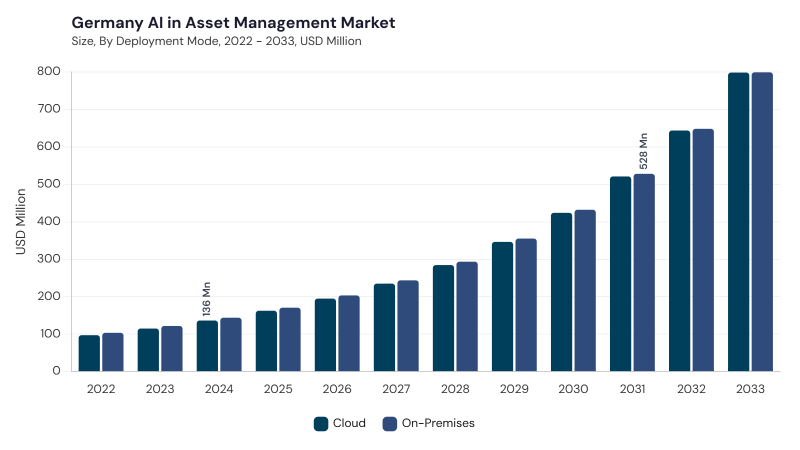
Based on Deployment Mode, the market is segmented into On-Premises and Cloud. The On-Premises market dominated the Europe AI In Asset Management Market by Deployment Mode in 2025, and would continue to be a dominant market till 2033; thereby, achieving a market value of USD 2.5 billion by 2031, growing at a CAGR of 23.2 % during the forecast period. Additionally, The Cloud market is expected to witness highest CAGR of 23.9% during (2026 - 2033).
On-Premises deployment remains important for institutions requiring strong data sovereignty, direct governance, customized infrastructure, and greater control over sensitive portfolio and client information. This model supports risk analytics, algorithmic trading, compliance monitoring, and other mission-critical applications where security and regulatory oversight are essential, although higher capital and maintenance requirements can limit adoption among smaller firms. Cloud deployment continues to expand as organizations seek scalable computing resources, collaborative analytics, faster model development, and lower infrastructure burdens. Secure multi-cloud environments, AI-as-a-Service platforms, and improved encryption technologies are helping firms balance scalability with European data protection and regulatory requirements.
Based on Technology, the market is segmented into Machine Learning, Natural Language Processing (NLP), and Other Technology. The Machine Learning market dominated the Europe AI In Asset Management Market by Technology in 2025, and would continue to be a dominant market till 2033; thereby, achieving a market value of USD 2.8 billion by 2031, growing at a CAGR of 23 % during the forecast period. The Natural Language Processing (NLP) market is expected to witness a CAGR of 24.1% during (2026 - 2033). Additionally, The Other Technology market is expected to witness highest CAGR of 24.6% during (2026 - 2033).
Machine Learning supports portfolio optimization, market prediction, risk assessment, quantitative analysis, and adaptive investment strategies by identifying patterns across historical and real-time datasets. Natural Language Processing followed as asset managers increasingly analyzed financial news, corporate disclosures, earnings information, regulatory publications, research reports, and investor communications to generate actionable intelligence. Other Technology includes deep learning, computer vision, reinforcement learning, robotic process automation, knowledge graphs, and expert systems that support fraud detection, alternative data analysis, workflow automation, compliance processes, and specialized operational functions.
Based on Application, the market is segmented into Process Automation, Portfolio Optimization, Risk & Compliance, Data Analysis, Conversational Platform, and Other Application. Process Automation supports data ingestion, reporting, reconciliation, trade processing, regulatory workflows, and other repetitive activities, helping firms improve efficiency and reduce operational errors. Portfolio Optimization followed as asset managers increasingly used machine learning, predictive analytics, reinforcement learning, and alternative datasets to refine allocation decisions and adjust portfolios to changing market conditions.
Risk & Compliance continues to strengthen through fraud detection, regulatory monitoring, anomaly detection, and explainable AI, while Data Analysis enables investment professionals to interpret large volumes of structured and unstructured financial information. Conversational Platform includes virtual advisors, intelligent customer support, and digital wealth management interfaces, while Other Application covers client onboarding, financial reporting, investment research, ESG analysis, scenario planning, and personalized advisory services.
Free Valuable Insights: The Worldwide AI In Asset Management Market is projected to reach USD 30.4 Billion billion by 2033, at a CAGR of 23.8%
Based on Country, the market is segmented into Germany, UK, France, Russia, Spain, Italy, and Rest of Europe. The Germany market dominated the Europe AI In Asset Management Market by Country in 2025, and would continue to be a dominant market till 2033; thereby, achieving a market value of USD 1.0 billion by 2031, growing at a CAGR of 21.9 % during the forecast period. The UK market is expected to witness a CAGR of 22.6% during (2026 - 2033). Additionally, The France market is expected to witness a CAGR of 24.4% during (2026 - 2033).
Across Europe, AI adoption in asset management is increasingly shaped by regulatory transparency, data modernization, predictive analytics, operational automation, and responsible AI practices. Germany is advancing explainable models, data-driven investment processes, cloud infrastructure, and collaborative technology ecosystems, while the UK is strengthening AI-enabled portfolio construction, workflow automation, strategic partnerships, and responsible governance. France is combining proprietary analytics, alternative data, cloud infrastructure, and regulatory-aligned AI development, whereas Russia is emphasizing workflow automation, ESG analysis, predictive modeling, and localized data platforms. Spain is progressing through sustainability analytics, generative AI, hybrid human-AI decision frameworks, and localized solutions, while Italy is expanding generative AI, automated data processing, cybersecurity, and compliance-focused deployment. Rest of Europe is also advancing through responsible AI governance, operational automation, generative models, and strategic technology partnerships.

By Deployment Mode
By Technology
By Application
By Country
Set to reach $5.0 Billion by 2031, growing at 23.6% CAGR during 2026–2033.
Germany leads with a market value of USD 1.0 billion by 2031, growing at a 21.9% CAGR during the forecast period.
Rising adoption of Machine Learning, reaching USD 2.8 billion by 2031, is a key growth driver.
The On-Premises segment will reach USD 2.5 billion by 2031, growing at a 23.2% CAGR during the forecast period.
The France market is expected to witness a CAGR of 24.4% during 2026–2033.
The Cloud segment is expected to witness the highest CAGR of 23.9% during 2026–2033.
Our team of dedicated experts can provide you with attractive expansion opportunities for your business.




 Unique Offerings