The sample copy of this report is available for access.
The Asia Pacific AI In Asset Management Market is expected to reach USD 3.7 billion by 2030, growing at a CAGR of 24.9% during (2026 – 2033).
AI adoption across Asia Pacific asset management evolved from basic automation of back-office processes into increasingly sophisticated applications spanning investment analytics, portfolio optimization, risk assessment, and client engagement. Early deployments focused on repetitive tasks such as data entry and compliance reporting, while advances in machine learning, natural language processing, big data infrastructure, and predictive analytics gradually expanded AI into core investment workflows. The rapid growth of alternative data sources and stronger computational capabilities further accelerated adoption.
Hyper-personalized investing, AI-enabled ESG analytics, regulatory governance, and automation are increasingly shaping the regional market. Asset managers are combining social sentiment, macroeconomic indicators, satellite imagery, and other alternative datasets to create more customized portfolio strategies and improve predictive accuracy. Explainable AI and model validation frameworks are gaining importance as regulators increase scrutiny of transparency, bias, and accountability. At the same time, AI-powered ESG analytics is helping firms assess sustainability risks and opportunities, while cloud platforms, edge AI, generative AI, and collaborative fintech ecosystems are supporting faster innovation, operational resilience, and localized investment services.
Based on Deployment Mode, the market is segmented into On-Premises and Cloud. The On-Premises market dominated the Asia Pacific AI In Asset Management Market by Deployment Mode in 2025, and would continue to be a dominant market till 2033; thereby, achieving a market value of USD 1.9 billion by 2030, growing at a CAGR of 24.5 % during the forecast period. Additionally, The Cloud market is expected to witness highest CAGR of 25.2% during (2026 - 2033).
On-Premises deployment remains important among institutions that require direct control over sensitive client information, proprietary models, real-time analytics, and regulatory governance. It supports secure transaction processing, portfolio optimization, risk management, and predictive analytics within internally managed infrastructure, although high capital requirements and specialized talent needs can restrict adoption. Cloud deployment continues to expand as firms seek scalable computing resources, AI-as-a-service platforms, lower infrastructure burdens, and faster access to advanced analytics. Improved cloud infrastructure, digital financial ecosystems, and pay-as-you-go models are increasing adoption, particularly among firms seeking flexibility and rapid innovation.
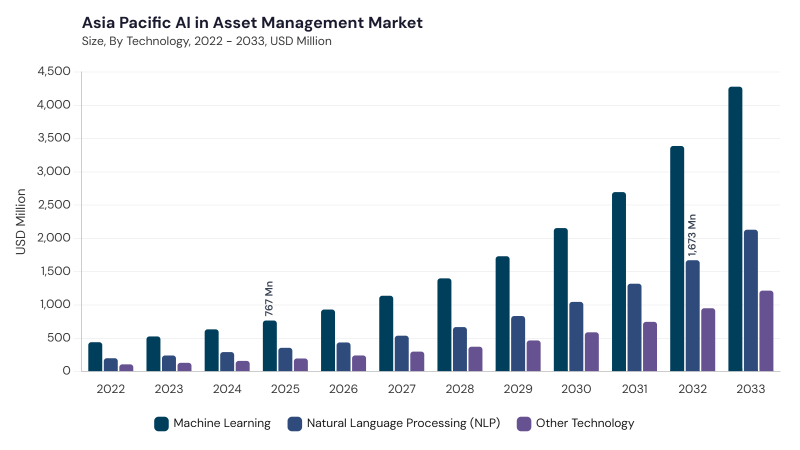
Based on Technology, the market is segmented into Machine Learning, Natural Language Processing (NLP), and Other Technology. The Machine Learning market dominated the Asia Pacific AI In Asset Management Market by Technology in 2025, and would continue to be a dominant market till 2033; thereby, achieving a market value of USD 2.1 billion by 2030, growing at a CAGR of 24.3 % during the forecast period. The Natural Language Processing (NLP) market is expected to witness a CAGR of 25.4% during (2026 - 2033). Additionally, The Other Technology market is expected to witness highest CAGR of 25.9% during (2026 - 2033).
Machine Learning supports asset allocation, risk modeling, fraud detection, predictive analytics, quantitative investment strategies, and adaptive portfolio management by identifying patterns across structured and real-time financial datasets. Natural Language Processing followed as firms increasingly extracted insights from financial reports, multilingual news, corporate announcements, research publications, earnings information, and social sentiment. Other Technology includes deep learning, computer vision, reinforcement learning, robotic process automation, and hybrid AI systems used for specialized functions such as satellite-image analysis, compliance automation, fraud monitoring, workflow optimization, and intelligent financial modeling.
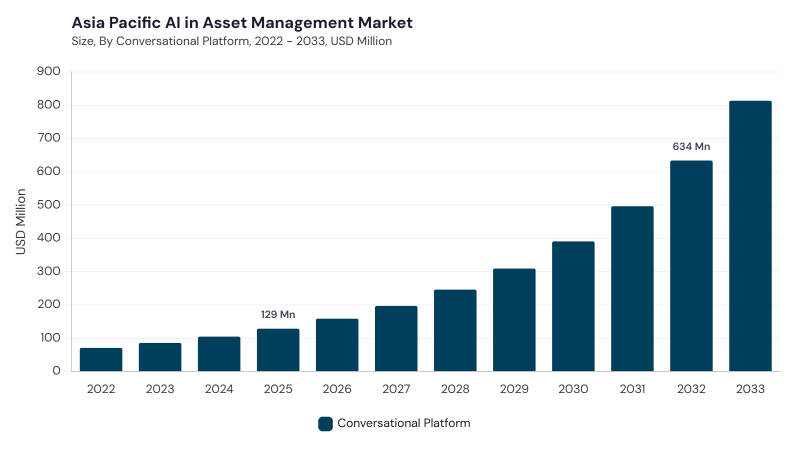
Based on Application, the market is segmented into Process Automation, Portfolio Optimization, Risk & Compliance, Data Analysis, Conversational Platform, and Other Application. Process Automation supports trade execution, reconciliation, reporting, compliance monitoring, data gathering, and repetitive administrative activities, helping firms reduce operational costs and improve processing accuracy. Portfolio Optimization followed as asset managers increasingly used predictive analytics, alternative data, dynamic rebalancing, and machine learning to improve diversification and market responsiveness.
Risk & Compliance continues to expand through anomaly detection, fraud monitoring, regulatory reporting, and transparent AI systems, while Data Analysis enables investment teams to extract actionable insights from large structured and unstructured datasets. Conversational Platform includes chatbots, virtual wealth assistants, and intelligent advisory interfaces, while Other Application covers financial forecasting, investment research, performance reporting, ESG analytics, market surveillance, cybersecurity, and client onboarding.
Free Valuable Insights: AI In Asset Management Market is Predicted to reach USD 30.4 Billion billion by 2033, at a CAGR of 23.8%
Based on Country, the market is segmented into China, Japan, India, South Korea, Singapore, Malaysia, and Rest of Asia Pacific. The China market dominated the Asia Pacific AI In Asset Management Market by Country in 2025, and would continue to be a dominant market till 2033; thereby, achieving a market value of USD 1.0 billion by 2030, growing at a CAGR of 22.6 % during the forecast period. The Japan market is expected to witness a CAGR of 24% during (2026 - 2033). Additionally, The India market is expected to witness a CAGR of 25.7% during (2026 - 2033).
Across Asia Pacific, AI adoption in asset management is increasingly influenced by predictive analytics, regulatory governance, automation, alternative data, and localized digital investment solutions. China is advancing big data integration, explainable AI, ecosystem partnerships, and scalable investment platforms, while Japan is strengthening responsible AI governance, local-language capabilities, and end-to-end AI deployment across asset management functions. India is expanding alternative data analytics, compliance automation, workflow digitization, and locally tailored AI platforms, whereas South Korea is emphasizing data quality, transparent models, collaborative innovation, and advanced infrastructure. Singapore is combining AI automation, generative AI, digital asset management, and high-performance data platforms, while Malaysia is progressing through explainable AI, localized algorithms, cloud infrastructure, and technology partnerships. Rest of Asia Pacific is also advancing personalization, responsible AI, operational automation, and predictive investment models.

By Deployment Mode
By Technology
By Application
By Country
Set to reach $3.7 Billion by 2030, growing at 24.9% CAGR during 2026-2033.
China leads with a market value of USD 1.0 billion by 2030, growing at a CAGR of 22.6% during the forecast period.
Rising adoption of machine learning, projected to reach USD 2.1 billion by 2030 at 24.3% CAGR during 2026-2033.
The Cloud segment is expected to witness the highest CAGR of 25.2% during 2026-2033.
The India market is expected to witness a CAGR of 25.7% during 2026-2033.
The On-Premises segment will achieve a market value of USD 1.9 billion by 2030, growing at a CAGR of 24.5% during the forecast period.
Our team of dedicated experts can provide you with attractive expansion opportunities for your business.




 Unique Offerings