The sample copy of this report is available for access.
The North America Affiliate Marketing Platform Market is expected to reach USD 11.5 billion by 2032, growing at a CAGR of 5.2% during (2026 – 2033).
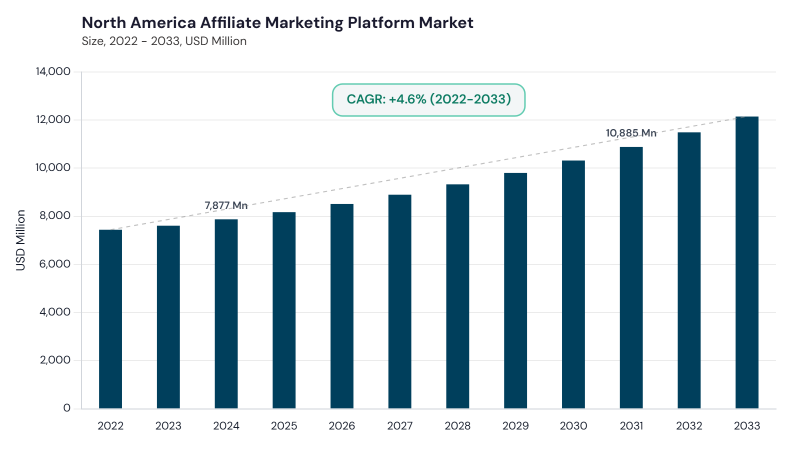
The North America Affiliate Marketing Platform Market developed alongside the rise of ecommerce, online retail, and performance-based digital advertising. Early affiliate programs relied on simple referral links, cookie-based tracking, and manual commission management between merchants and publishers. Over time, platforms evolved into automated systems with real-time analytics, campaign dashboards, fraud monitoring, and more accurate attribution. The rise of mobile commerce, influencer marketing, and direct-to-consumer brands further expanded affiliate activity across websites, apps, and social channels.
The North America Affiliate Marketing Platform Market is being shaped by ecommerce growth, creator-led commerce, privacy regulation, mobile-first engagement, and demand for measurable marketing ROI. Businesses are using affiliate platforms to manage partner recruitment, sales tracking, lead generation, payout automation, campaign optimization, and compliance monitoring. Demand is supported by online shopping adoption, expanding direct-to-consumer brands, influencer partnerships, subscription-based products, and rising use of performance marketing across B2C and B2B sectors. Vendors are focusing on AI-powered attribution, fraud prevention, cookieless tracking, CRM integration, ecommerce connectors, and real-time reporting.
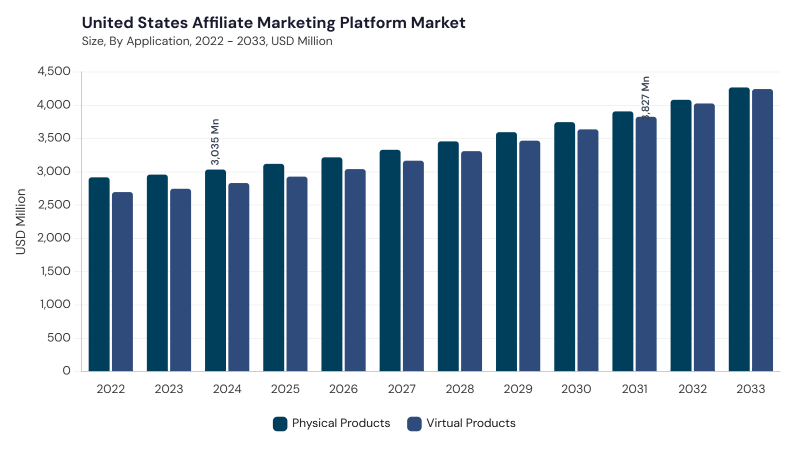
Based on Application, the market is segmented into Physical Products and Virtual Products. The Physical Products market dominated the North America Affiliate Marketing Platform Market by Application in 2025, and would continue to be a dominant market till 2033; thereby, achieving a market value of USD 5.8 billion by 2032, growing at a CAGR of 4.8 % during the forecast period. Additionally, The Virtual Products market is expected to witness highest CAGR of 5.6% during (2026 - 2033).
Physical Products lead due to the strong presence of ecommerce retailers, direct-to-consumer brands, digital marketplaces, and influencer-led product promotion. Brands use affiliate platforms to promote apparel, electronics, beauty products, household goods, food products, personal care items, and other tangible merchandise. Virtual Products remain important as software, cloud services, online courses, digital media, gaming, memberships, and subscriptions increasingly use affiliate-driven customer acquisition. This segment benefits from recurring commissions, faster campaign deployment, digital delivery, subscription tracking, and broad promotion across content creators, reviewers, educators, and professional communities.
Based on Pricing Model, the market is segmented into Cost Per Click, Cost Per Sale, and Cost Per Lead. The Cost Per Click market dominated the North America Affiliate Marketing Platform Market by Pricing Model in 2025, and would continue to be a dominant market till 2033; thereby, achieving a market value of USD 4.2 billion by 2032, growing at a CAGR of 4.7 % during the forecast period. The Cost Per Sale market is expected to witness a CAGR of 5.5% during (2026 - 2033).
Cost Per Click leads due to its strong use in traffic generation, brand visibility, audience testing, and large-scale digital advertising campaigns. It helps advertisers measure engagement while controlling spending around validated user actions. Cost Per Sale remains highly relevant for retail, travel, consumer services, and digital products because commissions are directly linked to completed purchases. Cost Per Lead supports financial services, education, real estate, insurance, B2B, and subscription businesses where qualified inquiries, sign-ups, trials, or applications are more important than immediate sales. Platforms increasingly support hybrid models to match different advertiser goals.
Based on End Use, the market is segmented into Consumer Goods, BFSI, Investment/Trading Firms, Hospitality, Multi-Asset Brokers, Healthcare, Transportation, and Other End Use. Consumer Goods lead due to the strong use of affiliate platforms by ecommerce retailers, DTC brands, marketplaces, lifestyle companies, and influencer-driven product campaigns. BFSI uses affiliate platforms for banking, insurance, fintech, credit products, and financial lead generation with strong compliance and fraud controls.
Investment/Trading Firms and Multi-Asset Brokers rely on affiliate partners for investor acquisition, account registrations, and finance-focused content marketing. Hospitality, Healthcare, Transportation, and Other End Use areas add demand through hotel bookings, travel services, telehealth, wellness products, mobility platforms, education, gaming, consumer electronics, and subscription-based digital services.
Free Valuable Insights: The Global Affiliate Marketing Platform Market will hit USD 34.3 Billion billion by 2033, at a CAGR of 5.7%
Based on Country, the market is segmented into US, Canada, Mexico, and Rest of North America. The US market dominated the North America Affiliate Marketing Platform Market by Country in 2025, and would continue to be a dominant market till 2033; thereby, achieving a market value of USD 8.1 billion by 2032, growing at a CAGR of 4.5 % during the forecast period. The Canada market is expected to witness a CAGR of 7.4% during (2026 - 2033). Additionally, The Mexico market is expected to witness a CAGR of 6.5% during (2026 - 2033).
The US leads due to its advanced ecommerce ecosystem, mature affiliate networks, strong creator economy, AI-powered campaign tools, privacy-first tracking innovation, and broad adoption across retail, SaaS, finance, and digital services. Canada supports market growth through bilingual affiliate programs, privacy-forward platforms, influencer partnerships, ecommerce expansion, and localized compliance needs. Mexico is advancing through mobile-first commerce, localized payment systems, rising digital financial services, iGaming-related affiliate activity, and growing use of performance marketing by online merchants. Rest of North America benefits from creator networks, cookieless attribution, automation, regional affiliates, and broader integration of affiliate platforms into digital marketing stacks.

By Application
By Pricing Model
By End Use
By Country
Set to reach $11.5 Billion by 2032, growing at 5.2% CAGR during 2026-2033.
The US leads with $8.1 billion by 2032, growing at a CAGR of 4.5% during the forecast period.
Rising demand for virtual products, expected to grow at 5.6% CAGR during 2026-2033.
Physical Products segment to reach $5.8 billion by 2032, growing at a CAGR of 4.8% during the forecast period.
The Canada market is expected to witness a CAGR of 7.4% during 2026-2033.
Cost Per Click model to achieve $4.2 billion by 2032, growing at a CAGR of 4.7% during the forecast period.
Our team of dedicated experts can provide you with attractive expansion opportunities for your business.




 Unique Offerings