The sample copy of this report is available for access.
The Asia Pacific Affiliate Marketing Platform Market is expected to reach USD 7.8 billion by 2030, growing at a CAGR of 6.3% during (2026 – 2033).
The Asia Pacific Affiliate Marketing Platform Market developed with the early expansion of digital advertising, online retail, and performance-based marketing across the region. Initial platforms mainly offered basic link tracking, commission management, and advertiser-publisher connectivity. Over time, rising internet penetration, smartphone usage, e-commerce growth, and social media adoption pushed affiliate platforms toward automation, real-time analytics, and multi-channel attribution. The growth of marketplaces, mobile apps, creator-led commerce, and content-driven promotion further expanded affiliate activity across both developed and emerging economies.
The Asia Pacific Affiliate Marketing Platform Market is being shaped by mobile commerce growth, creator economy expansion, digital payment adoption, localized marketing needs, and rising demand for measurable customer acquisition. Businesses are using affiliate platforms to manage partner onboarding, link tracking, sales attribution, lead generation, payout processing, campaign analytics, and fraud monitoring. Demand is supported by online marketplaces, social commerce, fintech growth, streaming services, online education, gaming, and cross-border digital commerce. Vendors are focusing on multilingual interfaces, local payment integration, AI-driven attribution, app-based tracking, compliance tools, and mobile-optimized dashboards.
Based on Application, the market is segmented into Physical Products and Virtual Products. The Physical Products market dominated the Asia Pacific Affiliate Marketing Platform Market by Application in 2025, and would continue to be a dominant market till 2033; thereby, achieving a market value of USD 4.0 billion by 2030, growing at a CAGR of 5.9 % during the forecast period. Additionally, The Virtual Products market is expected to witness highest CAGR of 6.7% during (2026 - 2033).
Physical Products lead due to rapid expansion of online marketplaces, mobile shopping, social commerce, and creator-led product discovery across the region. Brands use affiliate platforms to promote consumer electronics, apparel, beauty products, household goods, food products, personal care items, and other merchandise through influencers, bloggers, live-stream sellers, coupon portals, and comparison sites. Virtual Products remain important as mobile applications, online games, streaming services, online learning, software subscriptions, cloud platforms, and financial applications increasingly depend on affiliate-driven user acquisition. This segment benefits from app tracking, trial-to-paid conversion monitoring, recurring commissions, and performance-based promotion across technology reviewers, gaming creators, finance communities, and education portals.
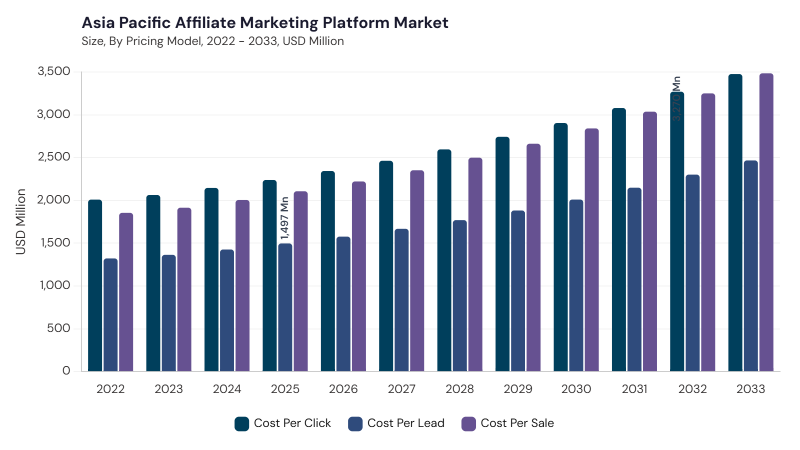
Based on Pricing Model, the market is segmented into Cost Per Click, Cost Per Sale, and Cost Per Lead. The Cost Per Click market dominated the Asia Pacific Affiliate Marketing Platform Market by Pricing Model in 2025, and would continue to be a dominant market till 2033; thereby, achieving a market value of USD 2.9 billion by 2030, growing at a CAGR of 5.8 % during the forecast period. The Cost Per Sale market is expected to witness a CAGR of 6.6% during (2026 - 2033).
Cost Per Click leads due to its strong use in traffic generation, brand awareness, mobile campaigns, and top-of-funnel digital advertising. It supports advertisers that want measurable engagement before optimizing toward conversion-based outcomes. Cost Per Sale remains highly relevant for e-commerce, travel, digital services, and marketplace-led campaigns because affiliate payments are directly linked to completed transactions. Cost Per Lead supports BFSI, education, telecom, technology, and subscription businesses where validated inquiries, registrations, trial sign-ups, or customer applications are more valuable than immediate sales. Platforms are increasingly supporting flexible and hybrid models to match different advertiser objectives across diverse regional markets.
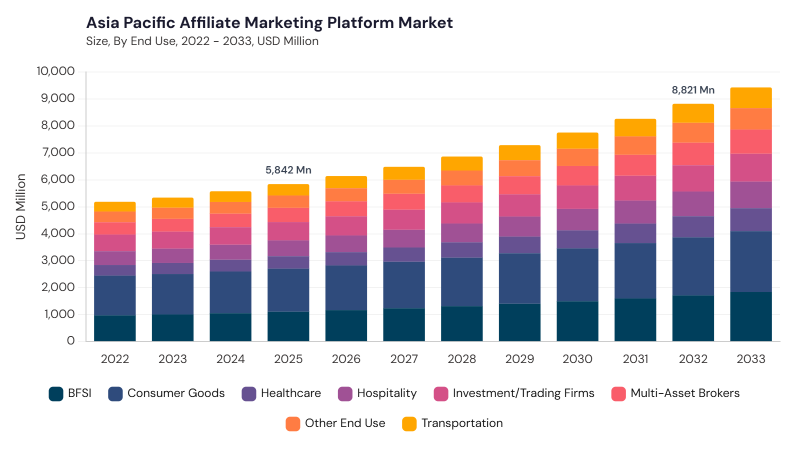
Based on End Use, the market is segmented into Consumer Goods, BFSI, Investment/Trading Firms, Hospitality, Multi-Asset Brokers, Healthcare, Transportation, and Other End Use. Consumer Goods lead due to strong e-commerce activity, mobile-first shopping, festival campaigns, social commerce, influencer-led purchasing, and marketplace-driven product discovery. BFSI uses affiliate platforms for digital banking, insurance, loans, fintech products, comparison portals, and regulated lead generation.
Investment/Trading Firms and Multi-Asset Brokers rely on affiliate programs for brokerage accounts, trading apps, investor education, and finance-focused customer acquisition. Hospitality, Healthcare, Transportation, and Other End Use areas add demand through hotel bookings, tourism campaigns, telemedicine, wellness platforms, ride-hailing, logistics, online education, gaming, real estate, entertainment, and digital business services.
Free Valuable Insights: Affiliate Marketing Platform Market is Predicted to reach USD 34.3 Billion billion by 2033, at a CAGR of 5.7%
Based on Country, the market is segmented into China, Japan, India, South Korea, Singapore, Malaysia, and Rest of Asia Pacific. The China market dominated the Asia Pacific Affiliate Marketing Platform Market by Country in 2025, and would continue to be a dominant market till 2033; thereby, achieving a market value of USD 1.9 billion by 2030, growing at a CAGR of 4.2 % during the forecast period. The Japan market is expected to witness a CAGR of 5.6% during (2026 - 2033). Additionally, The India market is expected to witness a CAGR of 7% during (2026 - 2033).
China leads due to strong mobile commerce, social commerce, live-stream selling, AI-powered affiliate tools, large marketplace ecosystems, and deep integration between creators, publishers, and advertisers. Japan supports market growth through AI-based campaign optimization, localized content strategies, mobile attribution, privacy-focused tracking, and creator partnerships. India is advancing through mobile-first affiliate marketing, regional language campaigns, influencer-led commerce, fintech promotion, and strong demand from e-commerce and EdTech advertisers. South Korea, Singapore, and Malaysia add momentum through advanced digital infrastructure, social commerce, local payment systems, compliance-focused platforms, and creator-led campaigns, while Rest of Asia Pacific benefits from mobile adoption, digital payments, cross-border commerce, and localized affiliate networks.

By Application
By Pricing Model
By End Use
By Country
Set to reach $7.8 Billion by 2030, growing at 6.3% CAGR during 2026-2033.
China leads with a market value of USD 1.9 billion by 2030, growing at a CAGR of 4.2% during the forecast period.
Rising demand for virtual products, witnessing a CAGR of 6.7% during 2026-2033, drives growth.
Physical products segment to reach USD 4.0 billion by 2030, growing at a CAGR of 5.9% during the forecast period.
The India market is expected to witness a CAGR of 7% during 2026-2033.
Cost Per Click model to reach USD 2.9 billion by 2030, growing at a CAGR of 5.8% during the forecast period.
Our team of dedicated experts can provide you with attractive expansion opportunities for your business.




 Unique Offerings