The sample copy of this report is available for access.
The North America Advanced Metering Infrastructure Market is expected to reach USD 14.6 billion by 2032, growing at a CAGR of 9.8% during (2026 - 2033).
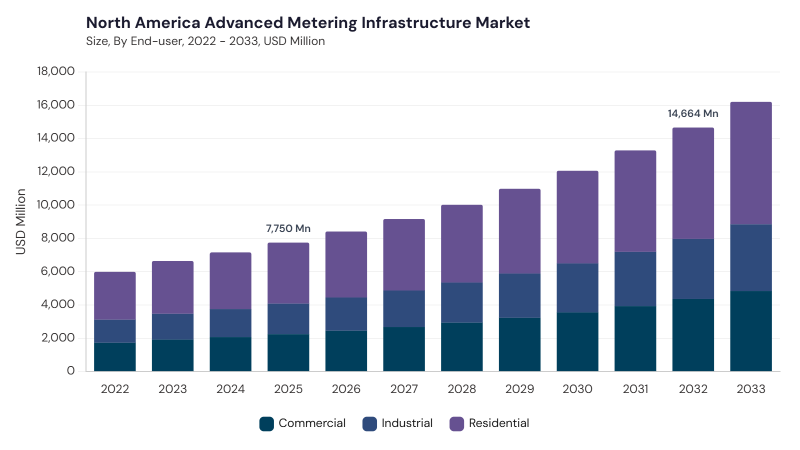
North America Advanced Metering Infrastructure Market traces its origins to the early 2000s, when utilities began adopting automated metering systems to improve accuracy, efficiency, and remote consumption measurement. Early systems relied mainly on smart meters for remote data collection, gradually evolving through two-way communication, RF mesh, cellular networks, and data analytics. Regulatory mandates, grid reliability needs, energy conservation goals, and utility modernization programs accelerated adoption. The market has matured into a smart-grid ecosystem supporting outage management, load management, customer engagement, IoT integration, and sustainable energy distribution.
Cybersecurity, IoT-enabled AMI, demand-side management, distributed energy resource integration, advanced analytics, and regulatory focus on sustainability are shaping current market development. Utilities are investing in secure communication protocols, encryption, AI, machine learning, edge computing, predictive maintenance, and demand forecasting to improve grid visibility and operational efficiency. Competition is driven by scalable communication architecture, interoperability, data security, analytics platforms, pricing, and utility-specific customization. However, high capital expenditure, legacy infrastructure, interoperability challenges, data privacy concerns, and implementation complexity continue to influence AMI deployment across North America.
Based on Component, the market is segmented into Hardware, Software, and Services. The Hardware market dominated the North America Advanced Metering Infrastructure Market by Component in 2025, and would continue to be a dominant market till 2033; thereby, achieving a market value of USD 8.0 billion by 2032, growing at a CAGR of 9.1 % during the forecast period. The Software market is expected to witness a CAGR of 10.7% during (2026 - 2033). Additionally, The Services market is expected to witness highest CAGR of 10.6% during (2026 - 2033).
Hardware forms the foundational AMI layer by enabling real-time consumption measurement, outage detection, remote service control, and two-way data exchange between utilities and end-users. Software garnered a considerable share through meter data management, analytics, billing integration, outage intelligence, customer engagement, cybersecurity, and centralized monitoring applications. Services maintained a promising presence, supported by consulting, installation, maintenance, system integration, deployment support, cybersecurity assistance, training, network design, software customization, and infrastructure optimization across complex utility environments.
Based on End-user, the market is segmented into Residential, Commercial, and Industrial. Residential AMI supports single-family homes, apartment complexes, rooftop solar adoption, electric vehicles, time-of-use pricing, demand response, home energy management, and improved customer transparency. Commercial garnered a considerable share through offices, retail facilities, hospitality properties, institutional buildings, energy audits, peak demand management, building management integration, sustainability goals, and operating-cost control.
Industrial maintained a promising presence across manufacturing plants, processing facilities, utility-scale infrastructure, SCADA-linked platforms, power quality monitoring, predictive maintenance, load monitoring, and precise energy management for continuous operations.
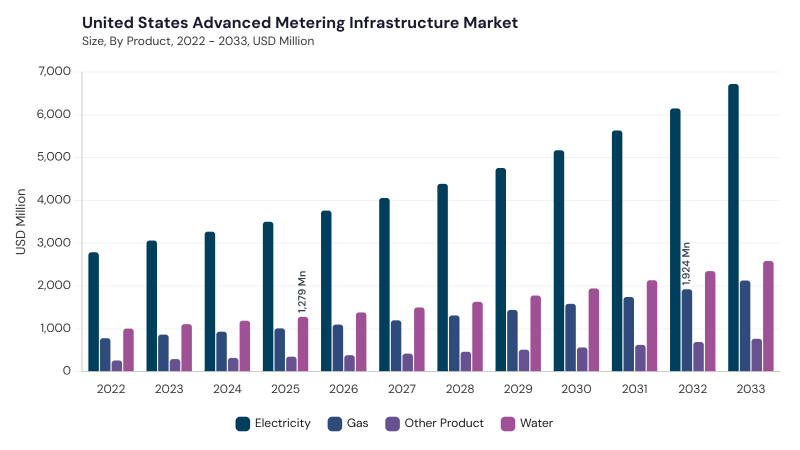
Based on Product, the market is segmented into Electricity, Water, Gas, and Other Product. Electricity meters support remote reading, outage identification, demand response, dynamic pricing, two-way communication, remote connection control, and integration with distributed energy resources. Water garnered a substantial share through smart water meters used for consumption tracking, leak detection, conservation, non-revenue water reduction, and municipal infrastructure modernization.
Gas maintained a noteworthy presence through connected gas meters supporting remote readings, consumption monitoring, leak detection, safety management, billing accuracy, and operational efficiency. Other Product maintained a promising presence across district heating, steam, sub-metering, multi-utility monitoring, campuses, industrial parks, and integrated platforms for broader resource management.
Free Valuable Insights: The Global Advanced Metering Infrastructure Market will hit USD 55.0 Billion billion by 2033, at a CAGR of 10.5%
Based on Country, the market is segmented into US, Canada, Mexico, and Rest of North America. The US market dominated the North America Advanced Metering Infrastructure Market by Country in 2025, and would continue to be a dominant market till 2033; thereby, achieving a market value of USD 11.1 billion by 2032, growing at a CAGR of 9.1 % during the forecast period. The Canada market is expected to witness a CAGR of 12.3% during (2026 - 2033). Additionally, The Mexico market is expected to witness a CAGR of 11.5% during (2026 - 2033).
Across North America, Advanced Metering Infrastructure adoption varies by grid modernization maturity, regulatory support, smart meter penetration, cybersecurity readiness, utility investment, and consumer engagement priorities. The US is shaped by AI-enabled analytics, DER integration, dynamic pricing, cybersecurity, and interoperable smart-grid platforms; Canada reflects decarbonization, energy efficiency, IoT-enabled meters, real-time analytics, distributed energy management, and secure AMI networks; Mexico is driven by utility modernization, AI and SCADA integration, sustainability compliance, real-time monitoring, and consumer-centric services; Rest of North America remains supported by advanced analytics, cybersecurity, open standards, interoperability, renewable integration, smaller-utility modernization, and rural AMI deployment.

By Component
By End-user
By Product
By Country
Set to reach $14.6 Billion by 2032, growing at 9.8% CAGR during 2026-2033.
The US leads with $11.1 billion by 2032, growing at a CAGR of 9.1% during the forecast period.
Hardware segment dominates with $8.0 billion by 2032, growing at a CAGR of 9.1% during 2026-2033.
The Software segment is expected to witness a CAGR of 10.7% during 2026-2033.
The Canada market is expected to witness a CAGR of 12.3% during 2026-2033.
The Services segment is expected to witness the highest CAGR of 10.6% during 2026-2033.
Our team of dedicated experts can provide you with attractive expansion opportunities for your business.




 Unique Offerings
