The sample copy of this report is available for access.
The LAMEA Advanced Metering Infrastructure Market is expected to reach USD 2.8 billion by 2029, growing at a CAGR of 11.8% during (2026 - 2033).
LAMEA Advanced Metering Infrastructure Market originated from the growing need for efficient energy management and modernization of utility grids across Latin America, the Middle East, and Africa. Early deployment was sporadic and mainly concentrated in pilot projects due to infrastructure limitations and financial constraints. Initial systems focused on automated meter reading to replace manual data collection, while later adoption of wireless communication, real-time data transfer, remote control, and analytics enabled the transition toward comprehensive AMI platforms. The market now reflects increasing emphasis on interoperability, cybersecurity, smart grid integration, and scalable utility modernization.
IoT integration, digital platforms, regulatory reinforcement, energy conservation, grid resiliency, renewable energy integration, and cybersecurity are shaping current market development. Utilities are moving from simple data collection toward predictive maintenance, demand response, dynamic pricing, advanced analytics, and customer engagement. Vendors are focusing on adaptable hardware, modular software, cloud-based data management, AI-driven tools, regional partnerships, and localized deployment models. However, high upfront cost, interoperability gaps, inadequate communication infrastructure, data-security concerns, and uneven utility maturity continue to influence adoption across LAMEA.
Based on Component, the market is segmented into Hardware, Software, and Services. The Hardware market dominated the LAMEA Advanced Metering Infrastructure Market by Component in 2025, and would continue to be a dominant market till 2033; thereby, achieving a market value of USD 1.6 billion by 2029, growing at a CAGR of 11.1 % during the forecast period. The Software market is expected to witness a CAGR of 12.7% during (2026 - 2033). Additionally, The Services market is expected to witness highest CAGR of 12.8% during (2026 - 2033).
Hardware includes smart electricity, gas, and water meters, communication modules, RF, PLC, cellular technologies, and data-collection equipment that support accurate measurement, real-time communication, revenue protection, and better visibility across dispersed utility networks. Software garnered a considerable share through meter data management, automated billing, consumption analysis, meter administration, anomaly detection, demand forecasting, cloud platforms, and remote diagnostics. Services maintained a promising presence through installation, commissioning, maintenance, system integration, consulting, network configuration, platform integration, training, compliance support, and localized technical assistance across varied LAMEA operating environments.
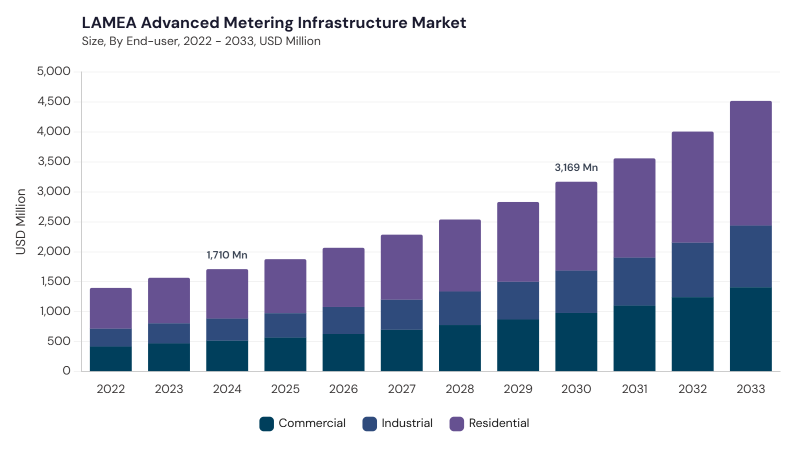
Based on End-user, the market is segmented into Residential, Commercial, and Industrial. Residential AMI deployment supports private households and multi-unit dwellings through real-time usage data, remote readings, prepaid metering, outage notifications, demand response, smart home integration, and improved billing transparency.
Commercial garnered a considerable share across retail establishments, offices, shopping centers, hospitality venues, educational institutions, and business properties requiring utility cost control, sustainability reporting, load management, and building management system integration. Industrial maintained a promising presence across mining, manufacturing, petrochemicals, processing, refineries, and large-scale facilities requiring robust metering, SCADA integration, predictive maintenance, energy-efficiency monitoring, and control over utility-intensive processes.
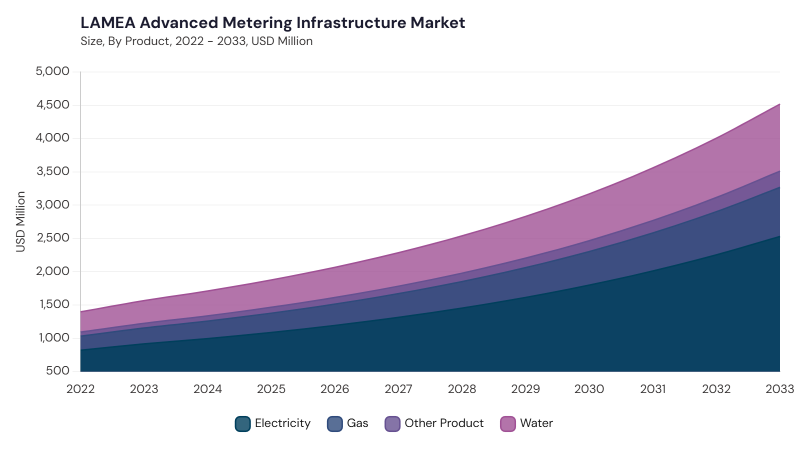
Based on Product, the market is segmented into Electricity, Water, Gas, and Other Product. Electricity AMI products support accurate energy monitoring, demand management, remote operational capability, dynamic pricing, smart grid development, theft reduction, billing accuracy, and real-time consumption visibility. Water garnered a substantial share through smart water meters, leakage detection, consumption monitoring, water-scarcity management, municipal applications, and distribution-loss reduction.
Gas maintained a noteworthy presence through smart gas meters, telemetry systems, flow measurement, pressure monitoring, leakage detection, safety compliance, and gas distribution oversight. Other Product maintained a promising presence through heat meters, compressed air meters, IoT-enabled resource monitoring, district infrastructure, smart buildings, industrial parks, and specialized resource-management applications.
Free Valuable Insights: Advanced Metering Infrastructure Market Size Worth USD 55.0 Billion billion by 2033
Based on Country, the market is segmented into Brazil, Argentina, UAE, Saudi Arabia, South Africa, Nigeria, and Rest of LAMEA. The Brazil market dominated the LAMEA Advanced Metering Infrastructure Market by Country in 2025, and would continue to be a dominant market till 2033; thereby, achieving a market value of USD 1.0 billion by 2029, growing at a CAGR of 10.9 % during the forecast period. The Argentina market is expected to witness a CAGR of 12.7% during (2026 - 2033). Additionally, The UAE market is expected to witness a CAGR of 10.3% during (2026 - 2033).
Across LAMEA, Advanced Metering Infrastructure adoption varies by grid modernization, regulatory support, smart city activity, energy-loss reduction needs, renewable integration, communication infrastructure, affordability, and cybersecurity readiness. Brazil is shaped by digital transformation, IoT-enabled meters, cybersecurity, demand response, consumer-centric services, and renewable-linked grid optimization; Argentina reflects renewable integration, smart grid initiatives, NB-IoT, cellular networks, billing accuracy, and consumer empowerment; the UAE is driven by smart city initiatives, real-time analytics, IoT-enabled devices, renewable integration, and customer-focused energy services; Saudi Arabia is supported by smart city projects, nationwide smart meter rollouts, IoT integration, Vision-linked digital infrastructure, and customer engagement; South Africa reflects AI analytics, last-mile communication, theft detection, water and gas metering, and sustainable resource management; Nigeria is developing through prepaid smart meters, digital power-sector reform, theft reduction, NB-IoT, GSM-enabled meters, and localized service models; Rest of LAMEA remains shaped by IoT-enabled metering, renewable integration, cybersecurity, advanced analytics, localized partnerships, and cost-efficient deployment.

By Component
By End-user
By Product
By Country
Set to reach $2.8 Billion by 2029, growing at 11.8% CAGR during 2026-2033.
Brazil leads with a market value of USD 1.0 billion by 2029, growing at a CAGR of 10.9% during the forecast period.
The Services segment is expected to witness the highest CAGR of 12.8% during 2026-2033.
Hardware segment will reach USD 1.6 billion by 2029, growing at a CAGR of 11.1% during the forecast period.
Argentina is expected to witness a CAGR of 12.7% during 2026-2033.
Software segment is expected to witness a CAGR of 12.7% during 2026-2033.
Our team of dedicated experts can provide you with attractive expansion opportunities for your business.




 Unique Offerings
