The sample copy of this report is available for access.
“Global Advanced Metering Infrastructure Market to reach a market value of USD 55045.39 Million by 2033 growing at a CAGR of %”
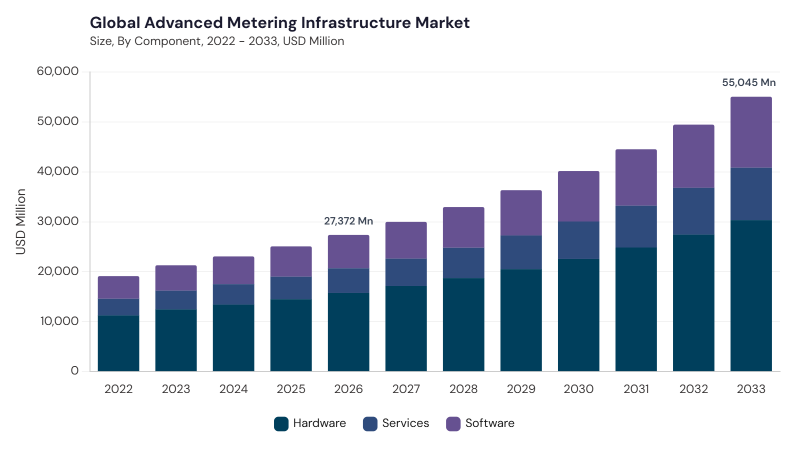
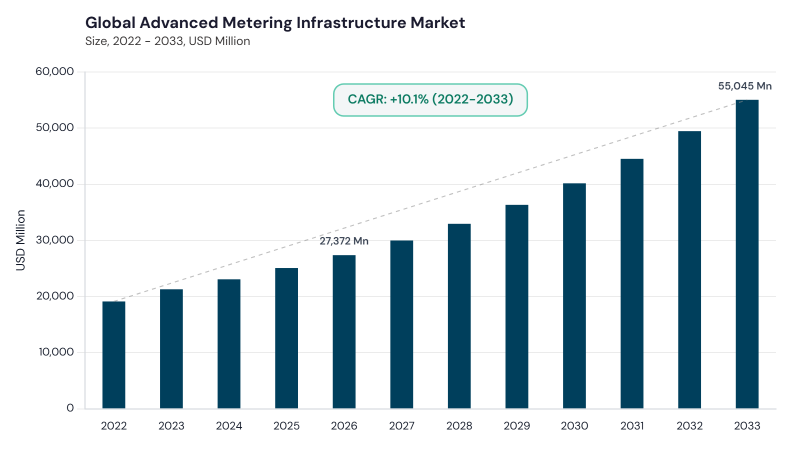
The Global Advanced Metering Infrastructure Market is expected to reach USD 55.0 billion by 2033, growing at a CAGR of 10.5% during (2026 - 2033).
Growing modernization of electricity grids, smart meter deployment, and demand for real-time energy consumption monitoring are driving Advanced Metering Infrastructure adoption across utilities. Demand is further strengthened by accurate billing, remote meter reading, outage detection, demand management, automated utility operations, smart grid investments, renewable energy integration, electrification, smart city development, and distributed energy systems. The market has evolved from manual metering and early automated meter reading into comprehensive two-way digital utility infrastructure. Initially, AMI adoption focused on smart meters for remote readings and billing accuracy, while high deployment costs and communication limitations slowed expansion.
Rising emphasis on grid modernization, utility automation, and real-time energy visibility is expanding AMI adoption across electricity, water, and gas infrastructure. Utilities are increasingly using AMI to improve billing accuracy, reduce manual meter reading, detect outages faster, manage peak demand, and support customer-facing energy transparency. Electrification, electric vehicle growth, renewable energy integration, and distributed generation are making grid operations more complex, increasing demand for two-way metering networks and granular data. Advanced analytics, AI, IoT connectivity, cloud-based platforms, and secure communication protocols are shifting AMI from a metering tool into a broader grid intelligence layer. As utilities seek scalable and interoperable systems, AMI is becoming foundational to demand response, dynamic pricing, asset planning, and digital utility transformation.
Competition in the AMI market is shaped by technology integration, communications flexibility, cybersecurity strength, interoperability, and deployment economics. Global and regional vendors compete through end-to-end platforms that combine smart meters, communication networks, head-end systems, meter data management, analytics, and services. Leading players are investing in AI-enabled analytics, edge intelligence, cloud-native platforms, and grid-edge applications to extend AMI beyond billing. Partnerships with utilities, telecom providers, software vendors, and government agencies are important for deployment scale and regional adaptation. Pricing flexibility, local compliance, lifecycle support, and the ability to reduce integration complexity remain major differentiators as utilities move toward next-generation smart grid infrastructure.
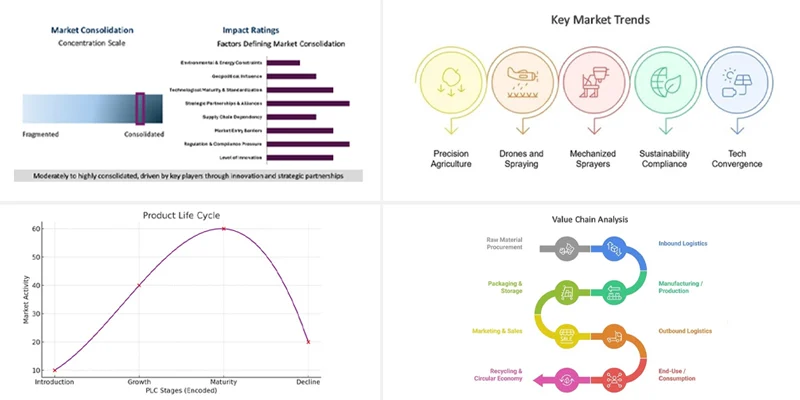

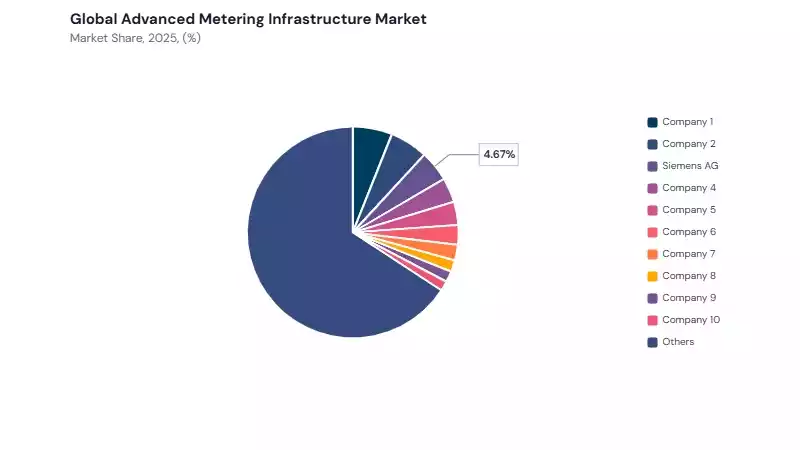
The Advanced Metering Infrastructure market is highly fragmented, with global smart meter manufacturers, utility software providers, communications specialists, and regional system integrators competing across electricity, gas, and water infrastructure. Itron, Landis+Gyr, Siemens, Sensus, Honeywell, Schneider Electric, Aclara/Hubbell, EDMI, Kamstrup, and Wasion are key participants with differentiated positions across metering hardware, communications networks, analytics, and grid-edge intelligence. Competition increasingly extends beyond meter hardware toward software, cybersecurity, data management, and lifecycle services. Regional certification requirements, local manufacturing preferences, communication standards, and utility procurement models keep the market diverse despite the presence of large international suppliers.
Based on component, the market is segmented into Hardware, Software, and Services. The Hardware market dominated the Global Advanced Metering Infrastructure Market by Component in 2025, and would continue to be a dominant market till 2033; thereby, achieving a market value of USD 30.3 billion by 2033, growing at a CAGR of 9.8 % during the forecast period. The Software market is expected to witness a CAGR of 11.4% during (2026 - 2033). Additionally, The Services market is expected to witness highest CAGR of 11.3% during (2026 - 2033).
Hardware forms the physical foundation of AMI through smart meters, communication modules, data concentrators, and network devices that capture and transmit utility consumption data. Software enables the intelligence layer through meter data management, billing integration, analytics, outage management, and operational dashboards. Services support deployment and lifecycle performance through installation, consulting, system integration, maintenance, training, and managed operations. Together, these components create a connected metering ecosystem that allows utilities to move from manual readings toward automated, data-driven grid and resource management.
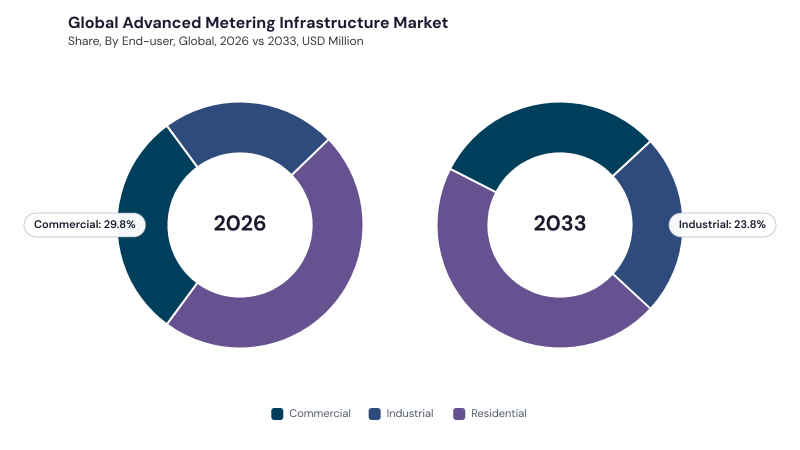
Based on end-user, the market is segmented into Residential, Commercial, and Industrial. The Residential market dominated the Global Advanced Metering Infrastructure Market by End-user in 2025, and would continue to be a dominant market till 2033; thereby, achieving a market value of USD 25.1 billion by 2033, growing at a CAGR of 9.9 % during the forecast period. The Commercial market is expected to witness a CAGR of 10.9% during (2026 - 2033). Additionally, The Industrial market is expected to witness highest CAGR of 11.1% during (2026 - 2033).
Residential adoption is supported by smart meter rollouts that improve billing accuracy, remote readings, customer engagement, and household-level energy transparency. Commercial users rely on AMI to monitor consumption, control utility costs, support demand management, and improve energy planning across buildings and facilities. Industrial users require deeper visibility into load patterns, peak usage, operational efficiency, and integration with energy management systems. Across all end-users, AMI helps utilities and customers improve consumption visibility, reduce operational inefficiencies, and support more responsive energy management.
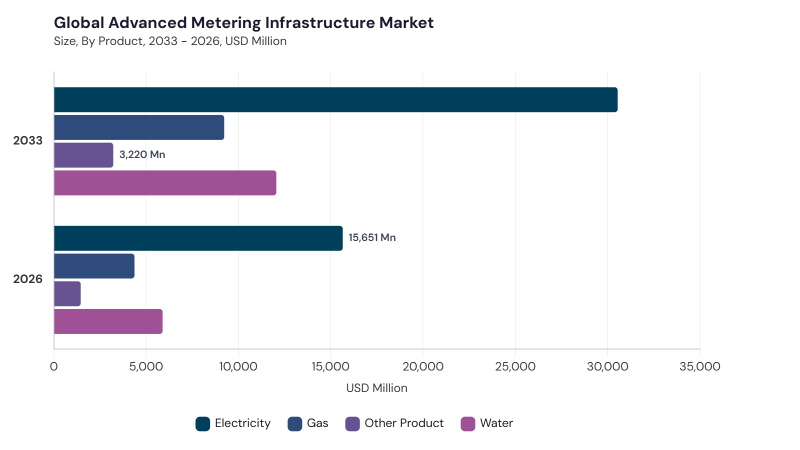
Based on product, the market is segmented into Electricity, Water, Gas, and Other Product. The Gas market dominated the Global Advanced Metering Infrastructure Market by Product in 2025, and would continue to be a dominant market till 2033; thereby, achieving a market value of USD 9.2 billion by 2033, growing at a CAGR of 11.3 % during the forecast period. The Electricity market is expected to witness a CAGR of 10% during (2026 - 2033). Additionally, The Water market is expected to witness a CAGR of 10.8% during (2026 - 2033).
Electricity AMI remains central to grid modernization, demand response, distributed energy integration, dynamic pricing, and outage management. Water AMI supports leakage detection, consumption monitoring, conservation programs, and more accurate billing for municipal and utility networks. Gas AMI improves remote reading, consumption analytics, operational safety, and distribution efficiency. Other Product includes specialized metering applications where automated data collection, remote monitoring, and digital utility platforms are increasingly used to improve resource management and operational transparency.
Free Valuable Insights: Advanced Metering Infrastructure Market Size to reach $55.0 Billion by 2033
Region-wise, the Advanced Metering Infrastructure Market is analyzed across North America, Europe, Asia Pacific, and LAMEA. The Asia Pacific market dominated the Global Advanced Metering Infrastructure Market by Region in 2025, and would continue to be a dominant market till 2033; thereby, achieving a market value of USD 21.7 billion by 2033, growing at a CAGR of 10.9 % during the forecast period. The North America market is expected to witness a CAGR of 9.8% during (2026 - 2033). Additionally, The Europe market is expected to witness a CAGR of 10.2% during (2026 - 2033).
Asia Pacific leads the market due to large-scale smart meter deployment, expanding electricity networks, smart grid development, and utility digitalization across major economies. North America benefits from grid modernization, replacement of conventional meters, demand-response initiatives, and distributed energy resource integration. Europe is supported by energy-efficiency policies, smart metering programs, consumption transparency, and digital grid management. LAMEA adoption is expanding gradually as utilities modernize infrastructure, reduce distribution losses, improve billing efficiency, and extend digital metering networks across developing energy systems.
| Report Attribute | Details |
|---|---|
| Market size value in 2026 | USD 27.3 billion |
| Market size forecast in 2033 | USD 55.0 billion |
| Base Year | 2025 |
| Historical Period | 2022 to 2024 |
| Forecast Period | 2026 to 2033 |
| Revenue Growth Rate | CAGR of 10.5% from 2026 to 2033 |
| Number of Pages | 521 |
| Tables | 420 |
| Report Coverage | Market Trends, Revenue Estimation and Forecast, Segmentation Analysis, Regional and Country Breakdown, Competitive Landscape, Market Share Analysis, Company Profiling, Companies Strategic Developments, SWOT Analysis, Product Life Cycle Analysis, Value Chain Analysis, Market Consolidation Analysis, Key Customer Criteria, Pandemic Impact Analysis, and Winning Imperatives |
| Segments Covered | Component, End-user, Product, and Geography |
| Country Scope |
|
| Companies Included | Itron, Inc.; Landis+Gyr; Siemens AG; Sensus; Honeywell International Inc.; Schneider Electric SE; Aclara / Hubbell; EDMI Limited; Kamstrup A/S; Wasion Holdings Limited |
By Component
By End-user
By Product
By Geography
The market is expected to reach USD 55.0 billion by 2033, growing at a 10.5% CAGR during 2026-2033.
The Hardware segment leads, projected to reach USD 30.3 billion by 2033.
Itron, Inc., Landis+Gyr, Siemens AG, Sensus, Honeywell International Inc., and Schneider Electric SE are key players.
Asia Pacific leads with a projected value of USD 21.7 billion by 2033.
Expanding regulatory frameworks and electrification are major drivers for market expansion.
The Electricity segment leads, expected to reach USD 30.5 billion by 2033.
Our team of dedicated experts can provide you with attractive expansion opportunities for your business.






 Unique Offerings
