The sample copy of this report is available for access.
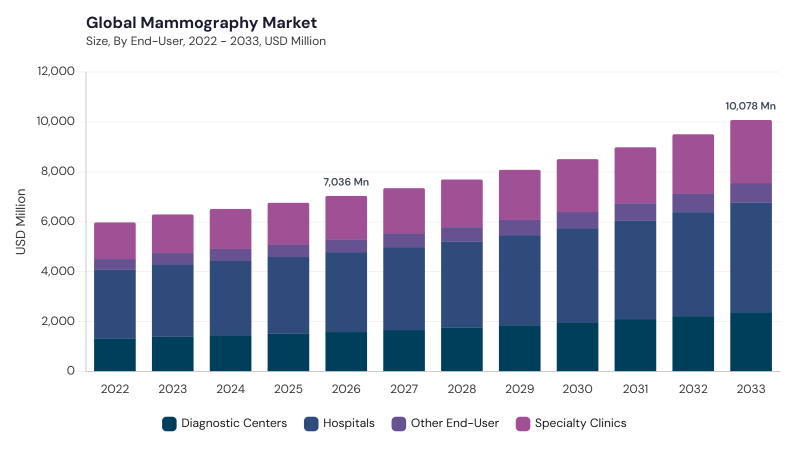
“Global Mammography Market to reach a market value of USD 10,077.99 Million by 2033 growing at a CAGR of 6.6%”
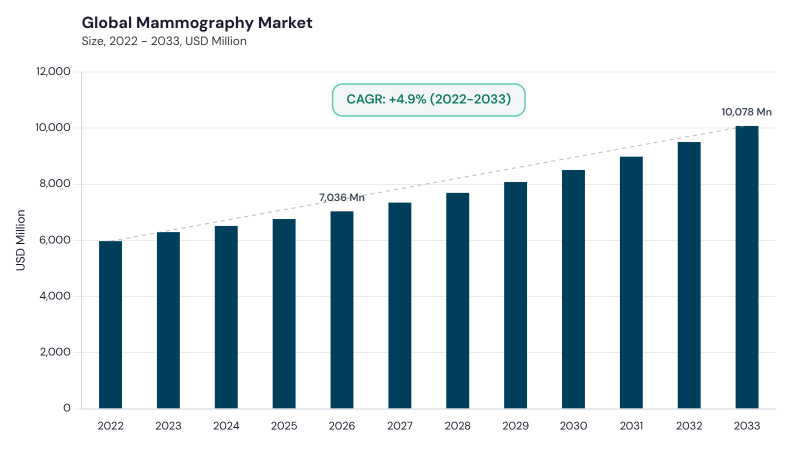
The Global Mammography Market is expected to reach USD 10.0 billion by 2033, growing at a CAGR of 5.3% during (2026 - 2033).
Rising breast cancer incidence, expanding screening programs, early detection awareness, and demand for accurate, low-radiation, patient-friendly imaging solutions are driving the Mammography Market across hospitals, diagnostic imaging centers, specialty clinics, mobile screening units, and community healthcare facilities. Growth is further strengthened by digital mammography, 3D breast tomosynthesis, AI-assisted image analysis, computer-aided detection, cloud-enabled image management, and integrated breast imaging workflows.
Rising emphasis on early breast cancer detection is expanding demand for mammography systems across preventive screening, diagnostic evaluation, and image-guided intervention. Healthcare providers are investing in digital platforms, 3D tomosynthesis, contrast-enhanced mammography, AI-assisted interpretation, and remote image-sharing solutions to improve diagnostic accuracy and workflow efficiency. The market is also benefiting from patient-centered care models focused on comfort, lower radiation exposure, faster reporting, and improved screening adherence. Emerging economies are creating additional growth potential through healthcare infrastructure expansion, portable systems, mobile mammography units, and wider screening access.
The competitive environment is moderately consolidated and innovation-driven, with multinational imaging companies and specialized breast imaging manufacturers competing on image quality, detector performance, AI integration, workflow efficiency, patient comfort, biopsy capability, and service support. Hologic holds a strong leadership position through its breast health portfolio, while GE HealthCare and Siemens Healthineers compete through advanced digital mammography, tomosynthesis, contrast-enhanced mammography, biopsy guidance, and enterprise imaging capabilities. Fujifilm, Planmed, IMS Giotto, Metaltronica, Trivitron, Allengers, and MEDI-FUTURE strengthen the market through regional reach, specialized platforms, value-oriented systems, and dedicated mammography portfolios.
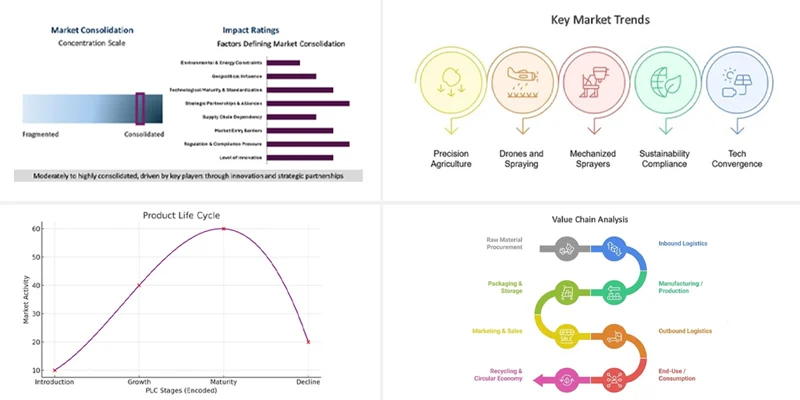

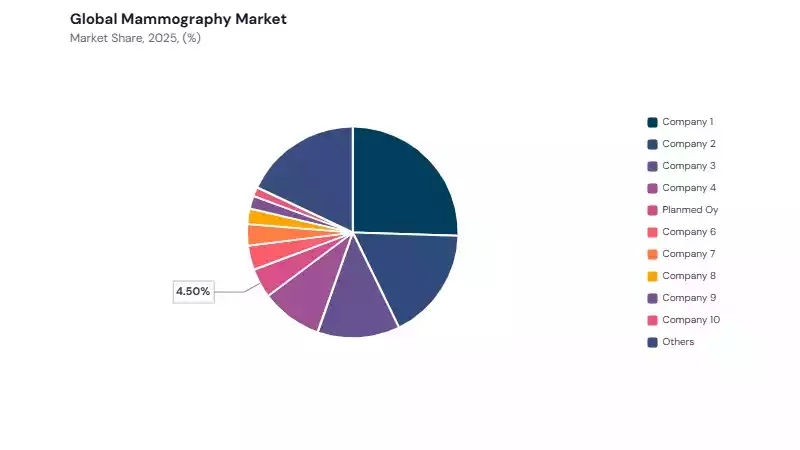
The global Mammography Market is moderately consolidated and technology-driven, led by established medical imaging companies, dedicated breast imaging specialists, and regional diagnostic equipment manufacturers. Hologic leads through its comprehensive breast health portfolio and strong position in digital breast tomosynthesis, while GE HealthCare and Siemens Healthineers maintain strong positions through advanced mammography platforms, biopsy guidance, workflow tools, and global imaging service networks. Fujifilm, Planmed, IMS Giotto, Metaltronica, Trivitron, Allengers, and MEDI-FUTURE add competitive depth through detector expertise, dedicated mammography platforms, regional manufacturing, cost-effective systems, and specialized breast imaging portfolios.
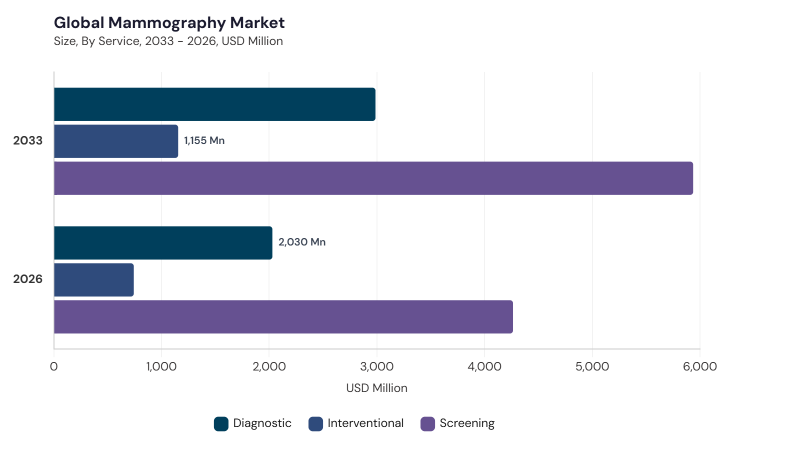
Based on Service, the market is segmented into Screening, Diagnostic, and Interventional. The Screening market dominated the Global Mammography Market by Service in 2025, and would continue to be a dominant market till 2033; thereby, achieving a market value of USD 5.9 billion by 2033, growing at a CAGR of 4.8 % during the forecast period. The Diagnostic market is expected to witness a CAGR of 5.7% during (2026 - 2033). The Interventional market is expected to witness a CAGR of 6.5% during (2026 - 2033).
Screening remains the core service category as healthcare systems focus on early breast cancer detection, population-based screening programs, and routine imaging for asymptomatic women. Diagnostic mammography supports follow-up evaluation of abnormal screening results, symptomatic cases, and suspicious clinical findings requiring more detailed imaging. Interventional mammography supports image-guided biopsy, lesion localization, and minimally invasive tissue evaluation. These services collectively support the full breast cancer care pathway from early detection to diagnostic confirmation and treatment planning.
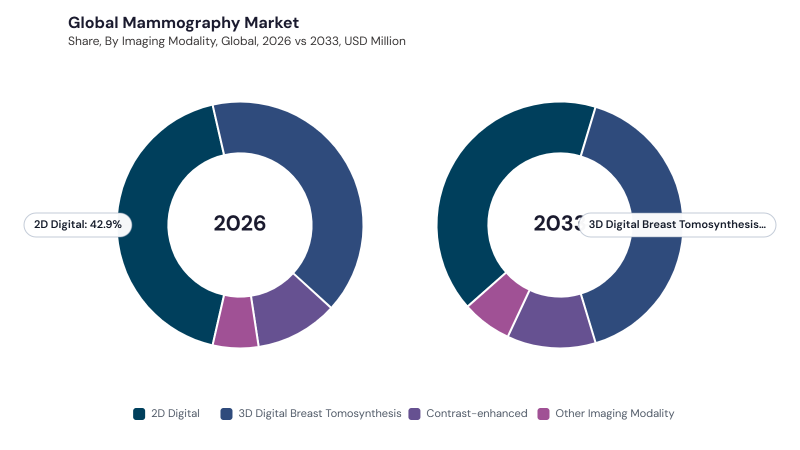
Based on Imaging Modality, the market is segmented into 2D Digital, 3D Digital Breast Tomosynthesis, Contrast-enhanced, and Other Imaging Modality. The 2D Digital market dominated the Global Mammography Market by Imaging Modality in 2025, and would continue to be a dominant market till 2033; thereby, achieving a market value of USD 4.1 billion by 2033, growing at a CAGR of 4.7 % during the forecast period. The 3D Digital Breast Tomosynthesis market is expected to witness a CAGR of 5.4% during (2026 - 2033). Additionally, The Contrast-enhanced market is expected to witness highest CAGR of 6.3% during (2026 - 2033).
2D Digital remains widely adopted due to its established clinical role, broad availability, efficient image acquisition, and suitability for routine screening workflows. 3D Digital Breast Tomosynthesis is gaining strong relevance as it improves visualization of overlapping breast tissue and supports more accurate lesion detection, especially in dense breast cases. Contrast-enhanced mammography supports evaluation of suspicious lesions and tumor vascularity, serving as a useful diagnostic adjunct. Other Imaging Modality includes complementary and emerging breast imaging techniques used selectively in advanced diagnostic workflows.
Based on End-User, the market is segmented into Hospitals, Specialty Clinics, Diagnostic Centers, and Other End-User. The Hospitals market dominated the Global Mammography Market by End-User in 2025, and would continue to be a dominant market till 2033; thereby, achieving a market value of USD 4.3 billion by 2033, growing at a CAGR of 4.7 % during the forecast period. The Specialty Clinics market is expected to witness a CAGR of 5.5% during (2026 - 2033). Additionally, The Diagnostic Centers market is expected to witness highest CAGR of 5.9% during (2026 - 2033).
Hospitals remain the leading end-user group because they combine high patient volume, radiology infrastructure, oncology services, interventional capabilities, and multidisciplinary breast care pathways. Specialty Clinics support targeted breast health services with focused screening, diagnosis, and patient-centered workflows. Diagnostic Centers are important for outpatient imaging access, routine screening, and faster diagnostic availability. Other End-User includes mobile screening units, community healthcare facilities, and specialized settings that help expand mammography access among underserved and remote populations.
Free Valuable Insights: Mammography Market Size to reach $10.0 Billion by 2033
Region-wise, the Mammography Market is analyzed across North America, Europe, Asia Pacific, and LAMEA. The North America market dominated the Global Mammography Market by Region in 2025, and would continue to be a dominant market till 2033; thereby, achieving a market value of USD 3.6 billion by 2033, growing at a CAGR of 4.7 % during the forecast period. The Europe market is expected to witness a CAGR of 4.9% during (2026 - 2033). Additionally, The Asia Pacific market is expected to witness a CAGR of 5.8% during (2026 - 2033).
North America remains the leading regional market, supported by established breast cancer screening practices, advanced healthcare infrastructure, reimbursement coverage, and adoption of digital breast tomosynthesis and AI-enabled imaging. Europe benefits from organized screening programs, modernization of diagnostic imaging infrastructure, and continued emphasis on early breast cancer detection. Asia Pacific is expanding through healthcare infrastructure development, increasing screening awareness, rising diagnostic investments, and improving access to advanced imaging systems. LAMEA is developing steadily as breast cancer screening access improves, digital mammography adoption increases, and healthcare infrastructure gradually strengthens.
| Report Attribute | Details |
|---|---|
| Market size value in 2026 | USD 7.0 billion |
| Market size forecast in 2033 | USD 10.0 billion |
| Base Year | 2025 |
| Historical Period | 2022 to 2024 |
| Forecast Period | 2026 to 2033 |
| Revenue Growth Rate | CAGR of 5.3% from 2026 to 2033 |
| Number of Pages | 607 |
| Tables | 660 |
| Report Coverage | Market Trends, Revenue Estimation and Forecast, Segmentation Analysis, Regional and Country Breakdown, Competitive Landscape, Market Share Analysis, Company Profiling, Companies Strategic Developments, SWOT Analysis, Product Life Cycle Analysis, Value Chain Analysis, Market Consolidation Analysis, Key Customer Criteria, Pandemic Impact Analysis, and Winning Imperatives |
| Segments Covered | Service, Imaging Modality, End-User, and Region |
| Country Scope |
|
| Companies Included | Hologic, Inc.; GE HealthCare Technologies Inc.; Siemens Healthineers AG; FUJIFILM Holdings Corporation; Planmed Oy; IMS Giotto S.p.A.; Metaltronica S.p.A.; Trivitron Healthcare Pvt. Ltd.; Allengers Medical Systems Ltd.; MEDI-FUTURE Co., Ltd. |
By Service
By Imaging Modality
By End-User
By Geography
The mammography market is expected to reach USD 10.0 billion by 2033, growing at a 5.3% CAGR during 2026-2033.
The screening segment leads, projected to reach USD 5.9 billion by 2033.
Hologic, GE HealthCare, Siemens Healthineers, FUJIFILM, Planmed, IMS Giotto, Metaltronica, Trivitron, Allengers, MEDI-FUTURE.
North America dominates, expected to reach USD 3.6 billion by 2033.
Advanced AI integration in screening and rising demand for contrast-enhanced mammography are key growth drivers.
The 2D digital segment leads, projected to reach USD 4.1 billion by 2033.
Our team of dedicated experts can provide you with attractive expansion opportunities for your business.








 Unique Offerings