The sample copy of this report is available for access.
The Europe Mammography Market is expected to reach USD 2548.3 million by 2031, growing at a CAGR of 4.9% during (2026 - 2033).
The Europe Mammography Market evolved from early analog X-ray breast imaging into a highly digitized diagnostic environment focused on early cancer detection, image quality, and patient safety. The transition toward digital mammography improved resolution, reduced radiation exposure, and enabled more efficient image storage and clinical workflows. Digital breast tomosynthesis further advanced the market by introducing three-dimensional imaging and improved lesion visibility, particularly in complex breast tissue. Organized screening programs, stronger regulatory standards, and growing integration of AI-powered image analysis have progressively shifted mammography toward more precise, interoperable, and technology-driven breast imaging pathways.
Artificial intelligence, digital breast tomosynthesis, personalized screening, and cloud-enabled imaging are shaping current market development. AI tools increasingly support lesion detection, risk stratification, workflow prioritization, and radiologist decision-making, while advanced digital modalities improve diagnostic accuracy and reduce unnecessary recalls. European regulatory frameworks are also encouraging greater standardization in image quality, radiation safety, clinical validation, and data protection. At the same time, cloud-based image management, telemammography, personalized risk-based screening, patient-centric technologies, and expanded access initiatives are improving collaboration, screening reach, and operational efficiency across diverse healthcare systems.
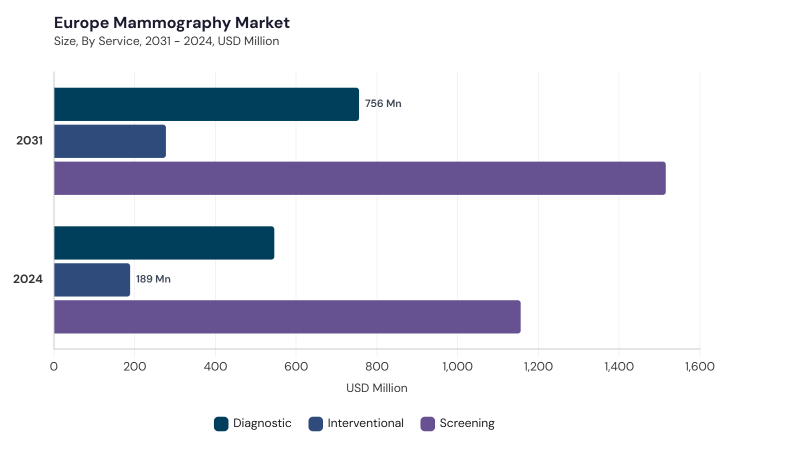
Based on Service, the market is segmented into Screening, Diagnostic, and Interventional. The Screening market dominated the Europe Mammography Market by Service in 2025, and would continue to be a dominant market till 2033; thereby, achieving a market value of USD 1515.2 million by 2031, growing at a CAGR of 4.5 % during the forecast period. The Diagnostic market is expected to witness a CAGR of 5.3% during (2026 - 2033). The Interventional market is expected to witness a CAGR of 6.2% during (2026 - 2033).
Screening services primarily support routine examinations for asymptomatic populations through national and regional preventive healthcare programs. Diagnostic mammography is used for symptomatic patients, abnormal screening findings, and more detailed evaluation through targeted imaging and complementary diagnostic assessment. Interventional mammography supports stereotactic and tomosynthesis-guided biopsy, lesion localization, tissue sampling, and related image-guided procedures. Technology adoption across these services is increasingly influenced by digital breast tomosynthesis, AI-assisted interpretation, contrast-enhanced imaging, standardized quality requirements, and more integrated breast-care workflows.
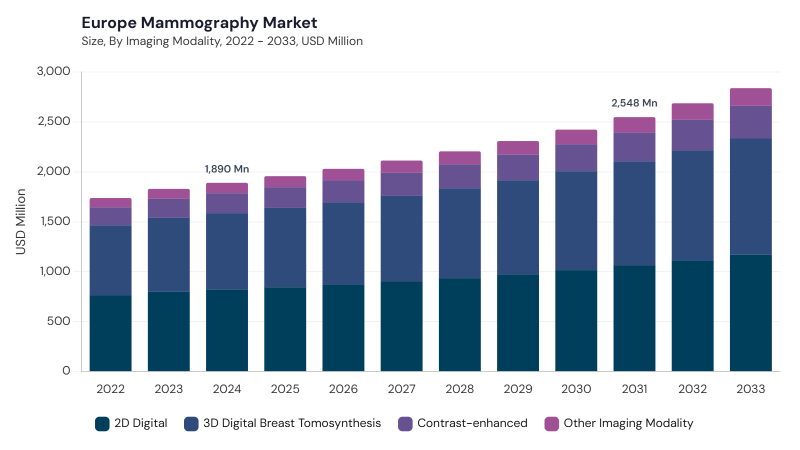
Based on Imaging Modality, the market is segmented into 2D Digital, 3D Digital Breast Tomosynthesis, Contrast-enhanced, and Other Imaging Modality. The 2D Digital market dominated the Europe Mammography Market by Imaging Modality in 2025, and would continue to be a dominant market till 2033; thereby, achieving a market value of USD 1062.9 million by 2031, growing at a CAGR of 4.3 % during the forecast period. The 3D Digital Breast Tomosynthesis market is expected to witness a CAGR of 5% during (2026 - 2033). Additionally, The Contrast-enhanced market is expected to witness highest CAGR of 6% during (2026 - 2033).
2D Digital mammography remains a foundational modality for screening and diagnostic imaging because of its established clinical use, cost-effectiveness, and integration with digital image-management systems. 3D Digital Breast Tomosynthesis provides volumetric breast imaging that improves lesion conspicuity and reduces tissue-overlap limitations, supporting broader use in both screening and diagnostic workflows. Contrast-enhanced mammography provides functional information for lesion characterization, ambiguous findings, and selected preoperative assessments. Other Imaging Modality includes complementary approaches such as automated breast ultrasound, molecular breast imaging, dedicated breast MRI, and other emerging techniques used for specific patient groups and complex diagnostic requirements.
Based on End-User, the market is segmented into Hospitals, Specialty Clinics, Diagnostic Centers, and Other End-User. Hospitals provide comprehensive mammography services across screening, diagnostic evaluation, interventional procedures, oncology coordination, and treatment planning, with access to advanced imaging technologies and integrated clinical infrastructure. Specialty Clinics focus on breast and women’s health through personalized screening, diagnostic consultation, and specialized imaging services.
Diagnostic Centers emphasize outpatient access, higher throughput, digital workflows, and rapid imaging turnaround while helping reduce pressure on hospital radiology departments. Other End-User includes mobile mammography units, community screening programs, public health organizations, wellness centers, and research institutions supporting outreach, preventive screening, and technology validation.
Free Valuable Insights: The Worldwide Mammography Market is projected to reach USD 10.0 Billion billion by 2033, at a CAGR of 5.3%
Based on Country, the market is segmented into Germany, UK, France, Russia, Spain, Italy, and Rest of Europe. The Germany market dominated the Europe Mammography Market by Country in 2025, and would continue to be a dominant market till 2033; thereby, achieving a market value of USD 473.4 million by 2031, growing at a CAGR of 3.4 % during the forecast period. The UK market is expected to witness a CAGR of 3.9% during (2026 - 2033). Additionally, The France market is expected to witness a CAGR of 5.7% during (2026 - 2033).
Across Europe, mammography adoption is being shaped by AI integration, digital breast tomosynthesis, cloud-enabled workflows, personalized screening, regulatory compliance, and efforts to improve accessibility. Germany emphasizes AI-assisted diagnostics, personalized screening, regulatory harmonization, and lower-dose imaging, while the UK focuses on NHS-supported AI trials, cloud enterprise imaging, screening capacity, and workflow modernization. France is advancing AI-based interpretation, cloud imaging, personalized protocols, and integrated digital health platforms, whereas Russia emphasizes standardized AI use, digital infrastructure, subscription-based imaging software, and broader screening access. Spain focuses on AI-supported diagnosis, patient-centric services, personalized screening, and EHR integration, while Italy emphasizes AI-assisted interpretation, risk-based screening, radiation safety, and diversified imaging capabilities. Rest of Europe continues to develop AI-supported reading, patient-friendly technologies, hybrid imaging, mobile screening, telemammography, and regionally adapted breast imaging solutions.

By Service
By Imaging Modality
By End-User
By Country
Set to reach $2548.3 Million by 2031, growing at 4.9% CAGR during 2026-2033.
Germany leads with $473.4 million by 2031, growing at a CAGR of 3.4% during the forecast period.
Rising demand for 3D Digital Breast Tomosynthesis with a CAGR of 5% during 2026-2033.
The screening segment will reach $1515.2 million by 2031, growing at a 4.5% CAGR during 2026-2033.
The France market is expected to witness a CAGR of 5.7% during 2026-2033.
The contrast-enhanced market is expected to witness the highest CAGR of 6% during 2026-2033.
Our team of dedicated experts can provide you with attractive expansion opportunities for your business.




 Unique Offerings