The sample copy of this report is available for access.
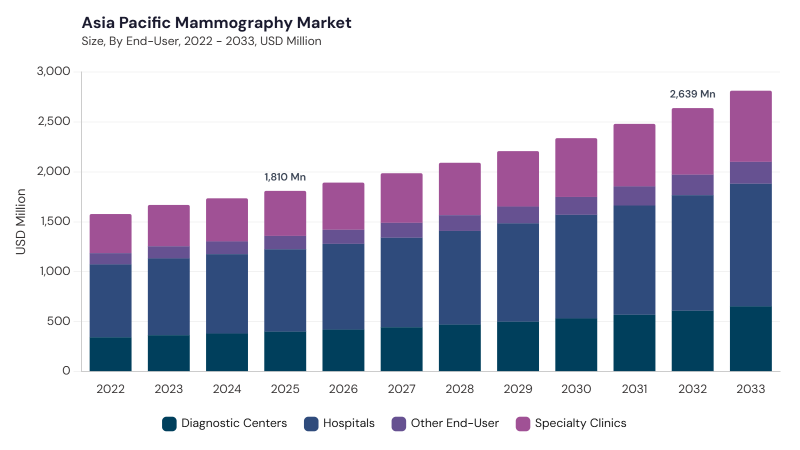
The Asia Pacific Mammography Market is expected to reach USD 2337.5 million by 2030, growing at a CAGR of 5.8% during (2026 - 2033).
The Asia Pacific Mammography Market evolved from limited analog mammography services concentrated in major urban centers into a more advanced digital breast imaging ecosystem. Progressive adoption of digital mammography improved image quality, diagnostic accuracy, storage, and workflow efficiency, while digital breast tomosynthesis introduced three-dimensional visualization for more detailed assessment of breast tissue. Expanding healthcare infrastructure, government-led screening initiatives, and rising awareness of early breast cancer detection further broadened adoption. The market now increasingly incorporates artificial intelligence, portable imaging systems, cloud connectivity, telemedicine, and integrated digital health solutions across screening and diagnostic workflows.
Artificial intelligence, portable mammography, digital transformation, and broader screening access are shaping current market development. AI and machine learning increasingly assist radiologists with lesion detection, image interpretation, risk stratification, workflow prioritization, and remote diagnostics, while cloud-based platforms improve data sharing and collaborative care. Portable and mobile mammography systems are helping extend screening into rural and underserved populations, addressing infrastructure disparities across the region. Local manufacturing, personalized screening protocols, advanced imaging modalities, telemammography, and evolving reimbursement and regulatory frameworks are also influencing technology adoption across developed and emerging Asia Pacific healthcare markets.
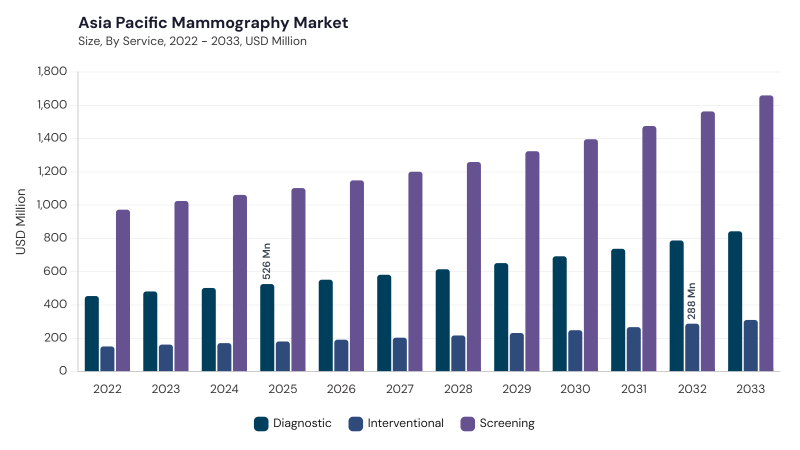
Based on Service, the market is segmented into Screening, Diagnostic, and Interventional. The Screening market dominated the Asia Pacific Mammography Market by Service in 2025, and would continue to be a dominant market till 2033; thereby, achieving a market value of USD 1396.0 million by 2030, growing at a CAGR of 5.4 % during the forecast period. The Diagnostic market is expected to witness a CAGR of 6.2% during (2026 - 2033). The Interventional market is expected to witness a CAGR of 7.1% during (2026 - 2033).
Screening mammography supports routine imaging for asymptomatic populations through preventive healthcare programs, community initiatives, hospital services, and mobile screening models. Diagnostic mammography provides more detailed evaluation for symptomatic patients, abnormal screening findings, high-risk individuals, and palpable abnormalities through targeted imaging and complementary assessment. Interventional mammography supports stereotactic biopsy, lesion localization, image-guided tissue sampling, and other minimally invasive breast procedures. Adoption across these services is increasingly influenced by digital mammography, 3D tomosynthesis, AI-assisted interpretation, improved accessibility, and greater integration of breast imaging within multidisciplinary care pathways.
Based on Imaging Modality, the market is segmented into 2D Digital, 3D Digital Breast Tomosynthesis, Contrast-enhanced, and Other Imaging Modality. The 2D Digital market dominated the Asia Pacific Mammography Market by Imaging Modality in 2025, and would continue to be a dominant market till 2033; thereby, achieving a market value of USD 980.9 million by 2030, growing at a CAGR of 5.2 % during the forecast period. The 3D Digital Breast Tomosynthesis market is expected to witness a CAGR of 6% during (2026 - 2033). Additionally, The Contrast-enhanced market is expected to witness highest CAGR of 6.9% during (2026 - 2033).
2D Digital mammography remains a foundational imaging modality for routine screening and diagnostic evaluation because of its broad accessibility, clinical familiarity, and comparatively lower implementation cost. 3D Digital Breast Tomosynthesis provides volumetric imaging that improves lesion visibility, particularly in dense breast tissue, and is increasingly adopted by advanced hospitals and diagnostic centers. Contrast-enhanced mammography provides additional functional information for lesion characterization, complex diagnostic cases, and pre-surgical evaluation. Other Imaging Modality includes automated breast ultrasound, molecular breast imaging, synthetic 2D imaging, and other emerging approaches that address specific diagnostic limitations and higher-risk patient requirements.
Based on End-User, the market is segmented into Hospitals, Specialty Clinics, Diagnostic Centers, and Other End-User. Hospitals provide comprehensive mammography services across screening, diagnostic imaging, interventional procedures, oncology pathways, and multidisciplinary breast care, supported by advanced equipment and integrated clinical systems. Specialty Clinics focus on breast and women’s health through personalized imaging, high-risk screening, consultations, and follow-up services.
Diagnostic Centers emphasize high-throughput outpatient screening, rapid turnaround, cost efficiency, and increasing adoption of cloud-based image sharing and telemammography. Other End-User includes mobile mammography units, community health centers, governmental programs, charitable initiatives, and outreach networks focused on extending breast cancer screening to rural and underserved populations.
Free Valuable Insights: Mammography Market is Predicted to reach USD 10.0 Billion billion by 2033, at a CAGR of 5.3%
Based on Country, the market is segmented into China, Japan, India, South Korea, Australia, Malaysia, and Rest of Asia Pacific. The China market dominated the Asia Pacific Mammography Market by Country in 2025, and would continue to be a dominant market till 2033; thereby, achieving a market value of USD 606.5 million by 2030, growing at a CAGR of 3.8 % during the forecast period. The Japan market is expected to witness a CAGR of 5.2% during (2026 - 2033). Additionally, The India market is expected to witness a CAGR of 6.6% during (2026 - 2033).
Across Asia Pacific, mammography adoption is being shaped by AI integration, digital imaging, mobile screening, localization, and healthcare infrastructure expansion. China emphasizes AI-enabled diagnostics, localized manufacturing, broader government screening programs, and technology adaptation, while Japan focuses on AI-supported mammography, digital breast tomosynthesis, reimbursement-driven technology upgrades, and portable screening solutions. India is advancing AI-assisted interpretation, cloud-based data sharing, mobile screening, tier-2 and tier-3 access, and cost-effective deployment, whereas South Korea emphasizes AI integration, localized manufacturing, regulatory compliance, and advanced digital platforms. Australia focuses on AI-supported diagnostics, personalized screening, regulatory validation, and remote access, while Malaysia emphasizes AI-enabled imaging, broader semi-rural screening, cloud connectivity, and localized support. Rest of Asia Pacific continues to develop digital mammography, portable systems, AI analytics, PACS and RIS integration, and affordable screening solutions for diverse healthcare environments.

By Service
By Imaging Modality
By End-User
By Country
Set to reach $2337.5 Million by 2030, growing at 5.8% CAGR during 2026-2033.
China leads with $606.5 million by 2030, growing at a CAGR of 3.8% during 2026-2033.
Rising demand for screening services, reaching $1396.0 million by 2030 at 5.4% CAGR during 2026-2033.
2D Digital segment will achieve $980.9 million by 2030, growing at a CAGR of 5.2% during 2026-2033.
India is expected to witness a CAGR of 6.6% during 2026-2033.
The Diagnostic segment is expected to witness a CAGR of 6.2% during 2026-2033.
Our team of dedicated experts can provide you with attractive expansion opportunities for your business.




 Unique Offerings