The sample copy of this report is available for access.
“Global Machine Translation Market to reach a market value of USD 6,370.78 Million by 2033 growing at a CAGR of 20.7%”
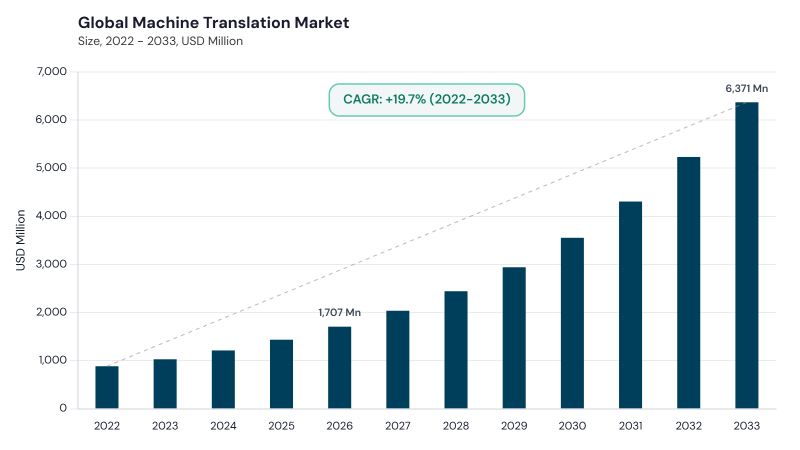
The Global Machine Translation Market is expected to reach USD 6370.8 million by 2033, growing at a CAGR of 20.7% during (2026 - 2033).
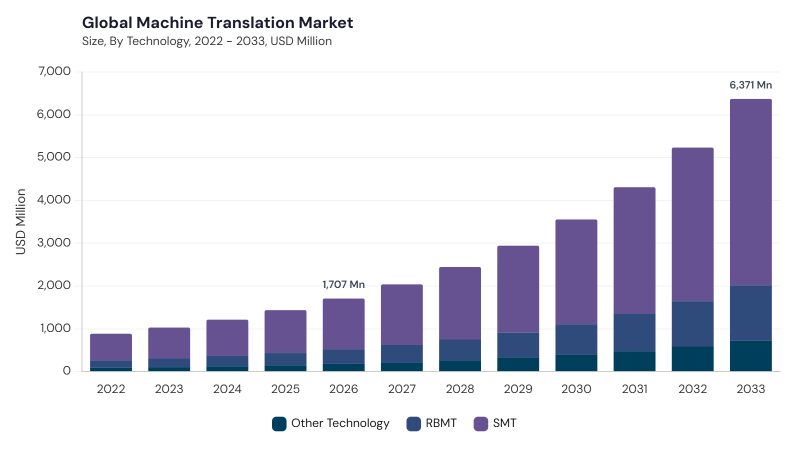
Machine translation market is experiencing market growth supported by growing demand for global digital content localization, real-time multilingual, communication, multilingual e-commerce, cross-border enterprise operations, automated customer support, and AI-powered language platforms. Market growth is driven by generative AI, neural machine translation, low-resource language support, secure enterprise deployment, domain-specific engines, and integration with content-management workflows. Machine translation market emerged from early computational linguistics efforts, when rule-based systems attempted literal translation between languages.
Machine translation market is experiencing growth as organization largely require scalable, fast, and cost-efficient multilingual content delivery. AI-powered translation engines are being embedded into customer support platforms, content management systems, enterprise workflows, collaboration tools, and digital commerce platforms. Machine translation market is further benefiting from growth in document translation, real-time speech translation, secure private deployment, and adaptive translation. Machine translation is becoming a core part of localization strategies, and global communication with translation quality enhances.
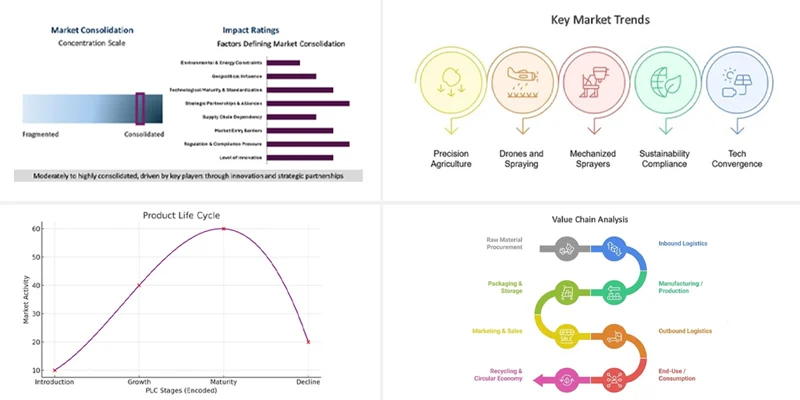
Machine translation market is innovation-driven and moderately fragmented, with competition led by specialist language-AI companies, hyperscale cloud providers, enterprise translation software vendors, and regional platforms. Market players compete through domain adaptation, translation accuracy, API scalability, language coverage, data governance, privacy safeguards, real-time performance, enterprise integration, and terminology control.
Machine translation market is innovation-driven and moderately fragmented with competition driven by specialist language-AI companies, hyperscale cloud providers, enterprise translation software vendors, and regional platforms. Market players compete through domain adaptation, translation accuracy, API scalability, language coverage, privacy safeguards, real-time performance, enterprise integration, and terminology control. Market competition will depend on multimodal capabilities, LLM-enhanced translation, speech-to-speech translation, and multimodal capabilities.

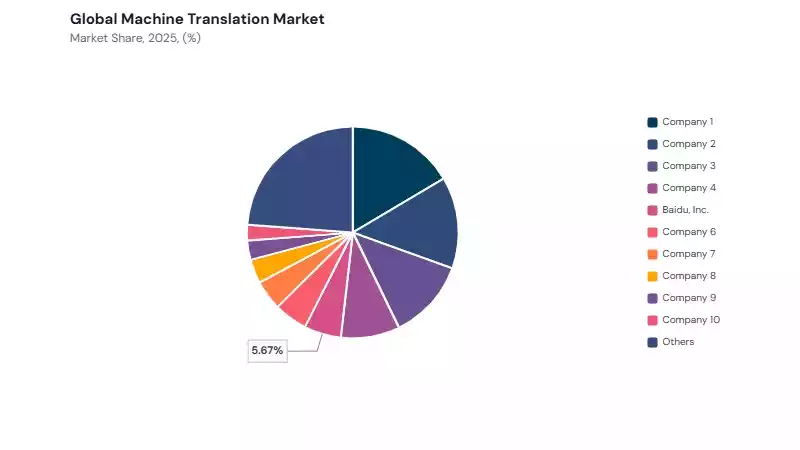
Machine translation market is intensively competitive with Microsoft Corporation, Google LLC, and DeepL SE forming the leading group across cloud translation, consumer translation, document translation, AI-powered multilingual communication, and enterprise localization. Baidu, Amazon Web Services, Alibaba, and Tencent support competition through API services, cloud-based translation, speech translation, domain-specific engines, and multimodal language tools. NAVER Corporation, RWS Holdings, and SYSTRAN Group reinforce the market through regional language expertise, enterprise language platforms, customized translation system, and secure deployment. Market competition relies on language coverage, LLM-enhanced accuracy, workflow integration, data privacy, real-time multilingual communication, and adaptive translation.
Based on Technology, the market is segmented into SMT, RBMT, and Other Technology. The SMT market dominated the Global Machine Translation Market by Technology in 2025, and would continue to be a dominant market till 2033; thereby, achieving a market value of USD 4355.1 million by 2033, growing at a CAGR of 20.4 % during the forecast period. The RBMT market is expected to witness a CAGR of 21.1% during (2026 - 2033).
SMT leads the market due to its established role in multilingual content processing, large-scale automated translation, and workflows where substantial bilingual corpora support translation output. RBMT remains relevant in environments requiring controlled language rules, terminology consistency, and predictable translation behavior. Other Technology is expanding through neural machine translation, transformer models, large language models, adaptive engines, and hybrid systems that improve contextual accuracy, translation fluency, and automation for complex multilingual use cases.
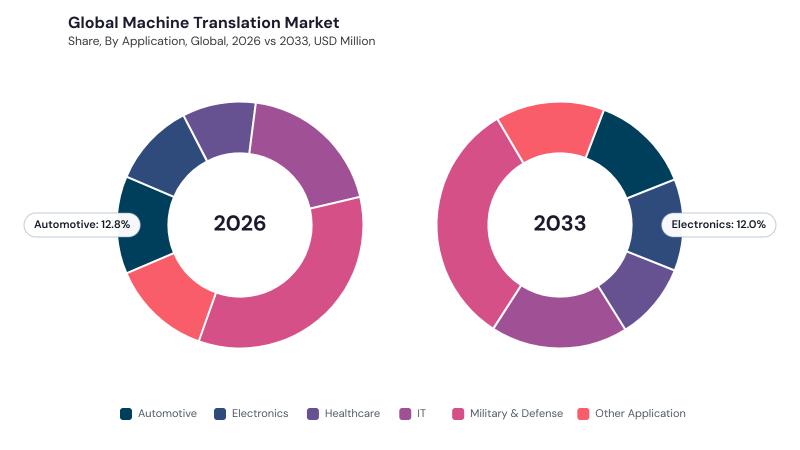
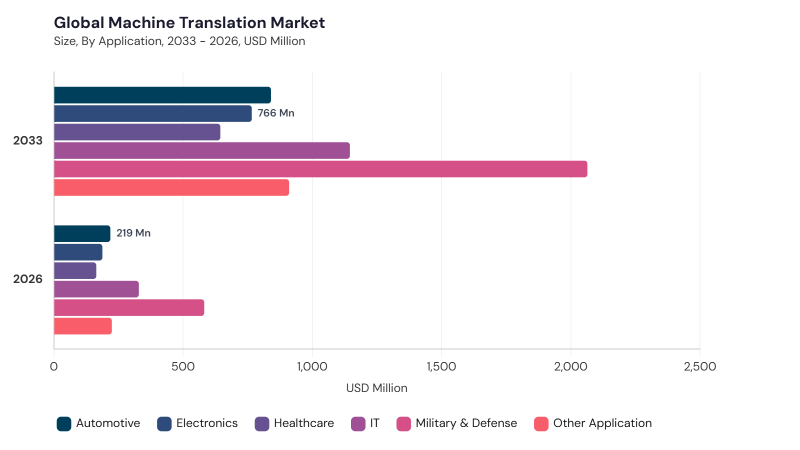
Based on Application, the market is segmented into Military & Defense, IT, Automotive, Electronics, Healthcare, and Other Application. The Military & Defense market dominated the Global Machine Translation Market by Application in 2025, and would continue to be a dominant market till 2033; thereby, achieving a market value of USD 2064.4 million by 2033, growing at a CAGR of 19.8 % during the forecast period. The IT market is expected to witness a CAGR of 19.5% during (2026 - 2033). Additionally, The Automotive market is expected to witness highest CAGR of 21.2% during (2026 - 2033).
Military & Defense dominates the market due to the need for rapid multilingual communication, intelligence analysis, document processing, and mission-critical translation under strict security requirements. IT demand is supported by software localization, technical documentation, digital services, cloud platforms, and global content operations. Automotive benefits from connected vehicle interfaces and technical documentation, while Electronics uses translation for product manuals, support content, and user interfaces. Healthcare adoption is supported by multilingual patient communication, medical documentation, and clinical information workflows.
Free Valuable Insights: Machine Translation Market Size to reach $6370.7 Million by 2033
Region-wise, the Machine Translation Market is analyzed across North America, Europe, Asia Pacific, and LAMEA. North America led the machine translation market in 2025 and is estimated to remain dominant till 2033, capturing the market value of USD 2353.0 million, expanding at a CAGR of 19.9% by 2033. The Asia Pacific market is predicted to grow at a CAGR of 21.6% during 2026-2033. Moreover, the Europe market is anticipated to expand at a CAGR of 20.5% during the forecast period.
North America led the market because of strong adoption of cloud platforms, AI-based language technologies, software ecosystems, enterprise digitalization, and automated multilingual content solutions. Europe is driven by cross-border business activity, extensive multilingual communication requirements, language technology adoption and public-sector localization needs. Moreover, APAC is further growing through digital services, linguistic diversity, AI-powered translation integration, and international commerce. LAMEA is witnessing expansion through expanding online content, digital transformation, adoption of cloud-based language solution, and cross-border trade.
| Report Attribute | Details |
|---|---|
| Market size value in 2026 | USD 1706.7 million |
| Market size forecast in 2033 | USD 6370.7 million |
| Base Year | 2025 |
| Historical Period | 2022 to 2024 |
| Forecast Period | 2026 to 2033 |
| Revenue Growth Rate | CAGR of 20.7% from 2026 to 2033 |
| Number of Pages | 528 |
| Tables | 570 |
| Report Coverage | Market Trends, Revenue Estimation and Forecast, Segmentation Analysis, Regional and Country Breakdown, Competitive Landscape, Market Share Analysis, Company Profiling, Companies Strategic Developments, SWOT Analysis, Product Life Cycle Analysis, Value Chain Analysis, Market Consolidation Analysis, Key Customer Criteria, Pandemic Impact Analysis, and Winning Imperatives |
| Segments Covered | Technology, Application, Region |
| Country Scope |
|
| Companies Included | Google LLC (Alphabet Inc.), Microsoft Corporation, DeepL SE, Amazon Web Services, Inc., Baidu, Inc., Tencent Holdings Ltd., Alibaba Group Holding Ltd., NAVER Corporation, and SYSTRAN Group |
By Technology
By Application
By Geography
The market is expected to reach USD 6370.8 million by 2033, with a 20.7% CAGR during 2026-2033.
Neural machine translation is advancing rapidly, contributing significantly to market growth.
Google LLC, Microsoft Corporation, DeepL SE, and Amazon Web Services, Inc. are the leading companies.
North America is a key region due to high adoption of advanced technologies.
AI-driven automation reducing operational costs and demand for multilingual content in globalized industries are major drivers.
The market is growing at a 20.7% CAGR during the forecast period (2026-2033).
Our team of dedicated experts can provide you with attractive expansion opportunities for your business.








 Unique Offerings