The sample copy of this report is available for access.
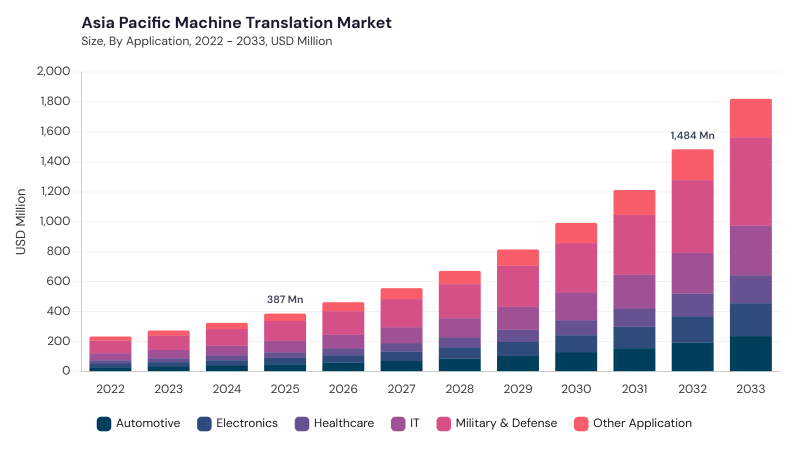
The Asia Pacific Machine Translation Market is expected to reach USD 992.4 million by 2030, growing at a CAGR of 21.6% during (2026 - 2033).
The Asia Pacific Machine Translation Market evolved from early rule-based language systems toward statistical and increasingly sophisticated neural translation technologies. Initial adoption was constrained by computational limitations and the region’s extensive linguistic and dialectal diversity, while statistical machine translation introduced data-driven learning from bilingual corpora and improved scalability. Neural machine translation later transformed translation quality through deep learning and contextual language processing. The regional ecosystem now incorporates AI, cloud platforms, hybrid translation models, localization workflows, and specialized language technologies designed to address diverse linguistic structures and industry requirements.
Neural machine translation, large language models, domain-specific customization, low-resource language development, cloud deployment, and continuous localization are shaping current market development. Enterprises increasingly embed automated translation within digital commerce, software, healthcare, media, and customer-engagement workflows to accelerate multilingual content delivery. AI-powered contextual processing and speech integration are improving translation relevance, while specialized models are addressing complex regional languages and industry terminology. Data sovereignty, privacy requirements, regulatory differences, and the need for culturally appropriate outputs are simultaneously encouraging secure deployments, human oversight, and localized AI architectures.
Based on Technology, the market is segmented into SMT, RBMT, and Other Technology. The SMT market dominated the Asia Pacific Machine Translation Market by Technology in 2025, and would continue to be a dominant market till 2033; thereby, achieving a market value of USD 685.3 million by 2030, growing at a CAGR of 21.3 % during the forecast period. The RBMT market is expected to witness a CAGR of 22% during (2026 - 2033).
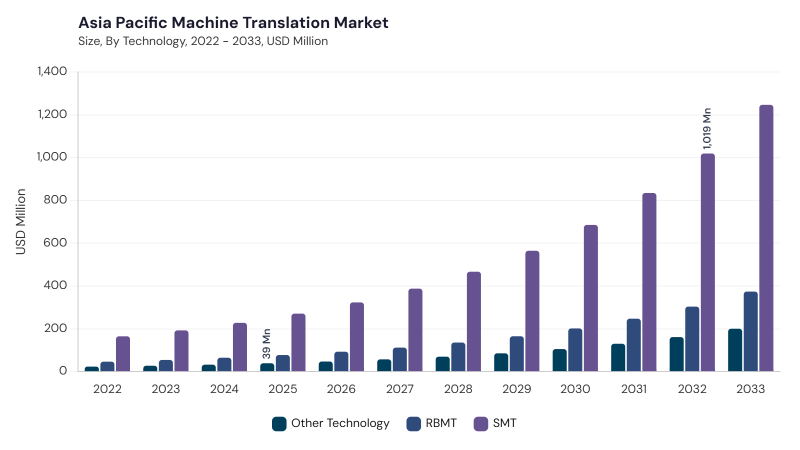
SMT applies probabilistic models trained on bilingual corpora and remains useful for high-volume content, e-commerce, digital platforms, and workflows supported by established linguistic datasets. RBMT relies on predefined grammatical rules, dictionaries, and controlled terminology, making it relevant for structured and precision-sensitive translation tasks in legal, medical, technical, and regulated environments. Other Technology includes neural machine translation, multilingual large language models, transformer architectures, speech-to-text integration, and hybrid systems that improve contextual understanding, fluency, adaptability, and support for complex or low-resource languages. These technologies are increasingly enabling real-time communication, automated localization, and customized enterprise translation.
Based on Application, the market is segmented into Military & Defense, IT, Automotive, Electronics, Healthcare, and Other Application. Military & Defense uses machine translation for intelligence analysis, technical communication, operational information, and multilingual coordination. IT applies MT to software localization, technical documentation, customer interactions, digital platforms, gaming, and continuous multilingual content delivery.
Automotive uses translation for navigation interfaces, connected-vehicle functions, engineering documentation, service manuals, and global production communication, while Electronics relies on MT for operating instructions, product interfaces, technical records, and supplier communication. Healthcare uses machine translation in clinical trials, medical device documentation, telemedicine, patient information, and digital health services, often supported by human review and domain-specific terminology. Other Application includes e-commerce, education, tourism, media, legal services, digital marketing, and broader multilingual business communication.
Free Valuable Insights: Machine Translation Market is Predicted to reach USD 6370.7 Million billion by 2033, at a CAGR of 20.7%
Based on Country, the market is segmented into China, Japan, India, South Korea, Singapore, Malaysia, and Rest of Asia Pacific. The China market dominated the Asia Pacific Machine Translation Market by Country in 2025, and would continue to be a dominant market till 2033; thereby, achieving a market value of USD 262.4 million by 2030, growing at a CAGR of 19.4 % during the forecast period. The Japan market is expected to witness a CAGR of 20.8% during (2026 - 2033). Additionally, The India market is expected to witness a CAGR of 22.3% during (2026 - 2033).
Across Asia Pacific, machine translation adoption is being shaped by neural AI, cloud services, localization, language inclusivity, regulatory compliance, and domain-specific customization. China emphasizes proprietary neural engines, cloud-based translation, human-in-the-loop workflows, domain specialization, and regulatory alignment, while Japan focuses on Japanese-language neural models, real-time multilingual communication, domain-specific engines, and secure infrastructure. India is advancing regional-language translation, low-resource language datasets, speech technologies, mobile-first solutions, and government-supported multilingual access, whereas South Korea emphasizes Korean-specific neural models, adaptive learning, secure on-premise deployments, and domain localization. Singapore focuses on contextual customization, government-linked language initiatives, AI analytics, and multilingual public-service applications, while Malaysia emphasizes Malay and regional-language neural models, CAT integration, localization, and scalable cloud platforms. Rest of Asia Pacific continues to develop cloud-native translation, transformer-based AI, localized language solutions, data privacy controls, and broader support for underserved regional languages.

By Technology
By Application
By Country
Set to reach $992.4 Million by 2030, growing at 21.6% CAGR during 2026-2033.
China leads with $262.4 million by 2030, growing at 19.4% CAGR during 2026-2033.
SMT technology dominates, reaching $685.3 million by 2030 at 21.3% CAGR during 2026-2033.
Japan is expected to grow at a 20.8% CAGR during 2026-2033.
India is expected to witness a CAGR of 22.3% during 2026-2033.
Our team of dedicated experts can provide you with attractive expansion opportunities for your business.




 Unique Offerings